
Subscribe
Kummera village in Telangana’s Nagarkurnool district is known for its Mallanna jatara, an annual temple festival celebrated after Maha Shivaratri. Last month, however, the village came into the limelight due to an alleged caste atrocity that led to the death of a two‑month‑old child whose mother, Mounika (25), is a Dalit and father, Ganesh (23), belongs to a Backward Class (BC).
The infant died on February 21, three days after a member of the land‑owning Reddy community allegedly kicked her during a physical altercation between Ganesh’s family and the accused, Undyala Srinivas Reddy, Madhusudhan Reddy, and other Reddy community members, including sarpanch Tukaram Reddy.
The family has not returned to their home in Kummera since the night of the incident, fearing caste violence. As the incident sparked massive outrage, opposition parties and anti‑caste organisations accused the police of failing to take prompt action and downplaying the role of caste dynamics.
Meanwhile, in a disturbing turn of events, members of the ruling Congress party actively took part in discrediting Ganesh’s family and held a rally in support of the accused sarpanch, a Congress-backed candidate.
TNM’s ground report revealed how the focus shifted from empathy for the death of the baby to allegations about the mother’s caste, exposing the prevalent casteism in the form of hostility, accessibility, and representation.
As one Congress leader from Nagarkurnool who preferred to stay anonymous put it, “The accused has caste arrogance along with political, socio-economic strength. It’s sad and unfortunate to see political leaders holding a rally in support for the accused. I hope the high command will note this.”

What happened at Kummera Jatara
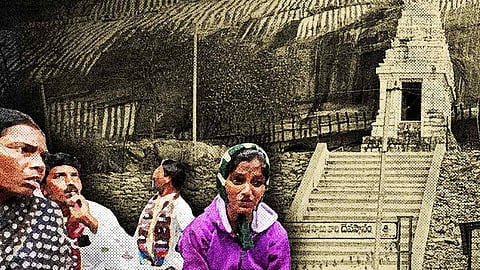
On February 18, Mounika, her mother‑in‑law Chandrakala, Ganesh’s sister Kirti, and Maheswari, wife of Ganesh’s brother Ashirwad, went to Kummera Jatara. According to Ganesh’s family, Srinivas Reddy was managing the crowd and allegedly collecting Rs 100 as entry fee.
Kirti said when she questioned why money was being collected when no token was being issued, Srinivas began hurling caste slurs at them and shoved them. The women returned home and told Ganesh what had happened. Feeling humiliated and angry on learning of the incident, Ganesh went to the temple to speak to Srinivas, which led to a scuffle. A group of men came in support of Srinivas, who allegedly dragged Ganesh into a coconut storage room at the steps of the temple and assaulted him.
“Seeing Ganesh being beaten by a gang of men, I pleaded with them to let him go by putting my two‑month‑old child at Srinivas’s feet, hoping that he would cool down on seeing the baby. Another accused, Madhusudhan Reddy, kicked the baby, hurling Madiga caste slurs at me,” Mounika told TNM.
“The baby cried continuously and her breathing became laboured. When I picked her up, I checked if she had any injuries; there were none. My family suggested I should feed her first, so I did that,” she added.
The family alleges there were no police personnel near the jatara when the violence erupted. By the time Nagarkurnool police arrived, the situation had already escalated.
The family alleged that later that night, when they approached the police, no FIR was registered based on their complaint. “The station writer did not help us write the complaint. I had to write it myself with whatever knowledge I have,” Maheswari, the only one in the family who had studied up to the intermediate level, said. Maheswari also belongs to a Scheduled Caste.
“The police should have registered the case under the SC/ST Atrocities Act under my name. I told them that I have my caste certificate to prove it,” she said. “But when Srinivas Reddy came to the police station, the police themselves wrote the complaint and registered an FIR against our family members immediately,” she added.
Three days later, on the morning of February 21, Mounika found that her baby was not breathing and rushed to the government hospital. The baby was declared dead.
What the police said
A police press release on February 22 stated that the family’s initial complaint on the night of February 18 was treated as a non-cognisable offence, and a police diary entry was therefore forwarded to the court for approval. The entry was made under sections of the Bharatiya Nyaya Sanhita (BNS) and not the SC/ST Prevention of Atrocities Act. The police later claimed that they were not informed at the time that Mounika was Dalit.
The release also said that on the same night, Srinivas Reddy filed a complaint alleging that Ganesh and his family members attacked him with stones. The police claimed that because Srinivas had a visible bleeding head injury, the complaint was treated as a cognisable offence. This meant Ganesh and his family members were immediately booked, while Srinivas Reddy and his supporters weren’t.
On February 21, based on the allegation that their infant died due to the physical attack on their family, a case of suspicious death was filed, the release said. The police also booked Srinivas Reddy and two of his supporters under the SC/ST PoA Act and other BNS sections over the altercation – only after the baby’s death – and arrested them. Meanwhile, a postmortem examination (PME) was conducted and the report was awaited to proceed with further investigation.
On the same day, Deputy Superintendent of Police (DSP) Burri Srinivas briefed the media, describing the incident as a “scuffle” that began when Ganesh confronted Srinivas Reddy and escalated when a woman from Ganesh’s family allegedly threw a stone and injured him. He said they initially treated it as a “small issue” and believed that discussing it with the village elders could resolve it.
“It is only after the baby died that the family came back, alleging that she died because she suffered injuries during the altercation on February 18. In the earlier petition, they did not mention that the baby was also injured. We examined the baby’s body at the hospital. There was not even a minor injury,” the DSP said.
He also stated that the police were informed that Mounika is Dalit only after the child’s death.
When asked why the family did not mention the baby allegedly being kicked in the initial complaint, Maheswari said, “We were more worried about whether my mother‑in‑law and Ganesh had suffered any injuries. The baby had a little milk from Mounika and then fell asleep; there were no visible wounds on her.”
In a later press release on February 24, the police said that according to the preliminary PME opinion, no external or internal ante‑mortem injuries were visible on the child’s body and that the final cause of death would be determined only after analysing the histopathology report from the Forensic Science Laboratory (FSL) – a more detailed report that would explain the precise cause of death.
Ordeal after the attack
Panicked after the incident at the jatara, the family decided not to return to the village. “We slept outside the government hospital and the bus stand. We were afraid because the sarpanch had threatened us in the police station compound that he would demolish our house,” Maheshwari said.
After the baby’s death on February 21, the family returned to the Nagarkurnool police station. They demanded that the officers register a case of murder (of the baby) and attempt to murder (of Ganesh), not merely “suspicious death.” Maheshwari alleged that the police did not register the case against Srinivas Reddy and the others until activists gathered in their support.
The family sat in protest in Nagarkurnool town for five days until February 25, along with leaders of the Dharma Samaj Party and Bahujan Samaj Party (BSP). Their protest attracted wide attention in the media and on social media platforms. Several leaders, including BRS working president KT Rama Rao, BJP state president Ramchander Rao, MLC Goreti Venkanna, as well as BC and SC commissions and several anti-caste organisations visited the protest site and expressed solidarity with the family.
Meanwhile, District Collector Badavath Santhosh promised Ganesh a job in an outsourced position at the Government Medical College, a double-bedroom house for the family in Nagarkurnool, and presented them with a cheque for Rs 1 lakh.
Manufacturing a narrative?
As more leaders flocked to the family’s protest site in support, the police made a few statements about the victims. DSP Srinivas said that the baby was born prematurely in the 31st week of pregnancy, severely underweight and with respiratory issues. He added that Ganesh had hit Mounika when she was pregnant. And also that Mounika had no proof that she is a Dalit and that they were verifying her caste with the Revenue Department.
These statements show the police’s attempt to disregard the family’s plight, alleged P Shankar from the Dalit Bahujan Front (DBF), an anti-caste organisation.
“The family had to flee the village, fearing for their life. They are being asked to prove their caste instead of being given protection. It must be understood that if the baby was already weak, as per the police, she needed more care and a clean environment to survive,” Shankar said.
He said the baby might have survived if the police had promptly estimated the severity of the situation on the night of the attack and protected the family.
At a rally organised by the All India OBC Students Association at Hyderabad’s Osmania University on March 1, Mounika told the media that the baby didn’t have any problems when they went to the jatara. “She started having breathlessness after she was kicked. I have already lost my child, what will I get by lying?” she said. Mounika also alleged that there were CCTV cameras near the coconut store room and demanded that the visuals of the attack be released.
When the police declared that Mounika had no proof that she is a Dalit, it led to a shift in the narrative, focusing on her caste while pushing the case updates to the background.
On February 28, under the banner of ‘Kummera Sabanda Vargala Prajalu’ (All communities of Kummera), Congress leaders – Mallu Ravi, who is the Nagarkurnool MP and brother of Deputy Chief Minister Bhatti Vikramarka, Nagarkurnool MLA Kuchakulla Rajesh Reddy, Shadnagar MLA Veerlapally Shankar – and leaders from different caste communities held a rally through the village holding a sign. It read that the incident was “unfortunate” but that the village “lived in harmony”. They blamed political forces for turning the baby’s death into a caste spectacle, saying that the sarpanch was being made a scapegoat.
After the rally, the leaders held a meeting with the residents. There, a person who introduced himself as the sarpanch of Sangaipally in Mahbubnagar district claimed that Mounika is originally from his village. He alleged that she also goes by other names and belongs to the Vamsiraj (BC‑E) community, not SC. He further claimed that she was already married to a Muslim man in Sangaipally and had two children with him. A video doing the rounds in village groups showed a child identifying Mounika as his mother on camera and calling her Yadamma.
Reacting to the controversy regarding her caste, Mounika said that she grew up without knowing her biological parents. “I was brought up by Madigas in a SC colony in Hyderabad until marriage,” she told TNM.
P Shankar of DBF said that the police were getting into technicalities instead of focusing on the investigation into the death of the child with empathy. “Even if they are skeptical of Mounika’s caste, Maheswari is a Dalit and her complaint remains valid. Their bias is evident right from the filing of the case.”
Accusing the ruling party leaders and the police of acting in tandem, Shankar said, “Even senior leaders are speaking like the police, attacking the family members’ characters because of their personal choices. If Mounika is really married twice, does that mean she cannot raise her voice against caste atrocity? This shows the attitude of the state towards people who are from lower castes and economically weak.”
Strong hostility in the village
In Kummera, there is already resentment towards Ganesh’s family, which intensified as local residents felt that the incident had ‘damaged’ the village’s reputation.
Kummera has about 600 households with nearly 2,000 voters. Electorally, Scheduled Castes are the strongest with around 600 voters from 100 households. Among the Backward Classes, Kurama is numerically dominant with 30 households, while Goud, Mudiraj, and Mangali are less than 10 households. Ganesh’s family belongs to the Chakali or Rajaka community, which is classified as a BC-A.
Similar to the demographics in any Telangana village, the Reddy community, though small in number with only 30 households, maintains a superior position in social hierarchy through village politics and economics.
Houses are visibly segregated by caste, with kachha roads inside the SC colony while most other castes enjoy better infrastructure. According to a BSP leader in the village, an underground drainage line was laid a few years ago, bypassing the SC colony.
When TNM visited the village, most residents were reluctant to talk about the incident.
An elderly lady from the Kurama community used casteist slurs while referring to Chandrakala and Kirti, when asked about the family. A few others made comments on the character of the family members but did not say anything about the accused.
A youth who did not wish to be named said, “There is a common consensus that the family blew it out of proportion. Ganesh and his family have a bad reputation in the village. So no one is going to speak in their support.”
During the baby’s funeral, only family members and a few activists were present; no one from the village attended.
At a press conference following the rally by Congress leaders, MLA Veerlapally Shankar, who belongs to the Chakali community, dismissed the incident as “very small” and called Ganesh “characterless.” “The incident has been blown out of proportion for the benefit of some political forces, and Ganesh’s family is being used as a pawn,” he said.
Maintaining that the accused should be punished, he said that there is consensus that the sarpanch is a good man. “The village residents say that Ganesh was roaming jobless and it was the sarpanch who had given him work for the past year. The residents are very upset that some elements have ruined the reputation of the village,” he said.
Visharadan Maharaj, founder of the Dharma Samaj Party, called the rally a “progressive disguise”, adding, “The sarpanch is part of the political system, which is ruled by the upper castes. The rally’s real aim was to divert attention from the caste‑based violence by smearing Ganesh’s family’s character.”
In Kummera, Ganesh’s family exists at the margins of every socio-economic aspect of society. It is probably the only household in the village without a pucca house. The family currently lives in a makeshift house built with scrap asbestos put together. Their pucca house under the Indiramma scheme is in the early stages of construction nearby. The baby’s grave is in a deserted shrub land and was partly washed away by rain.
In contrast, the Reddys in the village are well-to-do. For example, former sarpanch Tirupati Reddy (55) owns a petrol bunk and over 10 acres of land. The current sarpanch Tukaram (60) and his son Satish are in real estate. Srinivas Reddy, the main accused, is a close associate of Tukaram and lives in a two‑storey house.
Ganesh agreed that he was employed for a year in a water plant in Hyderabad owned by Satish before returning to the village when his wife became pregnant. His family works as daily wage labourers doing any available work in the houses of Reddys, including the sarpanch’s family. “My mother often goes to the homes of the upper castes whenever they call for work. Even I’m called for work sometimes. Hence, they always treat us like their workers. When they use casteist slurs, I get angry and argue. That’s why they’re painting me as an aggressive guy,” Ganesh told TNM.
The family’s radical choices in marriage are the primary reason for resentment in the village, Kirti alleged. All three siblings – Ganesh, Kirti, and Ashirwad – married outside their caste, into Dalit families. When intercaste marriage is still treated as a threat to a community’s honour even in urban areas, one can imagine the hostility in a village.
According to Manish*, a Kurama youth, there have been a few intercaste marriages in the village and those families are unofficially boycotted. He added, “People don’t invite families of intercaste couples to ceremonies at their houses or attend functions held by those families.”
Reddy dominance and casteism in the village
Nagarkurnool constituency has been represented by members of the Reddy community most of the time, and according to Kummera residents, the sarpanchs of the village have been closely associated with the MLAs, which gave them strong political support. Therefore, Reddys were elected as sarpanch unless there were reservations, while other community members became deputy sarpanch.
Manish said that there is a feud between two factions of the Reddy community itself – BRS and Congress – for dominance. “The supporters of these two factions are from all communities, but when someone becomes their target, they will send in SC/ST community youth in the forefront, fearing that Reddys might face atrocity cases,” he pointed out.
The Kummera Jatara is also a point of business and dominance in the village. Though Mallanna is considered the community deity of the Kurama caste, the jatara committee president has always been the sarpanch (a Reddy) of the village. Thousands of people attending the three-day jatara offer coconuts while many of them perform animal sacrifice. The coconut selling business is usually auctioned by the committee, but mostly it is the sarpanch who takes up the job.
Rent is also paid to the committee by businessmen who put up stalls during the fair. Manish told TNM that it is an affair involving at least Rs 20 lakh, and that sarpanchs often face allegations of misappropriating the money. “This time, Tukaram and his son Satish set up the coconut business. One can go for darshanam in line without a coconut and take a look at the deity from outside. But if a person wants to enter the porch and take the blessings of god, one has to pay Rs 100. If families of committee members, organisers or volunteers come for darshanam, the people managing the queue usually send them to the porch.”
Manish explained that even during other festivals such as Dasara or Vinayaka Chaviti, when Reddys put up Durga pandals or Ganesh pandals, entry for less powerful castes is restricted, with only a few politically strong BCs allowed access. “Even the Hanuman temple in the village is not accessible to Dalits,” he said.
Recalling past incidents of caste violence in the village by Reddys against Mudiraj and Kurama BC communities, Manish insisted that the village is not harmonious and casteism is openly prevalent.
When TNM contacted SP Sangram Singh Patil, he said that they are awaiting the final PME and FSL report. “The final decision will be taken by the court. As of now, there is no evidence that Mounika’s baby was kicked as per preliminary reports. The family is unable to give evidence that the baby was taken to hospital. We confirmed that Mounika is not a Dalit, and it seems like a false case planted by the family to make their case strong against the accused,” the SP said.
He added that they have not made any new arrests and that the other accused remain absconding.
Follow TNM's WhatsApp channel for news updates and story links.