
Subscribe
Follow TNM's WhatsApp channel for news updates and story links.
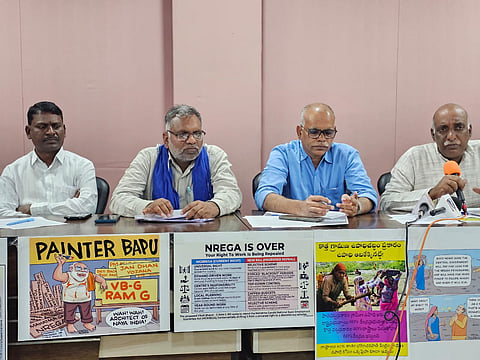
Several agricultural and people’s organisations have called for the repeal of the Viksit Bharat – Guarantee for Rozgar and Ajeevika Mission (Gramin), or VB-G RAM G Bill, which the Union government has tabled in the Lok Sabha to replace the existing Mahatma Gandhi National Rural Employment Guarantee Act (MGNREGA).
Activists slammed the VB-G RAM G Bill, saying it was introduced without any consultation with workers’ groups. “The Bill represents a fundamental shift from a rights-based law that provides an enforceable entitlement to a budget-constrained scheme without any accountability of the Union government,” organisations allied with the NREGA Sangharsh Morcha said in a statement on December 17.
P Shankar, national secretary of the Dalit Bahujan Front (DBF), said that the Union government has consistently reduced its budget allocations for the scheme over the years, depriving beneficiaries of work due to a paucity of funds. He also criticised the new provision in the Bill that suspends work for 60 days a year during peak agricultural seasons to “facilitate adequate agricultural labour availability”.
“This takes choice away from workers who earlier had the option to reject exploitative farm labour under landlords. It’s not as if MGNREGA previously led to a shortage of agricultural labour. Since wages are often delayed, many people would still opt for farm work for timely payment,” he said, arguing that the provision strips farm workers of bargaining power and alternative employment options.
He pointed out that mandating app-based attendance through the NREGA Mobile Monitoring System (NMMS) and the Aadhaar-based Payment Bridge System (ABPS) has already caused problems for beneficiaries in accessing work and wages.
Shankar said that the VB-G RAM G Bill must either be withdrawn or sent to a Parliamentary Standing Committee for detailed review.
Ravi Kanneganti of the Telangana People’s Joint Action Committee (TPJAC) called on the Telangana Congress government to adopt a resolution in the state Assembly opposing the VB-G RAM G Bill.
Puli Kalpana of the DBF pointed out that MGNREGA, as a gender-neutral scheme without a wage gap, has enabled women to access better wages. “Single women and those who otherwise struggle to find work have benefited from the scheme. But there have been consistent efforts by the BJP government to weaken its provisions,” she said, adding that MGNREGA beneficiaries would reject the new Bill.
The activists said that the Bill rolls back an important constitutional imperative of ensuring the right to work. They argued that it shifts the law from its universal, demand-driven nature – where work is provided to anyone who seeks it – to a supply-driven scheme with capped funding.
They also said that the Bill grants excessive discretionary powers to the Union government, allowing it to withdraw from its responsibility of bearing most labour wages by shifting to a 60:40 fund-sharing pattern in most states.
The draft Bill empowers the Union government to determine allocations to states based on parameters set by the Centre itself. Any expenditure beyond this fixed “normative” allocation would have to be borne by the state governments.
“The Bill does not lay down any core standards on the parameters based on which the normative allocation shall be made. This enables the Union government to arbitrarily decide the quantum of funds allocated to states, which in turn will determine how many days of employment and how many new job cards can be issued. This completely upends the logic of MGNREGA, where funding follows demand, and replaces it with a supply-driven system where demand must conform to a predetermined budget. In effect, the guarantee of 125 days of work is a distraction from these deeper structural issues,” the statement said.
The increased financial burden, they warned, would push states towards fiscal conservatism, discouraging the issuance of new job cards and the registration of workers’ demand for employment.
The activists also criticised the shift from planning works through Gram Sabhas under MGNREGA to a top-down approach. The new Bill states that a “Viksit Bharat National Rural Infrastructure Stack shall guide states, districts and Panchayati Raj Institutions in identifying priority infrastructure gaps, standardising work designs, and ensuring that public investments contribute measurably to saturation outcomes”.
They said that through a centrally controlled, budget-capped and surveillance-heavy framework, the Union government is seeking to dismantle a historic rights-based legislation and reduce the right to work to a “discretionary dole”.
