
Subscribe
Follow TNM’s WhatsApp channel for news updates and story links.
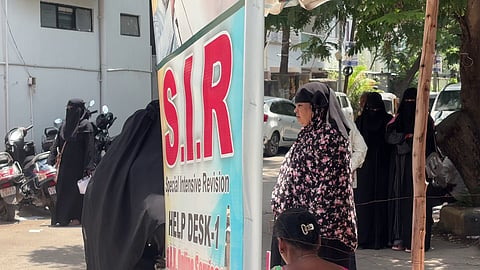
Hearing a writ petition challenging printing and distribution of enumeration forms exclusively in Telugu during the ongoing Special Intensive Revision (SIR) exercise in Telangana, the High Court has sought response from the Election Commission of India (ECI) on June 26, 2026. The next hearing has been posted to Monday, June 29.
The ECI submitted that enumeration forms were being printed in English as well as Telugu within the Greater Hyderabad Municipal Corporation (GHMC) limits considering its urban population, but only in Telugu in the remaining districts.
The SIR enumeration exercise began on June 25 in Telangana, and will continue till July 24. The petitioner, MA Mujeeb Ayyub, a social worker from Karimnagar, has sought directions from the court to declare the printing and distribution of only Telugu forms as arbitrary, unreasonable, and unconstitutional.
Senior Advocate V Ragunath, who appeared for the petitioner, argued that the exclusive use of Telugu in the SIR enumeration forms was an alleged conspiracy to delete minorities from the electoral rolls.
The ECI response stated that forms have already been printed for the nearly 3.5 crore voters involved. Everywhere except GHMC, sample forms in English and Urdu would be carried by the BLO to address practical difficulties.
The petitioner’s counsel argued that voters cannot depend on the “mercy” of the BLO and surrender their rights. He further submitted that English forms cannot be limited to GHMC, as there are people in rural Telangana too who are not familiar with Telugu.
Justice Pulla Karthik reportedly asked the Election Commission how it could justify the absence of non-Telugu forms.
When the ECI’s counsel said that English copies of the forms would be made available to voters on request, the court asked about access to Urdu copies.
ECI’s counsel said that Urdu forms were available online, and could be downloaded and printed. Due to printing costs, the state language, Telugu, had been chosen for physical distribution, the ECI’s counsel said.
The petitioner’s counsel, advocate V Ragunath, argued that voters shouldn’t be required to ask for English copies and the ECI was bound to provide them as a matter of right. He said there was no mechanism to provide such choices at the BLO level as many of them were undertrained and underresourced.
The court observed that if the forms were available online in English, Urdu and Telugu, the ECI should consider the petitioner's representation.
