
Subscribe
Earlier this week at the Met Gala, one of the most glamourous fashion events in the world, Hyderabad-based billionaire Sudha Reddy wore an extravagant designer outfit with motifs including Telangana’s state bird Palapitta, state tree Jammi Chettu, state flower Tangedu, and giant peacocks on her dress train. She called them “markers of identity” and “fragments of home”.
Amid the glass and concrete buildings that have cropped up in recent decades in Jubilee Hills, one of the most expensive real estate markets in Hyderabad, the 390-acre Kasu Brahmananda Reddy (KBR) National Park is a rare home in the city for these same birds, trees, and flowers.
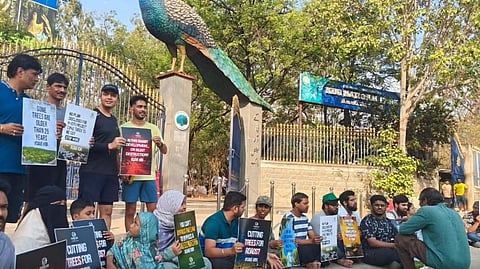
This park is now the site of growing citizen protests, both online and offline, against the state government’s push to build multilayer flyovers around it by felling nearly 2,000 trees. Protesters argue that this could hurt the park’s biodiversity and worsen climate change effects on Hyderabad.
The flyover project was initiated under the previous Bharat Rashtra Samithi (BRS) government in 2016, under its Strategic Road Development Plan (SRDP). For 10 years, the citizen-led ‘Save KBR’ movement fought legal battles to ward off the construction and the consequent tree-felling.
But under the present Congress government, the project has resurfaced in the name of Hyderabad City Innovative and Transformative Infrastructure (H-CITI). It is being built by Megha Engineering and Infrastructures Limited (MEIL). Sudha Reddy is a director of MEIL, which is run by her husband, PV Krishna Reddy.
The SRDP project involved six flyovers covering busy junctions around the park, including the KBR Park entrance, Jubilee Hills checkpost, Film Nagar junction, Jubilee Hills Road No. 45, Maharaja Agrasen junction (Banjara Hills Road No. 12), and Cancer Hospital junction (Banjara Hills Road No. 10). H-CITI is even bigger, involving seven flyovers and seven underpasses around KBR. It was allocated Rs 2,654 crore in the state Budget for 2025-26.
While the government has positioned the project as essential to reducing traffic congestion, residents argue that the environmental costs are too high.
Over the past couple of weeks, excavators and other heavy machinery have been at work near the Maharaja Agrasen and Cancer Hospital junctions, often during the nights. Citizens have been gathering at the KBR Park main gate day and night, holding placards protesting the project.
Activists allege that the state government has dodged environmental regulations to push the project ahead. Apart from tree-felling, they say the project will hurt the animals and birds living in the park due to carbon emissions, noise, and reduced green cover. They also voice concerns about tampering with Hyderabad’s largest lung space amid the intensifying heat crisis across Indian cities.
Nearly 2,000 trees to be axed
The KBR National Park is managed by the Telangana Forest Department. It is home to over 120 bird species, including peacocks, kingfishers, and parakeets, and over 500 species of flora. Formerly part of the private royal estate of the Nizam of Hyderabad, it was officially notified as a national park in 1998 under the Wildlife (Protection) Act.
The space also functions as a public park, used mainly by residents from the surrounding upscale areas of Jubilee Hills and Banjara Hills for walking and jogging through paid entry.
Under the previous SRDP version of the project, the Greater Hyderabad Municipal Corporation (GHMC) had proposed felling of 1,300 trees. Now, it plans to fell 1,942 trees in its revised proposal for H-CITI.
Of these, the Hyderabad district Tree Protection Committee (TPC) has given permission to fell 1,532 and translocate 380, asking to retain only 30 of them, The Hindu reported. Environment activists, however, have questioned the authority of the TPC – a body formed through a government order in 2008 – to give tree-felling permissions.
The trees set to be axed reportedly include conocarpus, neem, jamun, palm, mahogany, tamarind, sandalwood, etc., citing reasons such as “crooked growth”.
Kaajal Maheshwari, one of the core members of the Save KBR campaign, told TNM that while their movement had been successful in stalling tree-felling for the last ten years, some trees have actually been cut in the past month, triggering a fresh wave of protests.
Protesters TNM spoke to said that in March, visuals of tree-felling around KBR began circulating widely on social media, reigniting public anger. Demonstrators estimate that dozens of trees have been cut down since then.
Petitioners sought an urgent hearing in the Telangana High Court on PILs challenging tree-felling for flyovers around KBR Park, arguing that the work was being carried out in violation of Supreme Court guidelines for eco-sensitive zones (ESZ), and without conducting any public hearing, environmental impact assessment (EIA), or pollution study, and going against previous High Court directions.
At the latest hearing on March 31, the High Court declined to extend a stay on construction activity around KBR Park.
Back in August 2021, the High Court had issued an interim stay on tree-felling, and also asked the Forest Department to submit a report on the number of trees already felled, their age, and other details. Kaajal alleged the state government has only furnished the average age and other such aggregated information on the trees affected and not their individual detailed profiles as mandated.
With the notified ESZ of the park still under contention, the court adjourned the matter to May 5, but the hearing did not take place. Protesters worry that with the High Court going on summer vacation from May 7 to June 5, irreversible damage could be done before the next hearing.
According to a press statement from the Save KBR campaign, the project is estimated to permanently seal 38,095 sq m with asphalt and concrete, warning that local temperatures could rise by as much as 2-5 degree Celsius due to the resulting urban heat island effect. They also estimate that crores of litres of rain water will turn into surface runoff instead of recharging groundwater as a result of the construction.
“The noise and pollution from construction will heavily affect the wildlife. Once the biodiversity is erased, the space could lose its national park status and be razed for more construction,” Kaajal said.
Shrinking buffer zone
A major complaint from protesters has been the lack of a clear ESZ, a requirement under the Environment Protection Act 1986, to be set up around such parks to act as a buffer against unregulated construction.
They have been demanding that the government declare a 1-km ESZ as per Supreme Court directions for all protected forests, national parks, and wildlife sanctuaries. The court had, however, modified its order later to allow some exceptions, including cases where the ESZ was already notified by the Union Ministry of Environment, Forest and Climate Change (MoEFCC). However, this notification itself is under contention in KBR’s case.
The existing walkway that acts as a buffer has a width of 25 to 35 m. Kaajal said that while this itself is inadequate, activists have been fighting in court to stop the government from shrinking the ESZ further, to 3 – 29.8 m, and surround the park with flyovers and underpasses.
Major Sandeep Khurana, a former Army officer and member of the Save KBR campaign, said that since there was no notified ESZ till 2018, construction activity went on uninhibited around the park.
In 2015, the BRS government itself proposed a 25 to 35 m ESZ in line with the existing walkway, he said.
“The Union government’s own expert committee in 2016 called KBR ‘the only green lung of the city’. Then, the state government cut that buffer down to as little as 3 m – admittedly, on its own record, to save money on land acquisition for the SRDP project,” he said.
The National Green Tribunal (NGT) took suo motu cognisance of the issue, and later asked the GHMC to wait for the MoEFCC’s final ESZ notification before proceeding with any tree-cutting.
In 2018, the state government put out a draft ESZ notification, where the buffer zone varied between 3 and 29.8 m in different locations along the park’s perimeter. There was backlash from protesters, who sent emails, postcards, and online petitions to the MoEFCC. The Ministry’s expert committee then ordered a public hearing to fix the ESZ.
However, in 2020, the MoEFCC notified the same final ESZ of 3-29.8 m. According to the Save KBR campaigners, the state government falsely claimed that a public hearing was held.
In 2021, this ESZ notification was challenged in the Telangana High Court, which resulted in the interim stay on tree-felling. Since then, petitioners say the government hasn’t provided any proof of a public hearing. With construction work resuming in March, the petitioners sought an urgent hearing and once again demanded proof of public consultation. However, the court did not stay construction activity this time.
Campaigners have alleged that the H-CITI project has been broken down into six smaller projects to minimise their scale and avoid an EIA and public hearings over the project itself, as per the Environmental Impact Assessment Notification, 2006.
Environmental justice activist and researcher Narasimha Reddy Donthi has said that the project had committed “brazen evasion” of environmental regulations through multiple narrow exemptions which can be “cumulatively destructive”.
Sandeep questioned the state government’s transparency under both BRS and Congress, noting that there was no publicly available Detailed Project Report (DPR) when it came to the expansion works.
“The current state government silently replaced the SRDP project with the H-CITI project. This removes the basis for reducing the ESZ to 3–29.8 m and warrants restoring it to 25–35 m. H-CITI has a different plan, design, footprint on ground, architecture and environmental impact,” he said.
Kaajal too argued that H-CITI is much bigger and potentially more destructive, but is being pushed through under the same alleged regulatory evasions attempted in the SRDP version.
The Save KBR campaign has demanded that the full DPR for all H-CITI projects around KBR Park be immediately placed in the public domain, and also asked the state government to produce verifiable proof of the public hearing before the High Court. They want a fresh ESZ recalibration overseen by the MoEFCC.
For many, the issue is not development itself, but its implementation. Aside from the scale of the H-CITI project, a deeper dispute over whether environmental laws and due process have been followed is being questioned.
Property owners to lose out
Apart from environmental costs, residents and property owners from the upscale neighbourhoods surrounding the park have also raised objections to the H-CITI project.
“Properties are losing anywhere from 100 to 1,000 sq yards as part of the H-CITI project surrounding KBR. My income depends largely on rent, and the uncertainty is already affecting tenants,” said V Sridhar, a consultant residing in Journalist Colony in Jubilee Hills.
Anil Kumar, a property owner, said that the H-CITI project proposed by the Telangana government would affect a lot of commercial establishments. “I earn about Rs 5 lakh a month in rent, but a large chunk goes towards GST and EMIs. Thousands of crores worth of property as well as property owners will be impacted by the state government’s plans,” he said.
Both Sridhar and Anil are part of the KBR Park Road Widening Affected Owners Forum. Their concerns echo those of several commercial property owners in the area, where anxiety has intensified following the state government’s decision to push ahead with the H-CITI project.
“Several properties are going to lose lands. Take the Asian Spine Hospital in Journalist Colony, for instance. It will be left with no more than 50 yards. All our properties are in peril,” Sridhar told TNM.
He also pointed out that much of the public discourse has focused on high-profile properties. “Coverage has largely been about big names like actor-politician Balakrishna or Congress leader Jana Reddy. The plight of regular residents has been ignored,” he added.
Follow TNM's WhatsApp channel for news updates and story links.
