
Subscribe
Follow TNM's WhatsApp channel for news updates and story links.
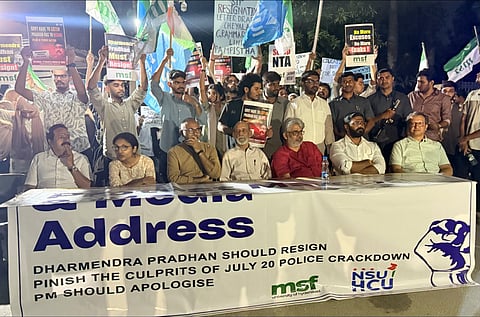
At a protest meeting held at the University of Hyderabad (UoH) on Friday, July 24, the speakers called for a complete overhaul of India's higher education admissions system, arguing that the National Eligibility-cum-Entrance Test (NEET) is symptomatic of a deeper problem: the increasing centralisation of entrance examinations. They demanded that NEET and other centralised admission tests be scrapped in favour of a decentralised system that restores institutional autonomy and respects the country's federal structure.
The gathering, organised by the National Students' Union of India (NSUI) and the Muslim Students' Federation (MSF), was held in solidarity with students protesting at Delhi's Jantar Mantar against the NEET paper leak. The protesters are demanding accountability by seeking the resignation of Union Education Minister Dharmendra Pradhan.
Professor D Narasimha Reddy, former Dean of the School of Economics at UoH, argued that the controversy surrounding NEET extended beyond allegations of paper leaks and reflected structural flaws in the examination system itself.
“The very institution of NEET, which is centralised, is corrupt,” he said. “There is no need to disregard the federal structure by centralising every entrance examination. If the government wants to restore equity, integrity and the right academic atmosphere in universities, it has to scrap NEET-type centralised examinations.”
Reddy criticised the growing trend of centralised admissions in higher education, saying universities had lost their autonomy in selecting students.
“The way students are being admitted to Central Universities through centralised examinations is wrong. Faculty members have no role in the admissions process, and institutions have lost their autonomy. We are not getting the right students because of this system,” he said.
Demanding the resignation of Minister Dharmendra Pradhan, he said: “We are a country where we live for certain thoughts. There are a large number of students dying because of the mischief and the corruption involved. And the first thing we expect is: whoever was responsible for it should get out. Should we go around shouting and get beaten with lathis? This is atrocious.”
Echoing similar concerns, Professor Bhangya Bhukya of the Department of History said the National Testing Agency (NTA) lacked transparency and accountability.
“We don't know who sets the question papers, who prints them or who is accountable when things go wrong. There is no effective grievance redressal mechanism. Around 80% of the NTA's workforce is outsourced. What experience do they have?” he asked.
Bhukya alleged that the Union's education policies were weakening public education while encouraging privatisation.
“This system is working against the downtrodden. They are being designed to kill the public education system. With no public-funded institutions, how will the poor get educated? By killing public institutions, they are parallelly building private universities, where there is no need for any NEET-type of exams.”
Economist Rathin Roy, former Director and Chief Executive Officer of the National Institute of Public Finance and Policy (NIPFP), described the ongoing student movement as one of the most significant youth-led agitations since Gujarat's Nav Nirman Movement of 1974. He said that the current ongoing protest is the only protest after the Nav Nirman Movement which is happening on an economic basis.
Roy argued that the protests reflected broader economic anxieties among young people.
“All over the world and particularly in India, this young population will be the first generation in the history of this country… for at least 100 years… which will be poorer than their parents.”
He added that many young people were not even earning enough to fall within the income tax bracket. "You don't have the luxury of paying income tax. That is why you are this democratic. All your prosperity is being buried in the ground, and that is where this solidarity is coming from," he remarked, suggesting that shared economic insecurity had united students across the country.
He also praised the solidarity shown by students travelling from across the country to support the protests in Delhi.
"People who have never met each other are helping one another. Fraternity has returned to society as a consequence of this movement," Roy said.
