
Subscribe
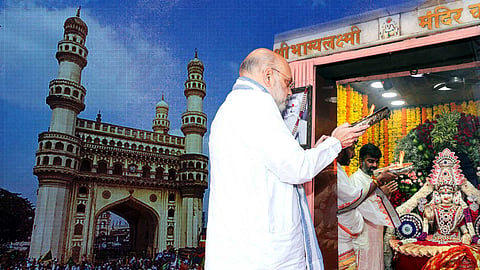
The Bhagyalakshmi temple, situated next to the historic Charminar in Hyderabad, has once again become a subject of intense debate on social media over the last few days. The visit of Union Home Minister Amit Shah to the temple on November 2, ahead of the Bharatiya Janata Party (BJP)'s padayatra in Hyderabad, has brought the shrine back into the centre of political discussion. The temple's extensive Diwali decorations, arrangements for a large number of devotees, and the apparent expansion of its temporary installations have added to the debate.
Several people on social media have questioned the role of Hyderabad MP and All India Majlis-e-Ittehadul Muslimeen (AIMIM) president Asaduddin Owaisi, alleging that the temple has been allowed to expand under his watch. Others have countered these allegations, pointing out the BJP's political use of the temple and its repeated attempts to turn it into a symbol of confrontation with AIMIM and Hyderabad's Muslim population.
Why I feel the need to put the facts on record
As a Hyderabadi Muslim, I do not consider it easy to speak publicly about the unauthorised expansion of the Bhagyalakshmi temple, particularly when the issue is being discussed in a highly polarised atmosphere. I do not want this discussion to be portrayed as Muslims being opposed to a temple, a particular religious community, or the religious practices of Hindu devotees. That is neither my position nor the purpose of this article.
Hyderabad has a long history of people from different religious communities living, working, and sharing public spaces. The everyday life of the Old City of Hyderabad is built around this coexistence. Thousands of Hindu and Muslim families run businesses, work, study, and depend on the commercial activity around Charminar. Their interests should not become casualties of political competition.

The BJP's repeated attempts to turn the Bhagyalakshmi temple into a political symbol, particularly by linking it to the identity and history of Hyderabad itself, need to be examined. The temple has increasingly been projected as a political tool against AIMIM and its leadership, rather than simply as a place of worship. Statements about renaming Hyderabad as Bhagyanagar, references to the legend of the queen Bhagmati, and the repeated use of the temple by BJP’s national leaders for election campaigns have contributed to this political narrative.
The insistence that the temple should be promoted, expanded, or made a symbol of political assertion, seemingly because it is located adjacent to a nationally important monument built by a Muslim ruler and falls within the constituency represented by Asaduddin Owaisi is particularly concerning. The BJP leaders challenging AIMIM and the Muslim residents of Hyderabad by mobilising crowds around a religious structure, regardless of its legal status or the heritage laws governing the site, is not a healthy way to conduct public life.
There is also a larger political context that cannot be ignored. The Ram Janmabhoomi movement, which mobilised common Hindu people against Babri Masjid, culminated in the demolition of the Babri Masjid on December 6, 1992. The subsequent political use of that movement and the continuing organised campaign against Muslims’ religious sites have brought up important questions about constitutional values, historical evidence, and the rule of law.
In this context, the use of religious structures as instruments of political mobilisation deserves serious scrutiny. Claims about historical ownership, religious antiquity, and the identity of cities cannot be established through propaganda of political leaders through speeches, social media campaigns, or the strength of a mobilised crowd.
I believe it is important to place the facts about the Bhagyalakshmi temple on record, particularly because I have personally pursued official records from the Archaeological Survey of India (ASI), Hyderabad, through the Right to Information Act. A few of these documents, including historical photographs and the official position of ASI, were subsequently reported by The Times of India on April 4, 2013.
Obtaining these records was not easy. It required sustained follow-up with the department, and my efforts to obtain and establish the documentary record extended over nearly three years. I believe these documents deserve wider public attention because the discussion should not be based on beliefs and political claims or counterclaims.
This is not an attempt to create a Hindu-Muslim dispute. It is an attempt to establish the history of a structure, examine its legal status, and question the political use of a religious place located next to Charminar, one of Hyderabad's most important protected monuments.
I also believe that ordinary Hindus of Hyderabad, who believe in peaceful coexistence and justice, should not be drawn into a political campaign that risks dividing the society. The issue must be examined on the basis of facts, law, and public interest.
Charminar: A historical monument and a shared heritage
Charminar was constructed in 1591 by the fifth Qutb Shahi ruler, Sultan Muhammad Quli Qutb Shah. It became the central landmark of the newly established city of Hyderabad and remains one of the most recognised monuments in India.
The monument is known for its four grand arches and minarets, which represent the architectural traditions of the Qutb Shahi period. Over the centuries, the area around Charminar developed into a major centre of trade, culture, and public life. The monument is not merely a religious or architectural symbol. It is part of the shared historical identity of Hyderabad and its people.
Charminar is a protected monument of the Archaeological Survey of India (ASI) under the Union Ministry of Culture, and its laws governing ancient monuments and archaeological sites. Its conservation requires protection not only of the main structure but also of its architectural integrity and the surrounding protected area. Any discussion about construction or expansion immediately adjacent to Charminar must therefore be examined in the context of these legal protections.
When did the Bhagyalakshmi temple come into existence?
The historical origin of the Bhagyalakshmi temple is the most important and contested question here.
Some right-wing political leaders and organisations have claimed that a temple existed at this location even before Charminar was constructed in 1591. This claim has been repeated on several occasions, particularly during election campaigns and debates about renaming Hyderabad as Bhagyanagar.
However, the available official records do not support the claim that the present temple structure predates Charminar.
In November 2012, I filed a RTI application with ASI’s Hyderabad Circle, seeking information about the temple situated adjacent to the south-eastern minaret of Charminar. I sought the department's official position on the legality of the structure, the records available regarding its existence, and historical photographs of the monument.
The ASI subsequently provided a response vide letter No. F.No. RT1/2012-13/HC/2321 dated December 3, 2012, along with three photographs from its archival collection, showing the south-eastern side of Charminar in 1959, 1980, and 2003. The photograph from 1959 does not show a temple structure at the location. The photograph from 1980 shows a small structure, while the 2003 photograph shows further development at the site.
The ASI's response also stated that the temple constructed adjacent to the south-eastern minaret of Charminar was considered an unauthorised construction under the Ancient Monuments and Archaeological Sites and Remains (AMASR) Act, 1958, the AMASR Rules of 1959 and the 2010 amendment to the Act. The Act disallows construction within a radius of 100 metres from a protected monument.
These findings were reported by The Times of India on April 4, 2013 under the headline, "Bhagyalakshmi temple was built post 1959, says ASI". The report specifically identified me as the RTI applicant and quoted the ASI's official response. This was an important development because it brought documentary evidence into a debate that had largely been driven by competing claims.
ASI’s 1968 correspondence seeking removal of unauthorised construction beside Charminar
The unauthorised construction of the temple was first noticed in the year 1968 by the ASI, which subsequently wrote several letters to the local authorities, urging them to take immediate action to remove the encroachment. Some of the important correspondences obtained through the RTI Act from ASI’s Hyderabad Circle are listed below:
The Superintendent Archaeologist, South-Eastern Circle, ASI, vide Letter No. Hyd.1/G1/5357 dated December 13, 1968, wrote to the Collector, Hyderabad, saying, “Foreman J. Francis, who was in charge of the Charminar monument, had reported that some local people in the Charminar area had constructed unauthorised brick structures on the south-eastern side of the national monument. These constructions had abutted the monument and, to some extent, encroached upon the monument itself.” The ASI requested the Collector to arrange for the immediate removal of the constructions abutting and/or encroaching upon the monument.
The same letter was also marked to the Assistant Commissioner of Police, Charminar, Hyderabad, requesting him to issue necessary instructions to the authorities concerned for the removal of the unauthorised constructions.
Further, vide Letter No. Hyd.1/G1/5362, also dated December 13, 1968, the ASI also wrote to the Commissioner, Hyderabad Municipal Corporation, requesting the immediate removal of the illegal constructions abutting the monument.
Hyderabad Collector sought clarification on legal provisions for removing encroachments
The Collector, Hyderabad, sought clarification from the ASI over the matter. Within a week, vide Letter No. F1/20132/68 dated December 19, 1968, the Collector sought clarification from the Superintendent Archaeologist regarding the legal provisions under which encroachments upon a centrally protected monument could be evicted by the Collector.
A couple of months later, in response to a letter from the Collector, Hyderabad, D. Mitra, the Director (Monuments), ASI, New Delhi vide Letter No. 7/4/AP/1/69-M dated February 10, 1969, wrote to the Superintending Archaeologist, South-Eastern Circle, ASI, clarifying that action could be taken under the Eviction of Public Premises Act [or The Public Premises (Eviction Of Unauthorised Occupants) Act, 1971].
In another communication soon after, R. Sengupta, Chief Archaeological Engineer, ASI, vide Letter No. 4/2/5E/1/68-M dated February 18, 1969, stated that the Commissioner of Police could be contacted for taking further action in the matter.
Thus, the official correspondence reveals that the ASI had taken up the issue of unauthorised constructions with different local authorities and sought their intervention for removal as early as December 1968. However, despite these communications, no effective action has been taken against the unauthorised constructions.
How the Endowments Department gave legal cover to the unauthorised temple
Since the temple’s traces were first flagged by ASI in 1968, construction went on gradually over the years, and the performance of puja began. In 1973, the temple was formally registered under the State Endowments Department to give it legitimacy and legal status.
However, the Superintendent Archeologist, South-Eastern Circle, ASI, issued a notice to the pujari (temple priest) and locked the entrance of the temple on November 30, 1974, vide Notice No. 3931. A couple of years later, on March 31, 1977, the Superintendent Archeologist lodged a complaint with the Commissioner of Police, Hyderabad, against the “self-styled pujari” for allegedly “forcibly entering the fenced area of the protected monument, Charminar.” However, the Commissioner of Police did not act on the complaint.
Consequently, the Superintendent Archeologist escalated the matter a couple of months later and submitted another complaint to the Inspector General of Police, Hyderabad, vide Letter No. 11/1/Hyd/1954, dated May 20, 1977, highlighting the failure of Commissioner of Police, Hyderabad to act on the previous complaint.
Meanwhile, in view of these developments, a local endowments officer, vide Letter No. E/4476/74, dated April 11, 1977, addressed to the Commissioner of Endowments, stated that the construction activities around the Bhagyalakshmi temple would in no way injure or affect the structure of Charminar. The endowments official requested the Superintendent Archeologist not to remove the marble stone construction and allow the puja. This letter was forwarded to the Superintendent Archeologist.
The 2012 dispute: A legal issue, not a question of communal ownership
The controversy surrounding the Bhagyalakshmi temple became particularly serious in October and November 2012, when the temple management allegedly tried to expand the temple structure adjacent to Charminar by putting up some scaffolding. The unauthorised expansion was opposed by local residents, and the matter was brought to the attention of the then Charminar MLA Syed Ahmed Pasha Quadri, the AIMIM leadership, Hyderabad Police, and other government authorities.
When these efforts failed to stop the expansion, AIMIM MLAs and corporators staged protests against it. The incident also threatened to disrupt the visit of an international delegation that had come to inspect Charminar as part of the World Heritage Site recognition process.
The issue was taken to the Andhra Pradesh High Court by a local AIMIM corporator Mohsin Bin Abdulla Balala, who challenged the unauthorised expansion of the temple by filing PIL No. 366 of 2012. On November 5, 2012, a division bench of the High Court directed the temple committee to maintain status quo at the site as on October 30, 2012, and made it clear that no construction activity should be undertaken that would affect the protected monument.
The court's intervention was significant for two reasons. First, it recognised that Charminar's protected status could not be ignored while considering any construction activity adjacent to it.
Second, it made clear that the dispute had to be addressed through legal and administrative procedures rather than through competing public demonstrations or communal mobilisation.
Restoration of tarpaulin on the temple under police supervision
The status quo was misrepresented by the local ASI officer (a Conservation Officer). In his report following the court’s status quo order, the officer stated that even before the issue of expansion was raised in this instance, the temple was covered by a temporary tarpaulin sheet. Despite the status quo order, the ASI officer’s report suggested that the tarpaulin must be laid back on the temple. The temple committee, too, contended that the tarpaulin was required to protect devotees and that the same arrangement should be maintained.
Over the next few days, protests erupted around the Charminar over the issue. The Hyderabad Police, under the Andhra Pradesh government led by then Chief Minister N Kiran Kumar Reddy, cordoned off the areas surrounding Charminar, restricting public movement and arresting several local leaders, AIMIM corporators, and MLAs. They also fired tear gas shells and resorted to mild lathicharge to disperse protesters opposing the expansion. The restoration of the tarpaulin reportedly took place under the supervision of Anurag Sharma, then Commissioner of Police for Hyderabad, in disregard of and by misinterpreting the High Court's order.
The police barricaded all streets leading to Charminar from Gulzar Houz, Shah Ali Banda, Kotla Alijah Hussaini Alam, Moghulpura, and Mirchowk. Under the supervision of officials from the Hyderabad Collectorate, Greater Hyderabad Municipal Corporation (GHMC), and ASI, the temple management restored the tarpaulin in an hour. Police provided security cover for the entire operation.
The division bench of the High Court, while disposing of Mohsin Bin Abdulla Balala’s PIL on February 11, 2013, made the following observations:
The court directed that “status quo obtaining as on 30-10-2012 to be maintained by the Temple Committee, and further made it clear that since ‘Charminar’ has already been declared as a historical monument and thereby protected under the Ancient Monuments and Archaeological Sites and Remains Act, 1958, no construction touching the said monument can be done by any party in any manner whatsoever.”
The court also recorded submissions made by D Prakash Reddy, who appeared on behalf of the temple committee “that they are not going to expand the Temple in any manner whatsoever either on the road side and also on the Charminar side in future, and accordingly, directed status quo as on 30-10-2012 to be maintained as agreed in the matter, apart from directing the State Government to look into the matter and take action in terms of the said order.”
The current debate: Amit Shah's visit, Diwali, and the question of further expansion
On November 2, 2026, Union Home Minister Amit Shah visited the temple before participating in the BJP's padayatra in Hyderabad. His visit received wide coverage in both national and regional media. However, this was neither the first time a national-level political leader had visited the temple, nor was it an isolated political event.
Following the 2012 controversy over the expansion of the temple, the BJP came to power in the Union government in 2014. Since then, several national and local BJP leaders including MLAs, MPs, and even Union Ministers have regularly visited the temple, gradually turning it into a symbol of political mobilisation and confrontation.
This strategy appears to have served two political objectives: first, to consolidate and appeal to Hindu voters by projecting the temple as a symbol of Hindu identity; and second, to politically challenge the AIMIM by demonstrating that the BJP could openly visit, promote, and mobilise support around the temple despite AIMIM's opposition, thereby using the issue to provoke a political confrontation.
The 2020 GHMC elections witnessed a heightened use of the temple as a political campaign platform. During the election campaign, the BJP not only invoked the temple but also raised the demand to rename Hyderabad as ‘Bhagyanagar’, making it a prominent part of its political narrative. Following the election results, on December 18, 2020, 48 newly elected BJP corporators visited the Bhagyalakshmi temple, led by then Telangana BJP president (now Union Minister) Bandi Sanjay Kumar, and MLA Raja Singh, who has since left the party.
The politicisation of festival celebrations
The Bhagayalakshmi temple decorations for different festivals such as Diwali have increasingly extended over a large area surrounding the Charminar, significantly altering the character and accessibility of the historic monument. The decorations and temporary structures occupy substantial portions of the surrounding public space, obstructing roads and covering nearly 50 per cent of the Charminar's view from two sides.
During Diwali celebrations on November 9, 2026, the Bhagyalakshmi temple mobilised thousands of devotees through social media campaigns and influencers. Media reports also stated that the temple offered silver coins as prasad to devotees attending puja, attracting a large number of visitors for darshan.
An important aspect that is consistently missing from the political debate is the everyday life of people living and working around Charminar. The Old City is not merely a location for political rallies, religious gatherings, or election campaigns. It is a densely populated urban area where thousands of families depend on small businesses, street vending, retail trade, tourism, and daily wage employment.
Every major gathering, road closure, or security arrangement affects their livelihoods and mobility. The shopkeepers, traders, street vendors, workers, residents, and visitors all have legitimate interests in how these public spaces are managed.
There is nothing objectionable about Hindu devotees visiting a temple during Diwali or celebrating their festival. Their religious practices and freedom of worship deserve respect. However, the question being raised on social media in this context is different: Have there been structural additions or extensions to the temple and, if so, were they undertaken in accordance with the applicable laws and required permissions?
The Babri Masjid movement and the politics of religious mobilisation
It is important to examine this controversy within the wider political history of religious mobilisation in India by the BJP and its allied organisations. The Ram Janmabhoomi movement, led by organisations associated with the wider Sangh Parivar, mobilised large sections of the population around the claim that the Babri Masjid stood at the birthplace of Lord Ram. On December 6, 1992, the Babri Masjid was demolished by karsevaks, despite assurances given to the Supreme Court and the authorities that the mosque would be protected.
The political consequences of that movement are well known. Religious mobilisation around a disputed historical claim became one of the defining features of Indian politics.
The larger concern is the growing tendency to turn historical and religious claims into political campaigns, often without establishing the underlying facts. The Bhagyalakshmi temple controversy must be understood in this context. Hyderabad should not become another arena where religious places and historical monuments are used to mobilise communities against each other.
The city has its own history, social realities, and traditions of coexistence. It should not be made a testing ground for political strategies developed elsewhere.
Hyderabad’s composite culture must be protected
The purpose of this article is to bring facts that must be placed before the public, particularly when historical claims are being used to create political narratives. There is no reason for ordinary Hindus of Hyderabad to feel that questions about the temple's historical origins or legal status are an attack on their faith.
At the same time, no religious institution should be placed above the law. The maintenance of Charminar, a protected historical monument, is a responsibility of the government and its agencies. Any unauthorised construction or expansion must be examined and dealt with in accordance with the law.
The BJP's political use of the temple, its attempts to distort the historical identity of Hyderabad and rename it as Bhagyanagar, and its repeated efforts to turn the temple’s location into a symbol of political confrontation deserve public scrutiny. Hyderabad does not belong to one political party, one religious community, or one electoral constituency. Its history is much larger than the political ambitions of those seeking to rename it, claim it, or use its monuments for electoral mobilisation.
The Hindus, Muslims, and people of other communities in Hyderabad have lived together, conducted business together and shared its public spaces for generations. That relationship should not be put at risk by political organisations looking for new opportunities for their political gains.
This is the responsibility of everyone to question public authorities, demand transparency, and defend historical heritage. My position on this issue is entirely based on historical evidence, official records, the rule of law, the protection of public heritage, and most importantly, communal harmony in the city.
Communities should not be influenced by political narratives and to protect Hyderabad’s culture of peaceful coexistence. This alone will make us truly proud of our religious values and help us build a society where our next generations can live happily and peacefully.
SQ Masood is a social activist based in Hyderabad. He can be reached at sqmasood@gmail.com. Views expressed are the author’s own.
Follow TNM's WhatsApp channel for news updates and story links.