
Subscribe
The Telangana government is planning several interventions to ease traffic and mobility in Hyderabad, including model roads, four new elevated corridors, a single mobility card for metro, buses, and MMTS, and at least 100 interventions to make the city more livable to be implemented in the next couple of years, announced Jayesh Ranjan, Special Chief Secretary for Municipal Administration and Urban Development.
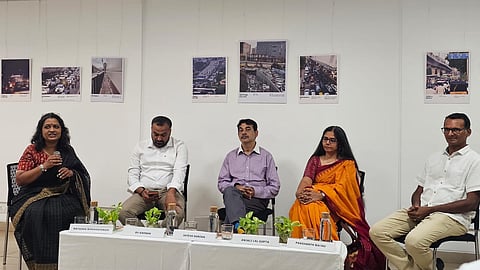
Jayesh was speaking at a panel discussion called ‘Choked’ on urban mobility and traffic issues at Goethe-Zentrum Hyderabad on July 30, Thursday.
Jayesh currently heads the administrative re-engineering of the Telangana Core Urban Region (CURE) which includes all areas within the Outer Ring Road, including the three municipal corporations of Hyderabad, Cyberabad, and Malkajgiri.
Noting that Hyderabad often tops livability rankings among Indian cities, Jayesh noted that however, it does not match up with other South Asian cities such as Manila and Jakarta. Jayesh said that his department has identified 100 interventions to improve the city’s livability index.
This includes steps to have more public libraries, air-conditioned rest shelters for gig workers, more functional toilets, more playgrounds, promoting night economy, and other aspects, he said.
Speaking of road engineering challenges to traffic management, Jayesh said, “We have identified 21 important corridors in the city with challenges such as narrowing road width or water logging due to the road gradient, where the traffic island is not designed correctly or a free left is not materialising because some transformer is constructed there, etc.”
He added that three important elevated corridors have been designed to ease congestion – two from Paradise Junction to Dairy Farm and Shamirpet, a third one from the Telangana Integrated Command and Control Centre (TGiCCC) to Shilpa Layout, while another one is being planned from Nagarjuna Circle to Masab Tank.
Jayesh also mentioned model corridors of around 20 km each identified to be developed in the three municipal corporations, where the road will be 120 feet wide with a median, cycling tracks on both sides, pavements, street furniture, toilets, and pop-up stores were possible.
A common mobility card is also being planned, which can be used to travel in the Hyderabad metro, MMTS (Multi-Modal Transport System) trains, and TGSRTC buses, he added. The government is also working with Google to develop an alert system for motorists on traffic congestion along their route, he said.
Public transport policy expert Prashant Bachu said that policy interventions must urge citizens to switch from private to public transport. He cited examples from cities such as Singapore, where using private cars became more expensive due to taxation and other costs, which could be used to fund public transport and decongest roads to make it faster and more efficient. He stressed on policies that influence commuters’ behaviour and make them opt for public transport.
Prashanth also noted that interventions such as flyovers cannot work simultaneously with improving walkability. “Every time we build a flyover, it permanently erases the possibility of improving public transport in that space,” he said, noting that flyovers often make public transport buses slower, and make crossing at intersections difficult for pedestrians.
Anjali Lal Gupta, an Assistant Professor at University of Hyderabad who teaches journalism, spoke about inclusive policy-making, urging officials to show serious commitment to environment impact assessments when taking up development projects such as the flyovers and underpasses planned around the KBR Park.
Greater Hyderabad Municipal Corporation (GHMC) Commissioner RV Karnan noted that the number of active buses available to citizens in Hyderabad is inadequate.
While the entire CURE area within the Outer Ring Road may have a population of around 1.4 crore, the buses available per lakh population is only about 25, he said, compared to the figure of 95 buses per lakh in Singapore, and over 50 buses per lakh population even in Bengaluru.
He noted that despite being a cheap, fast mode of transport, ridership in MMTS trains has fallen considerably to only about 60,000 daily commuters, compared to over 2 lakh before the Covid-19 pandemic.
Noting that first- and last-mile connectivity is a major issue for users of the metro and MMTS, Karnan said the government is working on the issue.
Jayesh also said that there was no paucity of funds to improve traffic management in the city, as the government was mobilising resources through bonds and other sources.
