
Subscribe
Follow TNM’s WhatsApp channel for news updates and story links.
The Hyderabad Literary Festival (HLF) 2026 drew significant footfall on its opening day, January 24, with various talks on history and Telangana’s political landscape. The three-day event is being held at the Sattva Knowledge City business park.
On Day 1, archaeologists Sriramoju Haragopal and Sumanaspati Reddy spoke about the decline of Telangana’s early human history. At a talk titled ‘Trekking Through the Historical Tracks of Telangana’, the archaeologists spoke about the state’s geological formations which need to be preserved.
Sumanaspati Reddy spoke about sites at Mylaram’s cave clusters and Kapilai area in Adilabad which shows proof of ancient worship practices.
In another session titled ‘Animal Matters: Observing Behaviour’, behavioural ecologist Anindita Badra spoke about how unregulated feeding of dogs worsens human-animal conflict in cities. The session was noteworthy in the backdrop of stray dog killings through lethal injections in Telangana villages.
“The concentration of large amounts of food in one area disrupts natural behaviour. Feeding many dogs at one given spot leads to overfeeding which in turn leads to conflict,” she said.
Discussing the infrastructure of the internet and how it sheds light on the four Big Technology companies, Samanth Subramaniam spoke about how Google, Amazon, Microsoft and Meta controlled the laying of cables rendering any government’s involvement in the infrastructure of the internet redundant.
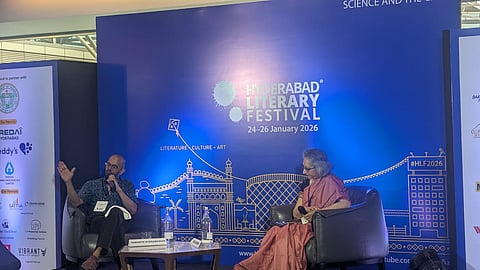
Addressing a session titled ‘Tangled Webs: The Internet’s Infrastructure’ moderated by University of Hyderabad (UoH) professor Usha Raman, Samanth spoke about his visits to Tonga, Taiwan, Singapore, Ivory Coast, Madrid and California to understand how the infrastructure of the internet has changed.
“Companies that laid cables 10 years ago and still do it are invariably American or Western European companies. The only involvement of the government is to allocate land and since privatisation kicked in the 1990s, the Big Tech companies completely took over,” he said.
Samanth argued that this poses a real politik problem. “Taiwan has so far made available their information on internet cables but the country is currently considering removing access to the information. If the cables stop working, we can only imagine Taiwan’s plight. On their eastern front, China renders them vulnerable. Aside from this, Taiwan’s semiconductor industry would also take a hit as would their commerce,” he added.
