
Subscribe
Karnataka’s Forest Department has filed a contempt petition accusing 39 Jenu Kuruba families living in the Nalkeri range of Nagarahole forest of "deliberate and malicious acts of disobedience". Jenu Kurubas are classified as a PVTG or Particularly Vulnerable Tribal Group, a sub-classification within the Scheduled Tribe category which denotes further historical as well as ongoing production of systemic marginality.
The petition, filed by ACF Ananya Kumar, will be heard by the High Court on November 19. It states that the families are in contempt of a status quo order issued by the court. These allegations emerge out of a misrepresentation of the facts of the case.
On May 5, 2025, these Jenu Kuruba families returned to the site of their ancestral village, Karadikallu Attur Kolli haadi, located just inside the boundary of Nagarahole Tiger Reserve in Kodagu district. The families were asserting their forest rights, 40 years after being forcefully evicted from this very site. Their return follows a long claims process under the provisions of India’s Forest Rights Act (FRA).
Filing a contempt petition against families who are fighting for their fundamental rights, and amidst an ongoing status quo order, is an underhanded move that risks extending four decades of injustice.
Layered injustices
In the 1980s, following the declaration of Nagarahole National Park, the Forest Department evicted scores of villages.
Conservationists today argue that people being removed from protected areas ‘voluntarily’ leave the forest. These early evictions in Nagarahole, however, proceeded through unquestionable force. Families will describe how foresters arrived in their villages brandishing lathis and guns and released elephants, pushing them out.
No provisions for rehabilitation or compensation were in place at the time. These policies were not were officially introduced in Nagarahole until the late 1990s.
Overnight, forest-dwelling communities found themselves in an unprecedented situation of landlessness. Left without options, many ended up in the labour lines of Kodagu’s coffee estates, living under cramped and exploitative conditions.
This has been confirmed in a 1998 report by the World Bank Inspection Panel, and the 2014 Assadi Report by the High Court’s ‘Committee on the Tribal Issues of Rajiv Gandhi National Park’. This was a devastating loss of autonomy, forest-based livelihoods, ancestral lands, and spiritual practices that proceeded without any settlement of rights.
A Jenu Kuruba elder recalls, "People had to gather up their children and run. Wherever we went, we had no place of our own. Eventually, many had no option but to move into the line houses".
These ill-conceived evictions were based on a conservation model focused on creating inviolate spaces for wildlife. World over, the implementation of this model has led to the widespread displacement of forest-dwelling and resource-dependent communities. While this approach has been challenged globally, it continues to have lasting effects on conservation policy. In Nagarahole, it has led to layered, multigenerational harm.
Nagarahole’s ‘vanished villages’
Tasked by the court with reviewing the extent of early evictions in Nagarahole, the 2014 Assadi Report identified a unique predicament. It declared that many villages evicted in the 1970s and 1980s had been entirely scattered into different coffee estates across the district. Importantly, it reported that data about these villages was also missing from government forest records. The Committee stated that this made it nearly impossible to compile comprehensive evidence.
This category, termed ‘vanished villages,’ was articulated in the Assadi Report precisely to denote villages such as Karadikallu. In fact, the Report names several families from Karadikallu in its list of formerly evicted families who were later living in the Beguru and Faith coffee estates.
Families have spent years labouring away while awaiting the recognition of their forest rights. Yet, they have sustained their relationship to the forest even after eviction. They continued to harvest honey, collect forest produce, and visit sacred sites and burial grounds, despite having to navigate restrictions by forest staff. They also exercised their constitutional right to conduct Gram Sabhas.
The Assadi Report raised an urgent question on the implementation of the FRA in a landscape shaped by layered harms: "Will the laws (be) applied to the Tribals who have 'vanished' in the coffee economy?" Through careful navigation of bureaucratic processes and faith in the judicial system, the Jenu Kuruba families of Karadikallu are forging an answer to this very question.
Legal proceedings over Karadikallu Attur Kolli
The Forest Rights Act, 2006 was brought into effect under the Congress-led UPA government with the explicit commitment to undo historical injustices.
Provisions of the FRA in Section 3(1)(m) read with Section 3(1)(e) allow for historically-evicted families to legally claim their ancestral lands. As the Jenu Kuruba are categorised as PVTGs in Karnataka, Section 3(1)(e) also entitles them to special habitat rights.
The families first submitted their FRA claims in 2010, but the process has seen bureaucratic delays and violations of procedure.
In 2024, Karadikallu’s Forest Rights Committee conducted a field verification of claims in the presence of officials from the Revenue and Forest Departments. As per procedure, following this verification process the Forest Rights Committee must prepare survey verification reports and submit them to the Gram Sabha. Approved claims from the Gram Sabha must then be submitted to the SDLC (Sub Divisional Level Committee). However in Karadikallu, forest officials reportedly insisted on preparing the reports, which were sent directly to Panchayat and ITDP (Integrated Tribal Development Project) officials. These were then forwarded to the SDLC without the knowledge of the Gram Sabha. Rajan, a volunteer for CNAPA (Community Network Against Protected Areas) explains, “this constitutes a procedural violation under FRA Rule 12”.
Since their return to the ancestral village, the families have been continuously pressured by local forest staff. In an act of erasure that only serves to extend historical injustice, the department refutes the families’ customary claims. The 39 families approached the High Court through a Writ Petition 21110/2025 in July 2025. The court followed with an interim order on July 28, 2025. The order stated that the constitutional rights of the claimants must be evaluated before the court and that in the meantime: "petitioners are not to put up any permanent structures and both parties are directed to maintain the status quo". This offered much-needed respite to the ongoing tensions.
Misrepresentations in the contempt petition
The contempt petition inaccurately claims that the families of Karadikallu Attur Kolli went against the status quo order.
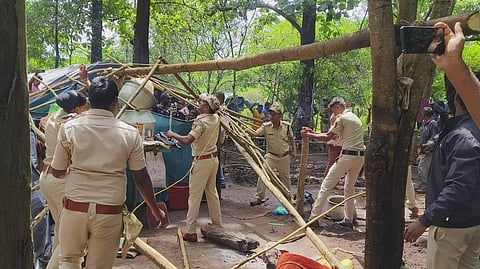
In May 2026, after living in temporary communal shelters for the past year, the families informed forest staff that they would be reworking these in anticipation of the monsoon. The shelters were made of short-lived tarpaulin and mesh fabric that had become weathered by sun and rain. The families reworked them to offer essential protection as well as privacy to their many elderly members, women, and children.
They also filed an interlocutory application I.A 1/2026 before the court, affirming that: "These structures are purely temporary in nature and do not alter the character of the land or the status quo directed by this Hon'ble Court".
The Forest Department’s contempt petition, filed on July 24, 2026, repeatedly points to the temporary nature of these shelters by describing them as “encampments”. What then justifies the allegation that the families are in contempt of the status quo order or further, that they are acting with malicious intent? In fact, when the families had attempted to add an extra tarpaulin roof over their heads back in 2025, prior to the status quo order, a team of forest staff led by the ACF went into the village and tore it down.
Given the pendency of the families' Writ Petition, a proper reading of the order is crucial. The Congress administration in Karnataka has the opportunity to reaffirm its commitment to the values of the FRA, as well as social justice, dignity, and rights of Adivasi communities. Rather than criminalising the claimants, the administration must uphold their statutory rights.
In the case of ‘vanished villages’ which lack past government documentation, it is important to uphold the legal veracity of the FRA’s provisions for a broad range of evidence of claims. The Assadi Report can be admitted as official historical evidence under Rule 13, which deals with official and public records. The families' submission additionally includes elders' testimonies, photographs of sacred sites and burial grounds, and remnants of past habitation. These are all admissible as evidence of claims.
It will be important for the courts to take cognizance of the historical context as mentioned in the Assadi Report along with the provisions and purposes of the Forest Rights Act, rather than the contempt petition’s unfounded vilification of the claimants. The families of Karadikallu have remained steadfast in their trust in the judiciary and have mobilized an in-depth understanding of multiple legal provisions.
They clarify repeatedly that they are unwilling to accept the perpetuation of historical injustice, be wrenched away once again from their territories, deities and sacred sites, or be expected to eke out a survival in the labour lines. This constitutes a refusal to be erased from their own histories and ancestral lands.
Recognising Jenu Kuruba customary as well as constitutional forest rights is an essential step to begin to right historical wrongs.
The author researches conservation and forest rights issues in Karnataka. Views expressed are the author’s own.
Follow TNM's WhatsApp channel for news updates and story links.
