
Subscribe
In April 1963, Martin Luther King Jr sat in a cell in Birmingham, Alabama. He had been arrested for marching without a permit. A smuggled newspaper reached him. In it, eight clergymen of that city, all respectable, all broadly sympathetic, counselled the Blacks of Birmingham to be patient and to wait. King wrote his answer in the margins of that newspaper.
The ‘Letter from Birmingham City Jail’ is remembered most for King’s discovery that the real obstacle was not the man with the dogs and the fire hose. It was the moderate who preferred order to justice, and who said nothing while waiting for a better time. King put it plainly on other occasions. What we remember in the end is not what our enemies shouted. It is what our friends did not say.
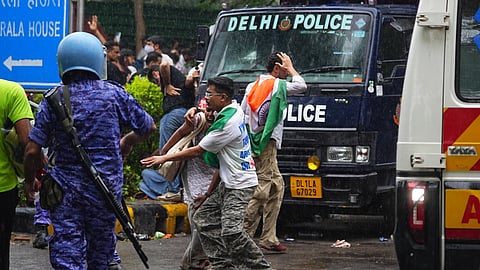
I have been thinking about that line all week. On July 20, students walked from Jantar Mantar towards Parliament. They were protesting the NEET paper leak. They wanted the Education Minister to go. Some of them returned home with metal in their bodies. A 19-year-old student of Delhi University, Sahil Lochab, may lose an eye. A journalist was admitted to Safdarjung Hospital with what the doctors recorded as consistent with pellet injuries. A 25-year-old protester went into surgery to have pellets removed from his face and upper body.
The Delhi Police first told the country that the reports of pellet guns being used were false and misleading. Then the Central Reserve Police Force conducted its own inquiry. It found that a Rapid Action Force man at Connaught Place fired at least seven rounds from a pellet gun that day, and that five of them struck peaceful protesters. The RAF has since barred the use of pellet guns until further orders. That is a serious admission. The capital used on its own students a weapon this country had reserved for the Kashmir Valley.
There is more. A video showed an Additional Deputy Commissioner of Police slapping a woman protester. He was removed from duty at Jantar Mantar after the footage was placed before the Delhi High Court. The Court directed that all CCTV footage be preserved. There were lathi charges and head injuries. The photographs and videos came hour after hour, day after day.
Through all of it, one institution kept silent for close to a week.
The National Human Rights Commission (NHRC) sits at Manav Adhikar Bhavan, a short walk from Jantar Mantar. Parliament created it in 1993 under the Protection of Human Rights Act. Its chairperson is a former judge of the Supreme Court. Previously, retired Chief Justices of India used to head it, till this government amended the Act to permit other retired judges as well. It is not a department of government. It is a statutory body designed to be independent, and its independence is the whole point.
Section 12 of the Act sets out what the NHRC must do. Its own website puts the first function plainly. It inquires into violations of human rights and into negligence by a public servant in preventing such violations. It may act on a petition. It may also act on its own motion. That last power is the important one. The Commission does not have to wait for a wronged student to find a lawyer and file a form. A newspaper report is enough. That is how the power has always been understood, and that is how the Commission itself has used it.
It has used it well in the past. In 1997, acting on a complaint from the Andhra Pradesh Civil Liberties Committee, it wrote to Chief Ministers laying down the procedure to be followed in cases of death in police encounters. Those instructions still shape the law. In the Punjab disappearances matter, it examined more than 2,000 cases of young men killed and secretly cremated and ordered relief for the families of over 1,500 victims. In 2002, it took cognisance of the Gujarat carnage from media reports, held its own inquiry, and then went to the Supreme Court under Article 32 on behalf of the victims. In 2000, it told the Government of India that the country did not need the Prevention of Terrorism Bill. Its chairperson had earlier written to every Member of Parliament asking for the repeal of TADA.
That Commission could have issued a notice on July 21 after the police brutalities of July 20. This Commission was not idle that week. On July 23, a newspaper carried a report that a school principal in Moga district of Punjab had sexually harassed his students. The Commission read it, took suo motu cognisance, and issued notices to the Chief Secretary of Punjab and to the Senior Superintendent of Police at Moga, calling for a report in two weeks. It was right to do so. Those school girls deserved exactly that speed.
But the machinery that reached Moga in a day took nearly a week to reach Connaught Place, headquarters of the Delhi Police, a short metro ride from the NHRC’s own front door. It was only on July 25 that the NHRC finally issued notice to the Commissioner of Police of Delhi seeking his response to the allegations of excess force by Delhi Police against student protesters reported in the media.
No principle explains the difference. What I can find is a pattern, and it is not a comfortable one. Notices travel easily to states the Union does not govern. They travel slowly, if at all, to forces that answer to the Union Home Ministry. While Delhi filled with tear gas, the NHRC’s public timeline carried on with its ordinary business. Seminars. Internships. Tenders. There is nothing wrong with any of that. There is something badly wrong with only that.
The students of this country have now learned what a lathi feels like. They have learned what a pellet does to an eye. In 20 years they will not remember the officer who slapped a woman on camera. Officers are what they are, and the country has always known it.
They will remember, instead, the body that carried the words ‘human rights’ on its letterhead, sat barely four kilometres away, and took its time to intervene.
Sanjay Hegde is a senior advocate at the Supreme Court of India.
Views expressed are the author’s own.
