
Subscribe
In October 2025, Google announced its first AI hub in India in Visakhapatnam, Andhra Pradesh, committing to bring Google’s full AI stack and consumer services to India. The investment of $15 billion USD over five years (2026-2030) is Google’s largest investment in India.
The state government gave 600 acres of land and incentives of nearly $2.6 billion USD (INR 22,002 crore), which include 25% discount on the land value, 100% stamp duty exemption, power tariff subsidy for a period of 15 years, electricity bill exemption for a period of 15 years, and 25% subsidy on water tariff for a period of 10 years.
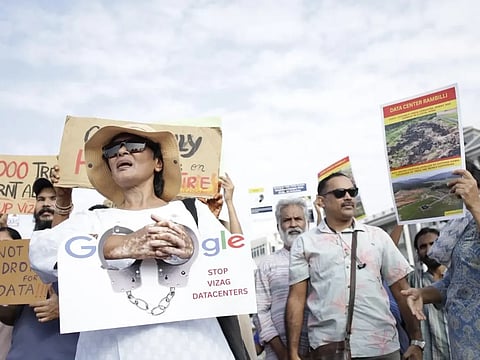
The expansion of data centres has raised concerns and protests. These have been centred around the extraction of water, electricity, and resources the physical infrastructure will require.
In the United States, 75 projects worth $130 billion USD of data centre projects are blocked or delayed due to organised local opposition. A £3.8 billion AI data centre project in Hertfordshire, UK has been delayed due to pushback from local communities. Residents of Johor, Malaysia staged protests against a hyperscale data centre being developed by Chinese operator ZDATA. The footprint these projects would leave on the economy and environment is the trade-off the governments’ policies seem to be making.
The narrative and the justification
Data centre companies claim to bring economic growth. Hosting this infrastructure within their borders will enable AI applications, digital services, cloud platforms and enterprise IT systems. Countries are competing to attract foreign infrastructure investment by incentivising frontier AI companies and foreign cloud service providers through favourable policies.
India announced a tax holiday until 2047. The current nationwide data centre capacity is at 1.5 GW, and is forecasted to grow to 5 GW by 2030. A total of $60-70 billion USD investments in data centres is announced over the next five years.
Other countries too are welcoming AI data centres with incentives. Chile offers full exemption from import duties on imported servers and technology equipment for data centres projects with an investment over $5 million USD. Malaysia offers a 10-year income tax holiday for eligible projects under Malaysia Digital (MD) tax incentive. The common incentive apart from tax holidays is the promise of fast-track clearance of bottlenecks like environment impact clearance and land acquisition.
To justify the incentives despite the massive resource extraction and consumption, countries are aggressively pitching these facilities as vital infrastructure required to secure sovereignty, employment and economic growth.
Why does the justification fail?
The industry-led AI infrastructure deals follow a consistent pattern. Over time, this pattern concentrates ownership of the infrastructure and the ecosystem that runs it among a small number of actors.
This concentration becomes a political and economic leverage in its own right. Host communities who bear the direct economic, environmental, and ecological costs are systematically excluded from the benefits of the very infrastructure built on their lands extracting their resources.
This creates structural dependency. And this dependency risks the gradual disempowerment of host communities' economic agency and of the institutions meant to govern on their behalf. Breaking this cycle of dependency requires moving past the buzzwords and examining what AI compute sovereignty entails.
Compute sovereignty has three layers – how much AI compute a country hosts within its borders, what is the nationality of the companies who own the data centres, and who made the chips inside it.
So building data centres within their territories does not guarantee digital sovereignty if those facilities are run by foreign entities. And access to compute provided by foreign-owned data centres are vulnerable to price hikes, political interference, or geopolitical interventions. This digital leverage is heavily reinforced by energy control.
Data centres need uninterrupted energy supply. It is a key input in the supply chain. Google, Microsoft, Amazon, Meta and other big tech giants are claiming sustainable solutions. Host countries see energy strategy as a commercial imperative.
Carefully structured long-term power purchase agreements(PPA) between data centre operators with renewable energy suppliers are emerging as a competitive opportunity. This is leading to power concentration.
The four big tech giants-Microsoft, Google, Amazon and Meta- accounted for 49% of global clean energy PPAs. This is the same pattern we have seen in the Google-Adani AI hub deal in India. In October 2024, Adani group and Google announced a PPA for the renewable energy plant at Khavda, Gujarat. This existing clean energy initiative is to power the data centre in Andhra Pradesh.
The jobs numbers do not add up
Of the 600 acres given for the Google-Adani AI hub, approximately 200 acres belong to Dalit farmers and other cash crop cultivators.
The Dalit farmers were given land occupation rights to these lands in the 1970s. They have spent generations cultivating it. The lands were their primary source of their livelihood. The land would have given them generational financial resilience.
The government has promised to compensate for their lands. The compensation package included a promise of employment. At the foundation-laying ceremony, Andhra Pradesh IT Minister Nara Lokesh said the facility could generate close to 2 lakh jobs and deliver a significant boost to the economy.
However, the official documents submitted show a total of 2,415 jobs during construction and operational phase included (90 permanent and 400 temporary during construction phase, and 1725 permanent and 200 temporary during the operational phase).
Environmental concerns
In India, the rights organisation Human Rights Forum (HRF) has raised concerns about the environmental impact as one of the project sites sits close to the catchment area of Mudasarlova reservoir which is the key drinking water source for Visakapatnam. The environmental clearances issued by the state government show a total requirement of 808 kilolitres of water a day (KLD). This is roughly enough for 6,000 people's daily needs.
The facility will require a total of 2,068 MW of power which is roughly enough to supply to more than 2 million households a year. Activists have raised concerns over water supply in a region which already faces drinking water challenges due to low groundwater levels and uneven monsoons. There has been a demand to stop building the data centre.
To offset the environmental concerns, companies worldwide have initiated to plant native plant species, and watershed management programmes under Corporate Social Responsibility initiatives. For example, in Quilicura, Chile, Google committed to planting 1,000 native plant species on five hectares of land. In 2018, after the approval of expansion of the data centre, Google committed to the “urban forest”. It was inaugurated in 2019. But due to lack of coordination between the local municipality, Google, and the Cultiva foundation which oversaw the plantation, this project was found to be in a state of neglect.
What do host communities get?
In traditional industrial manufacturing, a physical infrastructure would create an indirect economic network. But data centres rely on globalised supply chains for chips. The direct economic benefits of data centres do not reach the host communities who are the residents where the facilities are being built. The current data centre deployment strategy systematically excludes host communities from strategic decisions. This institutional exclusion is stripping them of natural capital and generational financial resilience without delivering equitable, localised wealth generation, and is one of the primary reasons for pushback from host communities.
What is the fix?
To mitigate negative social impacts, Community Benefit Agreements (CBA) emerged as a potential strategy. CBAs are currently a popular American concept quickly gaining international attention. Host communities across the US have begun to develop various types of CBAs. These are contracts between data centre developers and host community groups to ensure these communities receive benefits in exchange for hosting the facility. These benefits can include employment generation, upskilling, infrastructure improvement, or funding local sustainability projects.
For example, officials in Cedar Rapids, Iowa negotiated an agreement with Google and QTS, another data centre provider. The city has promised a 20-year, 70% tax exemption, as long as the project meets the job threshold of at least 31 full-time positions at a high-quality wage rate of at least $26.20 USD per hour after construction. Google agreed to pay $400,000 for the next 15 years and QTS agreed to pay $18 million USD over the next 18 years.
While CBA is a fixed one-time payment negotiated once, benefit sharing is a structured, long-term payment that shares the benefits of AI. Benefits of AI development do not spread by default. Closing that gap between AI countries and other countries requires deliberate mechanisms like benefit sharing. As detailed in a paper by the Governance of AI Foundation (GovAI), this could be implemented by sharing financial proceeds from AI commercialisation or AI-driven economic growth.
The framework means quantifying and setting a price on what a data centre extracts from the land, water and energy it depends on. This price is not fixed at the point of entry. It is systematically negotiated as information and transparency improves once the facility becomes operational and the scale becomes measurable through AI chips installed and the data egress it generates. This payment is directed to the benefit of host communities as long as the facility operates.
However, it brings up the uncertainty of how we will know the figures we are quantifying are real. According to a study from the University of Oxford, data centre-based AI activity is verifiable through verification hardware installed directly in data centres using confidential computing features available on AI chips. Compute infrastructure is physical and can be identified, tracked and counted. Therefore, building AI verification technology capacity should be a stated priority for the India AI Safety Institute launched by the Ministry of Electronics and Information Technology (MeitY) under the IndiaAI mission.
Distributing financial proceeds generated by AI development will face complex challenges of who actually should receive the benefits – the host country or host communities. Should the proceeds be shared directly from companies to individuals or channelled through governments or other intermediaries? What legal status would such an intermediary have?
Answering these institutional questions requires serious academic thought and careful legal design. However, treating this as a traditional policy and waiting for the frameworks to slowly mature while the infrastructure is being built today is a mistake.
The speed with which the Indian government tweaked the national data centre policy clearing way for Google’s investment in India, proves that policy timelines can accelerate when there is a political will. If complex regulations can be rewritten to subsidise big tech’s access to resources, the same agility can be used to ensure these investments directly benefit the people.
This does not mean rushing into policies that cause more harm than good. We must accelerate to protect host communities. Ultimately, benefit sharing strengthens the host communities’ and the host country’s participation in the AI economy.
The question was never whether India should host this infrastructure. It is about under what terms and who it actually belongs to.
Deepthi is a journalist with 15 years of experience in India. She is currently an Associate Lecturer (part-time) at Anglia Ruskin University, UK and an AI Policy and Strategy fellow with Successif.
Follow TNM's WhatsApp channel for news updates and story links.
