
Subscribe
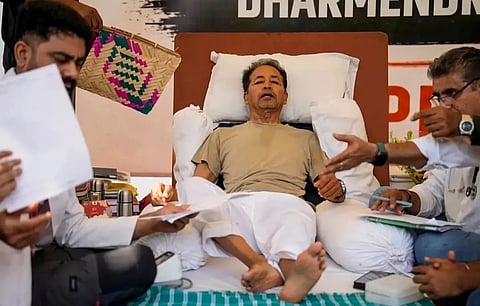
As education reformer and climate activist Sonam Wangchuk’s indefinite hunger strike entered its 19th day on July 16, Thursday, concern over his deteriorating health has spread far beyond Delhi’s Jantar Mantar. Several actors, writers, musicians, politicians, and civil society voices have appealed to the Union government to engage with him, while many have also urged Wangchuk to end his fast before it causes irreversible damage to his health.
Wangchuk began his hunger strike in support of the Gen Z-led Cockroach Janta Party (CJP), which emerged as one of the country’s biggest youth movements after the alleged NEET-UG 2026 paper leak. As the protest gathers momentum, the issue has also reached the Delhi High Court, where a petition has sought urgent medical intervention. Even as organisers have released regular updates on Wangchuk’s worsening health, the movement says its repeated calls for dialogue with the Union government have gone unanswered.
Here’s a look at how the protest began, why Wangchuk is fasting, and who has come out in support of him.
How did it begin?
The Cockroach Janta Party (CJP), a Gen Z-led satirical political movement founded by Abhijeet Dipke, shot to prominence after the alleged NEET-UG 2026 paper leak triggered nationwide outrage over repeated examination irregularities.
While the movement initially centred on the alleged leak, it soon expanded into a wide campaign calling for accountability in India’s education system. The controversy also took a devastating human toll. Between the cancellation of NEET-UG on May 12 and the June 21 re-test, at least 12 aspirants across the country died by suicide, according to an investigation by The Indian Express. While the circumstances varied from case to case, the deaths came to symbolise the immense pressure and uncertainty faced by students caught in the controversy.
The CJP has demanded the resignation of Union Education Minister Dharmendra Pradhan, the dissolution of the National Testing Agency (NTA), sweeping reforms to competitive examinations, and Rs 1 crore compensation for the families of students whom the movement says died by suicide following the NEET controversy.
The campaign quickly gained traction online, drawing millions of supporters and turning into one of the country’s most visible youth-led movements.
Why is Sonam Wangchuk on a hunger strike?
On June 28, Wangchuk joined the movement by beginning an indefinite hunger strike at Delhi’s Jantar Mantar.
Before starting the fast, Wangchuk and CJP founder Abhijit Dipke visited Rajghat to pay tribute to Mahatma Gandhi. Calling himself a follower of Gandhi’s philosophy of non-violent resistance, Wangchuk said he hoped the hunger strike would compel the Union government to engage in dialogue with the protesters. He has maintained that he will continue the fast until the government agrees to hold talks with the movement – a demand that organisers say has so far received no response.
According to the medical bulletin issued by the CJP on July 15, Wangchuk remains “very weak” and is under 24-hour medical vigilance. His weight has fallen to 57.15 kg, after dropping another 400 grams in the previous 24 hours, taking his total weight loss since the hunger strike began to 8.9 kg. His blood pressure was recorded at 105/76 mmHg, blood sugar at 80 mg/dL, oxygen saturation at 97%, while his hydration was described as “fair.”
Several others have also joined the indefinite fast alongside him, with one of them reportedly requiring hospitalisation after their health worsened.
Which celebrities have voiced support?
Many prominent celebrities have so far come out in support of Wangchuk, urging both the Union government to engage with the protesters and the activist to reconsider his indefinite fast.
Veteran actor Zeenat Aman was among the first prominent voices to speak out, expressing concern over Wangchuk’s deteriorating health in an Instagram post and urging the Union government to open a dialogue with him. “We must not become a society that sits back and watches one of its greatest minds be sacrificed. India has a long history of peaceful protest; those who wield power are obliged to meet such protest with peaceful dialogue,” she wrote.
Actor Prakash Raj, who had earlier attended a CJP protest in Bengaluru, later visited Wangchuk at Jantar Mantar to express solidarity.
Actor Omi Vaidya, best known for 3 Idiots, a film inspired by Wangchuk’s work in education, shared an Instagram video supporting the protest, saying he did not "want the guy to die."
Veteran actor Shabana Azmi also shared an emotional message, calling Wangchuk someone “our country gravely needs” for standing “against injustice” and “for the truth.” While expressing pride in his stand, she urged him to end the fast, writing that students needed his guidance and that “this is a long battle,” making it essential for him to stay healthy.
Actor Soni Razdan echoed that sentiment, sharing a poem asking Wangchuk to “live to fight another day,” and captioning it, “We need you. Don’t leave us.”
Actor Ayesha Khan said she had reached out to journalists and media organisations to encourage greater coverage of the protest, while Abhay Deol reshared Zeenat Aman’s appeal on social media.
Actors Naseeruddin Shah and Ratna Pathak Shah also expressed solidarity with Wangchuk’s demands while urging him not to continue risking his health through an indefinite hunger strike.
Other public figures, including Atul Kulkarni, Varun Grover, Swanand Kirkire, Shreya Dhanwanthary, Rubina Dilaik, and Punjabi singer Kaka, have also publicly backed the protest or called on the Union government to engage with the movement.
How have political parties responded?
Although Wangchuk has repeatedly insisted that the CJP’s protest is not aligned with any political party, the Union government has largely portrayed the movement as politically motivated. The BJP has stood firmly behind Union Education Minister Dharmendra Pradhan and has rejected calls for his resignation over the alleged NEET-UG paper leak.
The opposition’s response has been more mixed.
Congress leader Rahul Gandhi, who has separately been campaigning on alleged irregularities in the examination system through his Chhatron Ki Goonj initiative and has demanded Pradhan’s resignation, has not publicly endorsed Wangchuk’s hunger strike. Wangchuk said in an interview that if leaders such as Rahul Gandhi and Samajwadi Party chief Akhilesh Yadav chose not to support the movement, “it will only reflect their narrow-mindedness, and the public will eventually reject them.“
While Akhilesh Yadav has not publicly backed the protest, he appealed to Wangchuk to end his fast and deputed Samajwadi Party MP Priya Saroj to meet him at Jantar Mantar.
Some Congress leaders, however, have openly expressed solidarity with Wangchuk. Congress MP Shashi Tharoor has appealed to him to end his hunger strike while supporting the movement’s concerns over the examination system. Senior Congress leader Adhir Ranjan Chowdhury has also backed the protest.
Several opposition parties have extended explicit support to Wangchuk and the CJP’s demands. They include Aam Aadmi Party national convener Arvind Kejriwal, Shiv Sena (UBT) chief Uddhav Thackeray, Trinamool Congress chairperson Mamata Banerjee, NCP (SP) MLA Rohit Pawar, and leaders from the CPI(M) and CPI. Leaders from the Left parties, including former Kerala ministers, have also visited Wangchuk at the protest site to express solidarity.
What is happening now?
As support for the protest has grown, organisers say they have repeatedly urged Wangchuk to call off his fast because of his deteriorating health. According to Abhijeet Dipke, however, Wangchuk has remained firm in his decision and will continue until the Union government agrees to engage with the movement’s demands.
With no breakthrough in talks, the matter has also reached the Delhi High Court.
Activist-lawyer Rakesh Kumar Saini has filed a public interest litigation seeking urgent medical intervention, arguing that Wangchuk’s life is at immediate risk. The petition asks that he be shifted to a government hospital and provided treatment if necessary, contending that the state has a constitutional duty to protect his life and cannot remain a passive spectator while his condition deteriorates.
“The simple thing to be done is to take him to a government hospital and force feed him the necessary nutrients, vitamins and minerals by way of a liquid diet which are necessary for the human body to survive,” the plea said. It argued that the state has a constitutional duty to protect the life and health of every citizen and alleged that, instead of ensuring his safety, the authorities are treating Wangchuk “like a hardcore criminal.” The plea further contended that, under the Bharatiya Nyaya Sanhita’s provisions relating to the abetment of suicide, authorities cannot remain passive when a person’s life is in imminent danger.
The Delhi High Court subsequently issued notices to the Union government and the Delhi government seeking their response to the plea.
The petition argued that the state has a constitutional duty to protect the life and health of every citizen, and that the government is treating him like a hardcore criminal. The petition also concludes that under the suicide abetments of the Bharatiya Nyaya Sanhita, authorities cannot remain passive when a persons life is in imminent danger.
Meanwhile, Wangchuk has remained unmoved by the growing chorus asking him to end the fast. Responding to those urging him to call off the hunger strike, he said in a message shared by the CJP, “Instead of asking me to end my hunger strike, ask the government why it refuses to listen.”
This article was written by a student interning with TNM.
Follow TNM's WhatsApp channel for news updates and story links.
