
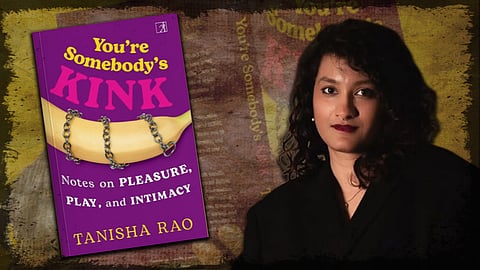
Why kink isn’t just about sex: Author Tanisha Rao speaks on consent and care
“What if nobody is actually ‘normal’ when it comes to desire?”
This is the question that sits at the heart of You’re Somebody’s Kink, Tanisha Rao’s exploration of sex, shame, consent, and intimacy. Through conversations with survivors, queer people, and members of India’s kink communities, Tanisha dismantles the idea that some desires are inherently “normal” while others are “deviant.” Instead, she invites readers to ask different questions: How do we communicate our desires? How do we negotiate boundaries? What does consent look like beyond a one-time “yes”? And how do trust, care, and accountability shape intimacy?
In India, public conversations about sex often begin only when something has gone wrong — a case of sexual violence, allegations of misconduct, or debates around consent. Pleasure, desire, and communication rarely receive the same attention. Tanisha argues that this imbalance shapes not just how we understand sex, but also the relationships we build. Read through that lens, You’re Somebody’s Kink is far more than a book about BDSM and kink communities. It makes a compelling case for expanding our understanding of consent beyond the binary of “yes” and “no,” framing it instead as an ongoing practice of communication, negotiation, and mutual respect — lessons that apply to every relationship, kinky or otherwise.
Popular culture, particularly Fifty Shades of Grey, the bestselling erotic romance franchise, has also left many people with a narrow understanding of BDSM — an umbrella term for consensual practices involving power exchange, restraint, pain or role-play — reducing it to whips, handcuffs, and erotic spectacle. Tanisha’s book argues that kink is not defined by pain or control alone, but by trust, explicit negotiation, aftercare, and the willingness to treat every partner as an individual with unique needs and boundaries. Ironically, relationships often dismissed as “unconventional” may offer some of the most valuable lessons on communication and consent.
In an interview with TNM, Tanisha reflects on why mainstream relationships often struggle with conversations that kink communities consider fundamental, what survivors have taught her about healing and rediscovering pleasure, and why sex education must move beyond fear and risk. Here are excerpts from the interview:
What inspired the title You’re Somebody’s Kink, and what do you hope readers take away from the book?
The title was always meant to be something that reiterated the intention of the book. I did not want people to jump into it expecting advice on how they could have sex or how they should improve their dating experiences. Instead, it was meant to be a collective reassurance.
Even amongst my most ‘conventional’ friends or chaste ones, the fear of being different from everyone who is considered normal, runs rampant. I used to think those were my fears alone, from being queer, but the more time I’ve spent working in sex and sexuality, the more common these sentiments seemed to be. If all of us seem to think there’s something wrong about our sexual desires, then is anyone really a deviant? I wanted the tone of this book to be one that reminds all of us that amongst all these billions of people we share the planet with, there’s got to be at least someone who craves the same things we do, and someone who finds our desires attractive and worth exploring.
While there is a lot we all have to re-learn about sex and sexuality to have healthier relationships with our own bodies, I think dismantling the notion that there is such a thing as ‘normal’ when it comes to sex and intimacy is important.
Your book argues that kink is less about sex than about communication, consent, safety, and care. Why do mainstream relationships often struggle with conversations that kink communities consider fundamental?
The mainstream has always romanticised lesser communication, lesser individuality, and it encourages this idea that we are all gendered stereotypes. Men must learn to decode women, women must exercise restraint and diminish themselves to be seen as desirable by men. These are the narratives that the mainstream feeds us, because it keeps us too preoccupied, scared, and lonely to recognise how little autonomy we truly have in our everyday lives. So when stereotypically vanilla relationships hit a wall with communication, that is entirely by design.
On the other hand, BDSM dynamics or kink-driven relationships recognise that they must accommodate a person’s individual needs and preferences to carefully create safe but fulfilling experiences. It is this act of treating every possible partner as entirely unique, and doing the work of building a brand new emotional and sexual blueprint with the person that teaches us to keep sharpening our communication skills, and it’s often those experiences that show us how consent can look vastly different among different people, or change within moments too.
Do you think conversations about consent in India are still too focused on violence and not enough on pleasure? How can that change?
Most cultures and conversations focus excessively on the violence and the ‘aftermath’ of sex. To understand where that comes from and why, we need to acknowledge how most Sex Education programs or consent education comes from governments and cultures that avoided the subject entirely, until it became their responsibility to create awareness about sexually transmitted infections (STIs), mitigate gender based violence and female foeticide, and control birth rates through Family Planning initiatives. With those three pillars bearing the load for modern day Sex Education, it comes as no surprise that the focus is still on early pregnancies, HIV, or intimate partner violence.
These conversations around sex feel like certain forms of violence must exist to justify having the conversation at all, and that forces us to move away from pleasure and focus on the uglier aspects of sex alone.
Change can only come when people are able to take more control in their own hands and speak freely, without intervention from larger authorities or corporations that benefit from controlling public narratives around intimacy. Sex ed needs to be community-driven, it needs to be shared amongst people who can empathise with each other’s cultural backgrounds while also being flexible enough to learn the nuances of people from other communities and it needs to be a dialogue that keeps growing and expanding. India’s struggle with bringing multiple states to agree to a common curriculum for Sex Ed is a perfect example of just how tedious it will always be for Sex Ed to be reduced to a blanket, nationwide module.
What do people get wrong about kink, and what can mainstream relationships learn from kink communities?
The biggest misconception is that these are a result of Western media or influence. And like any other culture in the world, of course Indians also believe that kink is a rich man’s hobby or an extremely privileged take on sex after trauma. To a certain degree, this is an understandable assessment because we do see kink parties being hosted in exclusive, high end venues or participants donning expensive leather, latex, and metal gear that only someone with a fair amount of spending power would be able to collect. But that’s not what kink is to everyone.
In India, it looks like Facebook groups in Rajasthan, Uttar Pradesh, or Himachal Pradesh where anonymous couples look for other couples to swing with. Or whispers of swinger parties amongst army men and their wives. Or a woman making a budget-friendly flogger out of shoelaces and excitedly showing her kinky friends how they can make their own gear too. There is a lot to learn from kink spaces and communities overall, but I think the most important skill is learning to champion your own needs and advocate for yourself, while also learning to nudge others around you to be more confident in their own advocacy.
One of the book's most powerful themes is survivors reclaiming intimacy. What do you wish people understood about survivors’ capacity for desire, intimacy, and joy?
As a survivor myself, I was often told that my desires would never be able to exist in healthy or nurturing ways until I was ‘completely healed.’ But the relationship between healing and desire is far more complicated, they often work in tandem to cause new ripples in each other, and with every desire comes the risk of being exposed to a whole new form of anxiety, injury, or trauma.
We still live in a culture where survivors have to play the part of a perfect victim to garner our pity, never mind our actual care or our shared desire to let them define justice on their own terms. That’s why the conversation cannot place a survivor and pleasure within the same realm.
We want to believe that pleasure is dirty, that seeking it is what makes other people deserving of the wrongs they have experienced, and that any sign of them still having desires erases their experience as a survivor.
There is no such thing as being completely healed, and life doesn’t slow down to let you lick all your wounds in peace either. All we can do is keep nurturing the interconnectedness between healing, pain, fear, and desires and to stay tender with ourselves. I wish society understood that interconnectedness too, and saw how much each of us was capable of mistakes or harm, so we could be better about showing up for each other not only to heal from the traumas we encounter but also to course-correct when acts of harm are committed.
I also wish we learned to make room for the profound impacts of sexual traumas, without reducing someone’s identity or spectrum of emotions to that of a survivor alone. People are allowed to be complex, and they are going to be. It’s up to us whether we want to bear witness to that complexity or reduce it to something one-dimensional just so it feels easier to digest.
If you could rewrite India’s sex education curriculum, what would be the first lesson? And what’s one lesson you wish everyone carried into their relationships?
The basics around anatomy and the fluidity of identities and desires is a no-brainer. We have mounting research and evidence to show how sex education teaches people to exercise more responsibility and care, and does not make them uncharacteristically sexual at ‘too early an age.’
But in addition to the basics around safety, I genuinely believe we could all use some skill-building when it comes to learning to ask for consent directly, learning to accept rejection with grace and not spiralling down a vengeful warpath, and learning how to take accountability and offer reparations when we do cause harm. So much of the rest can still be casually learnt from experience or from trusted friends and lovers, but it is this skill of giving and receiving feedback with grace, and treating it as a learning experience, that often dictates what the rest of our sexual journeys may look like. That skill, especially in this era of revenge leaks or deepfakes and growing cyber crimes and consent violations, is crucial.
Tanisha Rao is a sex educator, writer, and digital creator whose work focuses on sexuality, consent, relationships, and queer identities. Through workshops, online education, and her writing, she encourages nuanced conversations about intimacy, pleasure, and communication in a society where sex is often shrouded in silence and stigma.