
Subscribe
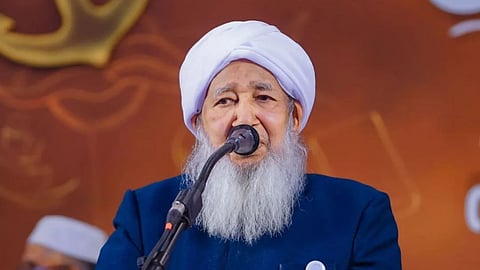
I was reminded of my time in Mecca this year while performing Hajj in May, walking shoulder to shoulder with men during most rituals, from stoning the ‘shaitan’ to circling the Kaaba during Tawaf, when I read of the recent anti-women statement by Kerala's grand mufti Sheikh Kanthapuram Abubakr Ahmad. He said bringing women into the public sphere could result in "great destruction" and that women are like gold ornaments that need to be kept safely inside a box. I wonder if Mufti Abubakr has performed Hajj or Umrah. I ask for a reason.
Umrah is a pilgrimage to Mecca that Muslims perform, and at its heart is Sa'i, a ritual where every pilgrim, male and female, retraces the desperate run of Hajar (RA), a woman, between the mountains of Safa and Marwa as she searched for water to save her son. A story so central that Islam's holiest rituals are built on her independent action. Without this run, the Umrah is incomplete. Men like the Mufti who invoke Hajar's memory while controlling women today aren't following in her footsteps; they're walking past them.
This is not the first time that Muslim women have been subjected to control over their bodies, their choices and their existence. As an Indian Muslim woman, I have to constantly be at the receiving end of identity-based hate and discrimination from outside of the community on one hand. At the same time, I am subjected to policing and asked to give away my right to ask for equality within the community, in the name of the larger cause of protecting the community in the current polarised political climate in the country.
If one fine day, I wake up to being put up for ‘Auction’ on an app called ‘Bulli Bai’ targeting Muslim women, on another day I have to justify my stand to my own community on why I think polygamy is un-Islamic and has no place in Muslim society.
I wonder if the Mufti and many others who think like him read about the life of the Prophet. I ask again, for a reason.
Have they not read about Umm Ammarah Nusaybah bint Ka'b al-Ansariyyah (RA)? During Hajj this year, our guide narrated her story to us, proudly sharing histories of courageous Muslim women during the Prophet’s life. These are the earliest and most striking examples of Muslim women stepping beyond the confines later interpreters assigned to them.
She had gone to the Battle of Uhud to give water and tend to the wounded, but when the tide of battle turned and the ranks around the Prophet Muhammad thinned, she placed herself directly in harm's way, taking multiple wounds while fighting off attackers who pressed toward him. Her presence on the battlefield, unflinching, stands as an early and unambiguous rebuttal to any claim that women's piety is best expressed through invisibility from public life.
Many religious scholars continue to push patriarchal interpretations of the Quran that restrict women’s freedom and agency and then present those restrictions incorrectly as Islam. The Mufti’s comparison of women to jewellery that belongs inside a box is not only patronising, but also stands in stark contradiction to Islamic history.
Hazrat Khadija (RA), the first believer of Prophet Muhammad's (PBUH) message, was a successful merchant who controlled her wealth, employed men and participated actively in society. The Prophet, her husband, respected her independence, sought her counsel and relied upon her support. If a woman’s virtue truly depended upon being kept inside like jewellery in a box, how do those preaching such restrictions account for Hazrat Khadija, the first believer of the Prophet’s message, and one of the most consequential women in its history?
As a curator of Muslim history, a year ago I helped bring together a whole collection of articles on the contributions of Muslim women across the world, and I cannot help but wonder what hell must have broken loose for most of them trying to fit outside of the box created for them!
To be subjected to control and saving from within and outside the community day in and day out is extremely exhausting for many of us Muslim women. Liberals telling us of the problems with Hijab not being a choice and obsessing over our choices, as was seen during many media stories on Iran as a recent example, to those within the community policing us Muslim women on what is modesty and what is not, what are the issues we need to raise and when we need to keep quiet, needs to stop.
Muslim women should not have to choose between defending our community from Islamophobia and challenging patriarchy within it. We should be able to do both. We can reject those who use our clothes, our faith and our bodies to portray Muslims as backwards, while also rejecting clerics and leaders who use religion to restrict our freedom and agency and stop us from asking for our rights guaranteed by the Quran and the constitution alike. Neither side gets to decide what liberation looks like for us.
None of this started with Sheikh Abubakr Ahmad, and it won't end with him either. Give it a few months and some other cleric or priest, or some politician, Muslim or otherwise, will say more or less the same thing: that a woman's voice is something to be covered up, that her ambition is a threat to the home, that modesty means being neither seen nor heard. What will then follow is a cycle of outrage on Twitter, a handful of opinion pieces and TV debates, and then quiet, until the next mostly man with a pulpit or a podium decides women need to be reminded of their place.
We can't keep responding to this one statement at a time, as if each one is a surprise. It's a pattern, and patterns don't fix themselves because people got embarrassed for a week. They fix themselves when the people saying this actually have to answer for it, every time, not just when it trends.
Comparing a woman to gold in a box is really just another way of saying she matters more as something to look at than someone to listen to. Muslim women don't need reminding of what Hajar (RA) or Khadija (RA) or Nusaybah (RA) would think of that box; they lived their faith in public, in the middle of things, not tucked away from them. We as Muslim women are not asking permission to step outside it. We were never really inside it to begin with. That box was built for everyone else's comfort, not ours, and it's on them to take it apart, not on us to keep proving we don't belong in it.
Mariya Salim is the Co-founder of Zariya. She is a human rights activist and an international sexual- and gender-based violence expert based in Delhi.
Views expressed are the author's own.
Follow TNM's WhatsApp channel for news updates and story links.
