
Subscribe
Follow TNM's WhatsApp channel for news updates and story links.
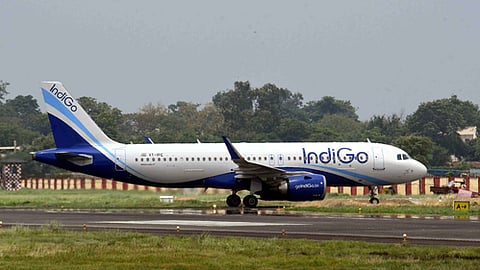
IndiGo, India’s largest airline by market share, has faced a wave of flight cancellations and delays over the past two days, disrupting air travel across the country and stranding thousands of passengers.
The airline, which operates more than 2,200 domestic and international flights daily, said its network has been severely affected by a combination of operational challenges and warned that disruptions are expected to continue for at least another 48 hours as it attempts to stabilise services.
The scale of the disruption became evident on Thursday, December 4, when over 170 IndiGo flights were cancelled in a single day. Bengaluru airport alone confirmed 73 cancellations, while at least 68 flights were cancelled from and to Hyderabad. Around 30 cancellations were reported from Delhi.
December 3 was also chaotic with at least 150 flights cancelled and many more delayed across major airports including Delhi, Bengaluru, Mumbai and Hyderabad.
On that day, Delhi recorded 38 cancellations, Bengaluru 42, Mumbai 33 and Hyderabad 19. Across the network, thousands of travellers were left struggling with missed connections, long waits and sudden cancellations.
At the core of the disruption is an acute shortage of flight crew following the implementation of stricter Flight Duty Time Limitations (FDTL) by the Directorate General of Civil Aviation (DGCA). The latest phase of these norms came into force on November 1, following a Delhi High Court mandate and years of complaints from cockpit crew over fatigue.
The revised rules sharply reduce the number of hours a pilot can fly, increase mandatory weekly rest periods to 48 hours, and restrict night landings to only two per week instead of six. They also cap flying time at 8 hours per day, 35 hours per week, 125 hours per month and 1,000 hours per year, with compulsory rest equal to twice the duration of flight duty and a minimum of 10 hours’ rest in any 24-hour window.
These changes have had a direct impact on IndiGo’s ability to crew its dense flight schedule, particularly its large number of overnight and high-frequency services.
According to media reports, several flights could not depart simply because no legally available crew remained to operate them under the new rules. In some cases, entire aircraft rotations had to be cancelled after pilots scheduled earlier became ineligible to fly due to duty-time restrictions.
The airline has acknowledged that the new FDTL norms contributed to the disruption, along with other factors including adverse weather, technology glitches, and airport congestion. “Minor technology glitches, schedule changes linked to the winter season, adverse weather conditions, increased congestion in the aviation system and the implementation of updated crew rostering rules (Flight Duty Time Limitations) had a negative compounding impact on our operations in a way that was not feasible to be anticipated,” an IndiGo spokesperson said in a statement.
Technology failures at key airports further worsened the situation. On Tuesday, airports including Delhi and Pune reported breakdowns in check-in and departure control systems, leading to long queues and cascading delays across multiple IndiGo flights. Given the airline’s tightly interconnected aircraft and crew movements, these early disruptions compounded throughout the day. High winter passenger traffic, fog-related operational stress and congestion at metro airports added further pressure, making recovery difficult.
The Federation of Indian Pilots (FIP) has strongly criticised IndiGo’s staffing strategy, alleging that the airline failed to prepare adequately despite having a two-year window before the full implementation of the new duty and rest norms. The pilots’ body said IndiGo had adopted a prolonged hiring freeze and followed a “lean manpower” strategy across departments, particularly in flight operations.
According to FIP, this directly triggered the chaos by leaving the airline without sufficient buffer crew once the new fatigue rules took effect.
In a letter to the DGCA, FIP urged the regulator not to approve airlines’ seasonal flight schedules unless they have adequate staff to operate services safely under the revised norms. It also asked the DGCA to consider reallocating IndiGo’s slots to other airlines if the carrier continues to fail in maintaining reliable operations due to staffing shortages. The organisation went further to allege that IndiGo maintained a pilot pay freeze through what it described as cartel-like behaviour and entered into non-poaching arrangements, calling these examples of short-sighted planning.
Another pilots’ body, ALPA India, also called on the DGCA to more closely assess the adequacy of pilots with each airline while approving schedules and allocating slots, especially as carriers transition to the Fatigue Risk Management System (FRMS). ALPA India said the recent cancellations have raised serious questions about airline management and regulatory oversight. While noting that the new norms do not inherently require a higher total number of pilots to maintain flight schedules, the body pointed out that many airlines failed to adjust crew rosters at least 15 days in advance, as required.
The rollout of the FDTL norms itself followed years of debate and delay. Although the DGCA issued the revised rules in January 2024, the industry lobbied heavily for postponements. The implementation was eventually phased, with the first phase beginning in July and the second, more stringent phase limiting night landings, taking effect on November 1. Airlines had originally sought more time, citing the need to hire and train additional crew, but the DGCA enforced the norms with only limited relaxations.
IndiGo’s capacity constraints over the past year have added to its difficulty in adapting. The airline’s owned fleet grew by just 24 aircraft over the last year, affected by slow aircraft deliveries and the grounding of more than 40 planes due to Pratt & Whitney engine issues. It supplemented capacity by adding over 20 damp-lease aircraft operated by pilots from leasing companies. However, despite these measures, the airline appears to have struggled to match crew availability to operational demand under the new rest requirements.
IndiGo reportedly did not recruit additional pilots or ramp up training in time, leaving existing crew overstretched with frequent reassignments, longer duty hours and increased “deadheading”, where pilots travel as passengers to operate flights from different stations.
The operational impact has also been reflected in the airline’s performance metrics. Government data showed that IndiGo’s on-time performance plunged to just 35% on one day this week. Its monthly on-time performance fell sharply from 84.1% in October to 67.7% in November. The DGCA reported that a total of 1,232 flights were cancelled across November alone, highlighting the mounting strain on airline operations after the new norms took effect.
While the new rules apply equally to all airlines, the disruption has been most visible at IndiGo due to the sheer scale of its operations. The airline runs the bulk of India’s domestic flights and has an extensive night-time network. With a tight crew utilisation model that seeks to maximise flying hours and minimise downtime, the tightening of duty limits quickly created gaps across its rosters. In contrast, carriers with smaller networks and fewer overnight services were able to adjust more easily.
IndiGo has said it is working to normalise operations over the next 48 hours through calibrated adjustments to its schedules and crew deployments. Passengers have been advised to monitor flight status closely and prepare for continued delays as the airline attempts to restore stability.
