
Subscribe
Follow TNM's WhatsApp channel for news updates and story links.
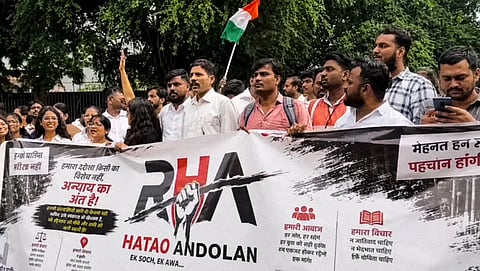
After the recent student movement led by the Cockroach Janata Party (CJP) over failures in the examination system, Delhi’s Jantar Mantar has housed another andolan: the Reservation Hatao Andolan. An online campaign that reportedly crossed 5.6 million Instagram followers has brought anti-reservation frustration into public view. Some protesters have said they are not against reservation as such, but believe eligibility should be determined by people’s financial condition. The movement, however, has broadly campaigned for the removal of caste-based reservations.
The demand raises a familiar question: who should get a scarce opportunity? But the more important question here is why opportunities have become scarce enough for their allocation to generate such intense group competition.
India’s reservation debate is partly a debate about scarcity. When limited jobs, educational seats, and public resources are allocated through socially salient categories, competition can acquire a zero-sum character in which one group’s gain is perceived as another’s loss. The answer is neither to dismiss redistribution nor to assume that growth will resolve the problem. It is to address historical discrimination while expanding the institutions and opportunities over which citizens compete.
More students, limited mobility
India’s higher education has expanded considerably. Total enrolment rose from 3.42 crore in 2014-15 to 4.46 crore in 2022-23, while the gross enrolment ratio for 18-23-year-olds rose from 23.7% in 2014-15 to 30% in 2023-24. SC enrolment increased by about 50% and ST enrolment by about 75% between 2014-15 and 2022-23.
But more students do not automatically mean more pathways to secure employment. A degree from a well-resourced institution with strong faculty, networks, and placement opportunities is not equivalent to a degree from a poorly equipped college.
The labour market reflects this gap. The 2025 PLFS puts unemployment among 15-29-year-olds at 9.9%, rising to 13.6% in urban areas. Only 23.6% of workers were in regular wage or salaried employment, while 56.2% were self-employed.
These numbers tell a more specific story than a simple job shortage. They show something more specific: education is expanding faster than access to the secure and desirable employment that many young people expect education to provide. That makes the allocation of existing opportunities politically consequential.
Reservation operates inside that scarcity
Reservation is an allocation mechanism that determines access to a limited number of positions, but it does not determine how many secure jobs the economy creates. This distinction does not make concerns about reservation illegitimate. Questions about implementation, targeting, and the distribution of benefits within categories deserve policy scrutiny. But neither can reservation be treated as the explanation for wider scarcity.
There is another reason the issue cannot be reduced to income or competition alone. Caste can shape opportunity before a person reaches an examination or recruitment process, through unequal schooling, professional networks, housing, credit, and discrimination.
Indian field experiments illustrate this. Zahra Siddique’s 2011 study found that lowered-caste applicants needed to send about 20% more applications than ‘high’-caste applicants to receive the same number of callbacks. A 2009 Delhi field experiment by Banerjee, Bertrand, Datta, and Mullainathan found no caste penalty in software recruitment, but significant disadvantages for OBC (Other Backward Classes) and, to a lesser extent, SC (Scheduled Caste) applicants in call-centre hiring. The variation across sectors matters, but so does the evidence that caste can affect access independently of formal qualifications.
The 10% Economically Weaker Section (EWS) reservation introduced through the 103rd Constitutional Amendment shows that economic disadvantage can also be recognised through affirmative action. But income and caste do not necessarily capture the same mechanisms of disadvantage.
The competition begins long before an entrance exam or interview, and people do not enter the race from the same starting point. Therefore, scarcity and social hierarchy interact rather than operate separately.
From scarcity to group politics
This interaction helps explain how distributive frustration becomes political. People who encounter limited seats or jobs compare their prospects with those of others, and existing identities provide ready-made categories through which that comparison can be understood. Political organisations and digital campaigns can then turn individual frustration into collective mobilisation.
This is where politics can become zero-sum: the issue is framed less as how to create more opportunities and more as who should receive the opportunities that already exist.
But scarcity itself is not entirely fixed. The number and quality of public universities depend partly on public investment and governance, while employment depends on industrial investment, infrastructure, and skills. Childcare and transport affect whether women can take and retain paid work. State capacity determines whether spending becomes a functioning school, hospital, college, or transport system.
Yet “make the pie bigger” is not, by itself, an easy answer either. Expansion of opportunities is constrained by fiscal resources, administrative capacity, federalism, private investment, and political capture. It can also create new forms of competition.
The point is therefore not that expansion will eliminate conflict. It can change the object of conflict from fighting over a fixed number of positions to competing over how institutions can create more and better ones.
Why allocation is easier politics
A welfare transfer has an identifiable beneficiary, and transfers reach households directly. A new medical college can be inaugurated and claimed politically. But better faculty recruitment, stronger accreditation, or improved apprenticeship systems take years to produce visible results.
This does not make transfers or reservations inherently undesirable. Immediate income support can be essential, particularly for economically vulnerable households. But long-term institution-building has a weaker electoral payoff.
India’s higher-education policy increasingly recognises this problem. PM-USHA, for instance, focuses not only on expanding access but on strengthening state universities and colleges through funding for infrastructure, governance, research, and quality improvement. The significance is precisely that enrolment expansion without institutional quality can leave the next bottleneck untouched.
Expanding the opportunity set
The practical response is not growth instead of redistribution, India needs both redistribution and institutional expansion.
Higher education needs stronger faculty, infrastructure, governance, and academic autonomy, not merely more seats. Apprenticeships need stronger links between colleges, employers, and actual employment. Childcare and public transport should be treated partly as employment infrastructure, particularly for women. And state governments need enough fiscal and administrative capacity to sustain public investment while maintaining immediate social protection.
The Economic Survey estimates unconditional cash transfers across states at approximately Rs 1.7 lakh crore in 2025-26. Such transfers can provide important immediate support, but the fiscal question is how to maintain that support without allowing investment in schools, hospitals, transport, and productive infrastructure to become the residual priority.
This is close to Amartya Sen’s basic insight: the objective is not simply to distribute resources, but to expand what people are actually able to do and become.
A different politics of scarcity
The Reservation Hatao Andolan does not prove that reservation caused India’s employment problem. Nor do unemployment figures prove that scarcity alone produced anti-reservation mobilisation.
What the episode makes visible is the political pressure created when more people seek upward mobility while access to the most desirable institutions and jobs remains constrained and socially unequal.
That is why the reservation debate cannot be reduced to “merit versus quota”, just as it cannot be resolved by saying “create more jobs”.
The task is simultaneous: address historical discrimination, improve the functioning of affirmative-action institutions, expand the quality of higher education, connect education to productive employment, reduce barriers such as inadequate childcare and transport, and strengthen the state’s capacity to deliver public goods.
Democratic politics will continue to produce disagreement over who gets what. The more consequential choice is whether that disagreement remains a permanent contest over a limited stock of opportunities.
The alternative is not politics without conflict. It is politics that treats scarcity as an institutional problem that needs to be reduced rather than as a permanent reason for one group to see another’s gain as its loss.
Kanchi Dileep is an independent researcher, and an alumnus of the University of Hyderabad and Pondicherry University.
Views expressed are the author's own.
