
By Jon Gambrell, David Rising And Samy Magdy
Iran and Iranian-backed militias fired missiles at Israel and Arab states, apparently hitting the U.S. Embassy compound in Kuwait, while Israel and the United States pounded targets in Iran as the war expanded on Monday with statements of defiance and increasing casualties.
Fire and smoke rose from inside the embassy compound in Kuwait City and an alarm wailed after the Iranian attack, which came not long after the U.S. issued a warning to Americans there to take cover and for others to stay away. There were no immediate reports on damage or casualties.
Meantime, as the American and Israeli airstrikes continued, top Iranian security official Ali Larijani vowed on X that “we will not negotiate with the United States.”
In Iraq, a pro-Iranian militia claimed responsibility for a drone attack targeting U.S. troops at the Baghdad airport, the day after it said it fired at a U.S. base in the city of Irbil in the north, and Cyprus said a drone attack targeted a British base on the Mediterranean island nation.
Israel and the U.S. bombed Iranian missile sites and targeted its navy, claiming to have destroyed its headquarters and multiple warships.
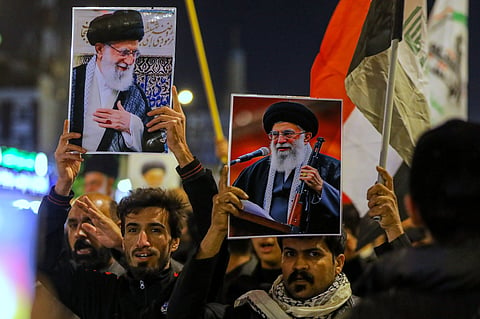
As the attacks on Iran continued, Hezbollah said it fired missiles from Lebanon into Israel early Monday in response to the killing of Iranian Supreme Leader Ali Khamenei and “repeated Israeli aggressions.” There were no reports of injuries or damage, and Israel said that it had intercepted one projectile while several fell in open areas.
Israel retaliated with strikes on Lebanon, killing at least 31 people and wounding 149 others, according to Lebanon's Health Ministry. About two thirds of the dead were in the country's south.
Lebanon’s government said it was holding an emergency meeting after Hezbollah’s attack on Israel triggered the Israeli airstrikes.
Iran has been firing missiles at Israel and Arab states in a counteroffensive since the joint America-Israeli attack Saturday that killed Khamenei and many top Iranian officials.
Gulf Arab states have warned that they could retaliate against Iran after strikes that hit key sites and killed at least five civilians, and U.S. President Donald Trump promised Washington would “avenge” the deaths of three American troops who were killed in Kuwait, while predicting more casualties.
“Sadly, there will likely be more before it ends,” Trump said. “That’s the way it is.”
Trump has urged Iranians to “take over” their government and, while he has also signaled he would be open to dialogue with new leadership there following the death of Khamenei, suggested Sunday there was no end in sight to the military operations.
“Combat operations continue at this time in full-force, and they will continue until all of our objectives are achieved,” he said in a video message. “We have very strong objectives,” he added, without elaborating.
The U.S. military said B-2 stealth bombers struck Iran’s ballistic missile facilities with 2,000-pound bombs. Trump said on social media that nine Iranian warships had been sunk and that the Iranian navy’s headquarters had been “largely destroyed.”
Others have mostly stayed out of the war and pressed for diplomacy. But in an indication that the conflict could draw in other nations, Britain, France and Germany said Sunday they were ready to work with the U.S. to help stop Iran’s attacks.
Early Monday, Cyprus said an uncrewed drone “caused limited damage” when it hit a British air base on the southern coast. Further details were not immediately available, but it came after British Prime Minister Keir Starmer said the U.K. would help the U.S. in the war against Iran.
The weekend attacks were the second time in eight months that the U.S. and Israel had combined against Iran, in a startling show of military might for an American president elected on an “America First” platform and pledged to keep out of “forever wars.”
In the 12-day war last June, Israeli and American strikes greatly weakened Iran’s air defenses, military leadership and nuclear program. But the killing of Khamenei, who ruled Iran for more than three decades, creates a leadership vacuum, increasing the risk of regional instability.
Hezbollah’s launch of missiles at Israel was the first time in more than a year that the militant group has claimed an attack.
Iran’s proxies were a chief concern for American and Israeli officials before they suspended negotiations with Iran last week and moved ahead with strikes on Iran.
Israel said the Lebanese militant Hezbollah group had “joined the campaign” alongside Iran as it retaliated with strikes on Beirut, Lebanon's capital.
Associated Press journalists in Beirut were jolted awake by a series of loud explosions that shook buildings and caused windows to shatter. Warplanes could be heard flying low overhead.
“The strikes continue,” said Maj. Gen. Rafi Milo, head of Israel’s Northern Command. “Their intensity will increase.”
The Iraqi Shiite militia Saraya Awliya al-Dam claimed a drone attack Monday targeting U.S. troops at the airport in the Iraqi capital, Baghdad, further widening the retaliation over the killing of Khamenei. It had claimed a drone attack on Sunday against a U.S. air base in Irbil, in Iraq’s north.
The group is one of a number of Shiite militias operating in Iraq. The U.S. and Iraq did not immediately comment on the claims.
In the Persian Gulf, Iran’s retaliatory strikes pushed the conflict into cities that have long marketed themselves as regional safe havens. Three people were reported killed in the United Arab Emirates and one each in Kuwait and Bahrain.
In the United Arab Emirates, authorities said most Iranian missiles and drones were intercepted. But some either got through or fell as debris, causing the deaths and significant damage. Bahrain and Kuwait said Iranian strikes in both countries hit civilian targets outside the U.S. bases where Iran had pledged to retaliate.
In Iran, more than 200 people have been killed since the start of the strikes, according to officials.
Tehran’s streets are largely deserted as people have been sheltering during airstrikes, witnesses told The Associated Press, speaking anonymously for fear of retribution. The paramilitary Basij, which has played a central role in crushing protests, set up checkpoints across the city, they said.
In Israel, rescue services have confirmed several locations have been hit by Iranian missiles, including Jerusalem and a synagogue in Beit Shemesh, where nine people were killed and 28 wounded, bringing the overall death toll in the country to 11.
The World Health Organization called Monday for sparing civilians and healthcare facilities in the Middle East amid the escalating conflict.
“The protection of civilians and health care must be absolute,” Hanan Balkhy, regional dietitian at WHO wrote on social media. “All parties must … ensure medical facilities remain protected.”
