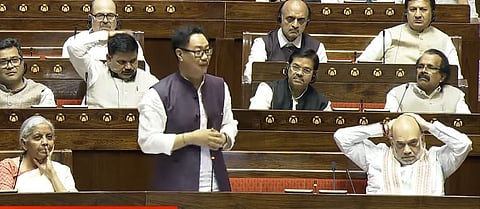

The Waqf Amendment Bill was passed in the Rajya Sabha in the early hours of April 4 with 128 in favour and 95 against it. The debate lasted close to 12 hours with the Bill being passed only at 3 am.
The contentious Bill has been passed despite Muslim objections and Opposition protests that it violates minority and state rights. It has also been pointed out that the Bill allows for the appointment of non-Muslims to the Central Waqf Council and to the Waqf Board, infringing on the religious freedom of Muslims.
However, Union Minority Affairs Minister Kiren Rijiju claimed during the debate that not more than four out of the 22 members of the Central Waqf Council can be non-Muslims and that out of the 11 members of the Waqf Board, only three can be non-Muslim. He further claimed that “Waqf bodies are statutory bodies and not religious bodies like the Hindu endowment boards. A statutory body should be secular.”
The Bill has been met with strident opposition from INDIA bloc MPs both in the Lok Sabha and in the Rajya Sabha. Leader of Opposition (LoP) in the Rajya Sabha and Congress president Mallikarajun Kharge slammed the Bill calling it divisive. Earlier in the day, Lok Sabha LoP and Raebareli MP Rahul Gandhi described the Bill “as a weapon aimed at marginalising Muslims and usurping their personal laws and property rights.”
From Tamil Nadu, both the Dravida Munnetra Kazhagam (DMK) and the All Indian Anna Dravida Munnetra Kazhagam (AIADMK) voted against the Bill. Vaiko’s Marumalarchi Dravida Munnetra Kazhagam (MDMK) also dissented against the Bill.
Notably, the AIADMK’s dissent comes amid speculations of an alliance revival with the Bharatiya Janata Party (BJP). The BJP’s ally, the Pattali Makal Katchi (PMK) abstained from voting.
It is also to be recalled that the DMK announced on March 3 that it would challenge the Bill in the Supreme Court. Earlier on March 27, the Tamil Nadu Assembly also passed a resolution against the Bill with the support of all parties excluding the BJP.
Meanwhile, on March 4 in the Rajya Sabha, other non-INDIA Bloc parties to dissent in the were the Biju Janata Dal (BJD), Bharat Rashtra Samithi (BRS) and YSR Congress Party (YSRCP). Both the BJD and YSRCP did not, however, issue whips to their MPs ahead of the debates, leaving it to their “conscience” instead.