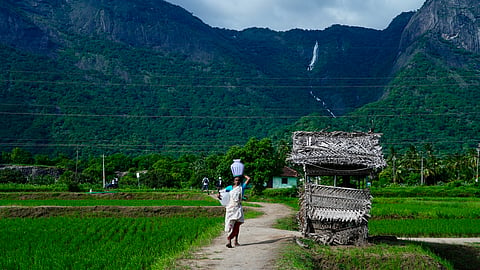

In the quiet agrarian landscape of the Krishnagiri district in Tamil Nadu, a body of water known to locals as Vanamma (literally translated as “the goddess of the forest”) is fighting a silent war against its own digital fame. Located near a roughly 120-acre forest, Vanamma lake has, for generations, been the economic, cultural, and environmental heartbeat of its surrounding village. However, as resident and birdwatcher Gopakumar Menon, who has documented the area’s decline first-hand, warns, the very beauty that sustained this community is now being buried under a mountain of non-biodegradable urban refuse.
The story of Vanamma Lake is no longer an isolated incident. It is the opening chapter of a national, and increasingly global crisis, where trend tourism is outstripping the capacity of rural infrastructure to survive it. From the backwaters to the mountain passes, the unregulated influence of social media is reshaping the geography of tourism, often at the cost of the very ‘hidden gems’ it claims to celebrate.
For the local community, Vanamma Lake is not a ‘weekend getaway’ but a primary economic asset. “The lake is vital for the local community, especially during the summer season, as it provides water for their cattle and other livestock. Therefore, it plays an essential role in the community's economy,” explains Gopakumar. Beyond this economic role, the lake also holds cultural significance, with a sacred connection to a nearby temple. During the hot months, when other water sources fail, this perennial water body remains the sole provider for the region’s sheep and cattle.
Environmentally, the lake is a jewel of Krishnagiri district. It serves as a crucial habitat for migratory birds that visit south India during the winter months. Various migratory and resident wetland birds inhabit the area, adding to its ecological significance. Yet this delicate equilibrium was shattered approximately three years ago.

The transformation began with a single post. Someone seeking to share the lake’s aesthetic beauty uploaded images and reels to Instagram. The post caught the attention of distinct demographics: families from the urban hubs of Bengaluru and Hosur looking for overnight picnic spots, and groups of motorbike riders seeking the thrill of the ride. “Unfortunately, many of these visitors camp at the site and leave behind a significant amount of litter, including plastic waste, which is non-biodegradable and detrimental to the bird life in the area,” Gopakumar notes.
The environmental stakes are high, as many of these species are protected under the Wildlife Protection Act. Observations at the site revealed a disturbing trend. “We have also observed birds consuming items left behind in the dumped waste,” Gopakumar says. Even the local elephant population, which occasionally frequents the lake to drink, must now navigate a landscape marred by discarded snack wrappers and plastic bottles.
The Forest Department finds itself in a difficult position. Because the lake is surrounded by a village and is essential for local livestock, it is impractical to restrict access entirely. Unlike a closed sanctuary, Vanamma Lake is a shared space, and that openness is now being exploited by reckless tourism.
The plight of Vanamma echoes similar patterns across the country, where destinations that accidentally went viral on social media have struggled to cope with sudden attention. In village after village, local lives and biodiversity have been strained by tourism growth that arrives without warning, planning, or consent.
In 2018, a crisis unfolded in the village of Malarikkal in Kerala’s Kottayam district. Once a local attraction, Malarikkal’s water lily fields became a tourism hotspot virtually overnight after appearing in Instagram reels. Thiruvarppu panchayat’s former president, Aneesh, recalls the aftermath. “There were days when thousands of people came here to see the pink water lily flowers, which created a dilemma for the locals. The road to Kottayam town was choked with traffic, leaving both residents and tourists stuck. Locals struggled to go about their daily lives, just as visitors faced long delays,” he says.
Malarikkal was caught completely unprepared. “At the time, there were no proper parking facilities, waste management systems, or sanitary infrastructure,” Aneesh explains. Visitors often trampled the crops that the community relied upon, leaving packaging waste scattered across the fields.
The speed of social media was again evident in 2023 in Kollengode, in Palakkad district. After being featured by the Instagram page Colours of India, which ranked it third among India’s 100 most beautiful villages, the area was quickly overwhelmed. The surge brought familiar problems: trampled fields, plastic waste accumulation, and a profound disruption of rural life. The privacy of local communities was compromised as visitors explored the area without understanding agricultural boundaries or cycles, or the consequences of careless engagement.
The environmental toll is particularly visible in Kerala’s Wayanad district. In 2018, a wildfire at Elambileri Peak, allegedly caused by tourists, led to a year-long ban on access to the popular Chembra Peak and resulted in significant ecological damage. This incident also disrupted the livelihoods of Meppadi residents who depend on tourism. At Kuruvadweep, a protected river island in Wayanad, tourists frequently stray from designated paths, disturbing wildlife and damaging plant life. These behaviours have increased human-animal conflicts and created safety risks.
The human cost of unregulated exploration reached a devastating peak in the Kurangani hills near Bodinayakkanur in Tamil Nadu. A forest fire there killed 23 people who had gone for a hike, sending shockwaves through the trekking community. Locals say the accident was caused by hikers who took a detour without informing the forest department. Their carelessness, combined with a lack of professional guidance, proved fatal.
In Ernakulam district, Oonjapara, a small water canal, gained popularity as a swimming spot through social media reels. As visitors flocked to the canal, its limited capacity was ignored. Water contamination increased, and local supplies meant for domestic use were depleted, forcing residents to restrict access to the area. In such cases, viral tourist spots pose serious safety risks not just to local communities, but to visitors themselves.
In the world of social media algorithms, a significant regulatory gap exists between traditional media and influencer-driven content. While formal video productions require permits and impact assessments, influencer content remains largely unregulated. Tourism officials acknowledge these issues, but responses remain reactive. Measures are typically introduced only after damage occurs — trail closures following fires, or fines after community complaints.
Many content creators attempt to mitigate their impact by adding “travel responsibly” disclaimers to captions, but such messages rarely translate into responsible behaviour. There is a fundamental disconnect between digital advice and human convenience. For a family seeking a weekend escape, or a group of riders on a long haul, the effort required to carry waste back to a city, often kilometres away, frequently loses out to the convenience of leaving it behind. Without visible authority, designated disposal zones, or enforceable penalties, a “hidden gem” becomes a lawless space.
The core of the crisis lies in the lack of any mechanism to control the speed of virality. By the time a local panchayat realises a video has trended, ecological damage is often already done, leaving rural infrastructure struggling to play a losing game of catch-up against the infinite reach of an algorithm.
Despite these challenges, communities are showing resilience. Malarikkal eventually adapted by rebuilding the local bridge with greater capacity, introducing parking on residential properties, and implementing the Haritha Karma Sena’s waste management system. In Kollengode, local authorities have shifted towards a regulated agro-tourism model to balance tourism with ecological preservation.
Following directives from the district administration, visitors are now allowed to enter fields in a controlled manner, with a nominal entry fee. This shift was pioneered by local farmer Zakir Hussain through his 'Kudilidam' farm retreat, which uses traditional huts to manage footfall. The model has revitalised local biodiversity. While farming was once limited to standard ‘Uma’ and ‘Jyoti’ varieties, the fields now flourish with rare crops such as Maharashtra’s violet-leaved ‘Nasarbath’ and the medicinal ‘Karuppu Kavuni.’
In Krishnagiri, a group of concerned residents, including Gopakumar Menon, believe the situation is still manageable if addressed now. They are calling on the district collector and the tahsildar to work with the local panchayat to implement strict regulations. “Visitors should not be allowed to drive their cars close to the lake. Instead, cars should be stopped about 1 km away,” Gopakumar proposes. He also suggests providing bins for waste collection, enforcing rules against plastic, and installing signboards to raise awareness about the lake's importance. A small visitor fee could help cover costs, while residents would be exempt.
The phenomenon extends beyond India. Residents near Bannau Brycheiniog National Park in Wales have struggled with viral tourism at ‘Waterfall Country’ after a New York Times recommendation. A 2022 survey by Booking.com found that 64% of respondents would avoid crowded tourist sites to reduce congestion, ironically fuelling the search for ‘undiscovered' locations.
According to industry forecasts reported by the National Geographic Channel, tourism is expected to account for 11.6% of the global economy by 2033, with increasing numbers of travellers seeking sustainable experiences. The most effective responses combine environmental protection, community involvement, and sustainable economic frameworks. Practical solutions include visitor management systems that limit numbers based on infrastructure capacity, rapid deployment of waste disposal facilities, and clear signage to minimise environmental damage. Protecting private spaces and indigenous communities from trespass is essential, as are revenue mechanisms that ensure benefits flow back to affected communities.
At the end of the day, these rural places were not meant to be tourist destinations. They were shaped around the lives and livelihoods of local people who have lived there for generations. If appropriate steps are taken early, as many south Indian villages have demonstrated, these locations can adapt without losing what makes them special. The challenge remains as social media continues to expose new ‘hidden gems’ every day: can systems be built to protect communities before they are overwhelmed? The delicate balance between discovery and preservation depends on whether governance can move as quickly as virality itself.
Arya AT is a passionate writer and translator. A pessimist by intellect, yet an optimist by will, she clings to words as both refuge and rebellion.
Views expressed are the author’s own.