
Subscribe
A group of civil aspirants has raised concerns regarding significant irregularities in the Civil Services (Preliminary) Examination, 2026, conducted by the Union Public Service Commission (UPSC).
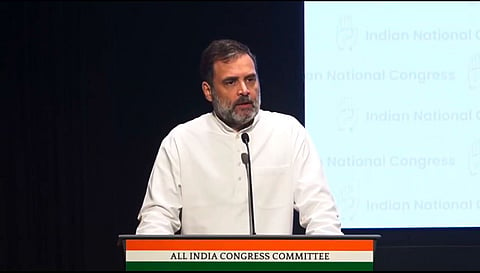
In a representation submitted to Leader of Opposition Rahul Gandhi, they state that the General Studies Paper I had "ambiguous, non-conclusive answers, leading to ambiguity in 14 questions, along with wrong answers in the provisional answer key." They further state that the GS Paper II, i.e., CSAT, had "wrong interpretations in 12 questions (10 Reading Comprehensions + 2 Mathematics), thereby compromising the objective nature of the examination."
Aspirants have cited the subjectivity of several answers, as well as the mistakes in the UPSC’s provisional answer key, which they say reveals a lack of institutional diligence and accountability.
An aspirant from the UPSC accountability forum said, “There are candidates for whom this was the last attempt this year. Because of these errors in the question paper, their last attempt has been ruined. So, we are demanding one compensatory attempt for such candidates.”
He also added that since the Leader of Opposition makes videos highlighting the grievances of people, his echoing concerns of UPSC aspirants would help the cause.
“Recently, I saw a video about some tribal students in Maharashtra. So, in the same way, we want a video about our issue to be made so that our concerns can reach a broader audience,” he explained.
In their representation, the aspirants point out that the Preliminary Examination being an objective stage of the selection process, answers must be definite and conclusive. “However, in the 2026 examination, there was a high level of subjectivity. For example, questions related to ethics involved significant subjectivity, leading to non-conclusive arguments in a high-pressure examination environment," the representation notes.
Aspirants have also raised concerns about the arbitrary nature of the questions, stating that "the design of the questions was largely luck-based, thereby compromising the merit-based selection system."
They have further pointed out that "the CSAT paper has evolved in a manner that is contrary to the findings and recommendations of the Parliamentary Standing Committee under MP Brij Lal, leading to the gradual exclusion of meritorious humanities candidates."
The representation also notes that this is the first time UPSC has released a provisional answer key, but "the provisional key itself contained issues, including a dropped question, indicating a lack of due diligence and institutional accountability." It further points to a "consistent pattern in UPSC's conduct of examinations, whereby even in the UPSC CAPF Examination, UPSC had to drop a question in the provisional answer key, reflecting recurring deficiencies in the answer key preparation process."
Among the key reliefs sought, the aspirants have requested that affected candidates be permitted to appear in the Civil Services Main Examination, "considering the large number of disputed answers in the provisional answer key, in line with the relief granted by the Hon'ble Court in Jaymin Mukeshbhai Patel v UPSC."
The 2025 judgment in Jaymin Mukeshbhai Patel v UPSC concerned the UPSC’s examination process and alleged errors in the answer key. The Supreme Court had held that where there was a prima facie/manifest error in the answer key, and the candidate would otherwise be left without an effective remedy, interim relief may be granted to allow the candidate to continue in the examination process, without creating any vested right to appointment.
The representation sent to Rahul Gandhi further demands the publication of the final answer key before the Mains Examination, provision of carbon copies of OMR answer sheets to candidates, and the abolition of the optional subject system or the publication of the scaling methodology used for evaluating optional papers.
It also calls for "strict alignment of the CSAT paper with the notified syllabus, i.e., up to the Class 10 level, in line with the recommendations of the Brij Lal Committee on examination reforms."
They have also sought compensatory attempts for candidates who have exhausted their final permissible attempt in 2026, arguing that the "substantial deviation from the established pattern and standards deprived them of a fair and reasonable opportunity to perform."
The aspirants have further urged the publication of annual RTI data regarding the number of candidates qualifying the CSAT paper and for proper weightage for questions from the notified syllabus. The representation notes that "significant deviations such as the substantial reduction in the number of questions from Indian Polity and Indian Economy in the 2026 Preliminary Examination should not be made without prior notification to candidates."
