
Amarjyoti Borah | The News Minute | January 11, 2014 | 6.22 pm IST
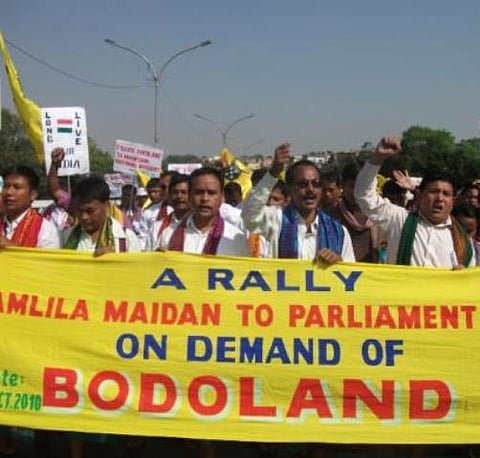
The recent massacre of over 70 people within the Bodoland Territorial Autonomous District (BTAD) area and the nearby areas in Assam has once again raised the debate about a permanent and peaceful solution in the region.
The massacre took place towards the end of December last year, and militants of the outfit NDFB (S) targeted civilians living within the BTAD area and the Sonitpur district. After the massacre, Union home minister Rajnath Singh, and Minister of state for home affairs, Kieren Rijiju held parleys with Assam chief minister Tarun Gogoi and the decision was taken to send central forces to hunt down the militants, and operation ‘All Out’ was launched.
The BTAD covers 4 districts—Kokrajhar, Baksa, Udalguri and Chirang in Assam, and is ruled by an autonomous council, Bodoland Territorial Council (BTC) formed under the provisions of the 6 th schedule of the Indian constitution. It was formed on February 10, 2003 after the Assam government, the Union government and the Bodo Liberation Tigers (BLT), a Bodo militant outfit, signed the Memorandum of Settlement (MoS) on BTC.
However the much hyped MoS failed to deliver and bring lasting peace in the state, and violence failed to cease in the state. According to a compilation by the South Asia Terrorism Portal (SATP), since the formation there has been over 200 reported instances of violence in the areas within the BTAD since its formation.
Experts have pointed out that the major reason is that the Bodos are not in a clear majority and the non-Bodos have got together to oppose what they see as Bodo majoritarianism, and that has sharpened the conflict.
“Also the Bodos lack unity and far too many fratricidal killings have taken place. The usual factional contest to take control of BTAD has impeded a proper functioning of the autonomy arrangement -- and corruption and nepotism have played their part,” said Subir Bhaumik, veteran journalist and author, who is also an expert on insurgency issues in the region.
On being asked what could bring a permanent solution to the whole problem, Bhaumik said that fair representation of all communities in the BTAD holds the key to peace in the area.
“Besides this attacks on non-Bodos must stop, and the BTAD should not be projected as a Bodo institution -- but as one that will represent all communities living there,” said Bhaumik.
The BTAD has always been projected as a Bodo achievement as a result of their struggle .
Social groups have said that while it is true the Bodo movement was the driver for the autonomy package Delhi gave, the interests of other communities have to be protected.
“There are several communities living within the BTAD area, and it is important to be seen that their rights are not deprived,” said Pankaj Gogoi, of the social activist group Destination North East.
“The sooner all stakeholders understand this, the better. Or else there would be no solution despite accords,” said Bhaumik.
Accord after Accord
The Bodo accord signed in 2003 is not the only accord signed with the hope for peace. The first Bodo accord was signed way back in February 1993 that led to the formation of a Bodo Autonomous Council (BAC).
However the accord triggered violence and finally had to be scrapped.
A clause in the accord stipulated that villages with a 50 per cent Bodo population would come under the jurisdiction of the Council, and this flawed clause triggered a series of attacks on the non-Bodos particularly in the areas, within the proposed Bodo homeland, where the community did not have absolute majority.
“The motive was apparently to change the demographic pattern of those villages where Bodos were in minority,” said senior journalist Samir K Purkayastha, who has reported extensively on the issue.
The first such attack by Bodo militants was carried out against the Muslim settlers in October 1993 in Bongaigaon district. This was followed b killing of eight Hindu Bengalis in Darrang district in October 1995 and another eight people, mostly Nepalis, a few days later in Nalbari district. Then they turned their guns towards the Adivasi settlers. In the Bodo-Adivasi clashes in 1996 and 1998, 198 people were killed and 2, 02,684 were displaced triggering the worst ever humanitarian crisis in the state.
Another reason behind the failure in the first Bodo accord was because the then Assam chief minister, late Hiteshwar Saikia was not happy with the top role played by the then Union minister Rajesh Pilot.
“Saikia also torpedoed the accord implementation by raising the issue that a majority of villages in proposed BTAD did not have Bodo majority,” said Bhaumik.
According to Social scientists the whole conflict is centric over land rights, and questions have now also been raised on the government's existing peace policy wherein it provides amnesty, lucrative financial package and political legitimacy to the militants once they smoke peace pipe after unleashing trail of violence to prove their supremacy or importance.
"Control over land is at the core of violence in Bodoland areas," said Guwahati-based social scientist Udayon Mishra.
Besides this, peace agreements rather than solving the problem are actually leading to proliferation of militancy and competitive radicalism in the state.
“Once the government concedes some concession to a group, another group soon comes up raising the stake and repeat the same cycle of violence until government takes note of them and initiate peace talks," said Purkayastha
Citing an example of the issue, he said that after the BLT was disbanded following the Bodo accord of 2003, the NDFB, another Bodi militant outfit entered into a ceasefire agreement with the government. After the ceasefire, a faction of the NDFB broke-away into a new faction called the NDFB (Songbijit).
Interestingly, Songbijit, who is claiming to champion the Bodo case is nt even a Bodo, and is a member of the Karbi community.
“The NDFB (S)'s primary objective is to create fear so that people easily comply to its extortion demands,” said Assam Director General of Police (DGP) Khagen Sarma.
Civil society groups have also pointed out that the government needs a rethink on its strategies in dealing with militant outfits.
"Clearly, government needs to redraw its strategy in dealing with militancy in the Northeast India's most populous and important state and just cannot pander to the demands of any particular group or community without safeguarding the interest of others," said Sahajan Talukdar, a leading voice of the minorities in the state.
Disclaimer: The opinions expressed in this articles are the personal opinions of the author. The News Minute is not responsible for the accuracy, completeness, suitability or validity of any information in this article. The information, facts or opinions appearing in this article do not reflect the views of The News Minute and The News Minute does not assume any liability on the same.