
Subscribe
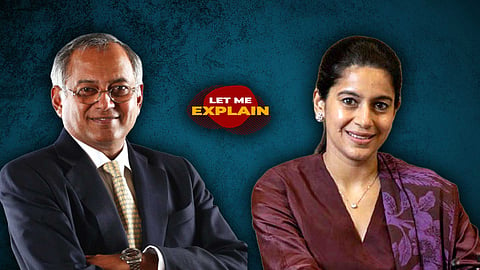
The dispute within the TVS family over the distribution of its assets among the next generation took a legal turn on Monday, with Dr Lakshmi Venu sending a notice to her father and TVS Holdings Chairman Venu Srinivasan.
Through the legal notice, Lakshmi has called for a “fair and lawful partition” of the assets of the Venu Srinivasan branch of the Chennai-based TVS family, and contends that “the concentration of beneficial interest in favour of her (younger) brother,” Sudarshan Venu, was to the exclusion of her own lawful rights.
Lakshmi is the MD of auto parts maker Sundaram-Clayton, with a market cap of over Rs 2,000 crore, while Sudarshan is the chairman and MD of two-wheeler maker TVS Motors, which has a market cap of over Rs 2 lakh crore. Sudarshan is also MD of TVS Holdings, the holding company, which is headed by their father, Venu. Venu’s wife, Mallika Srinivasan, is the chairperson and MD of tractor manufacturer TAFE, where Lakshmi is vice-chair.
In April last year, Venu named his son and current CMD of TVS Motor, Sudarshan, as the Significant Beneficial Owner. This would mean that he would inherit the larger portion of the businesses and assets of TVS Holdings.
Lakshmi contends that no settlement of the assets within her immediate family was ever initiated, and says that she is being wrongfully denied her rightful share of the joint family property. Citing the Hindu Succession Act 1956, which now recognises daughters as equal inheritors of property in an undivided Hindu family, Lakshmi has asked her father to “discharge his fiduciary duties” and effect a fair and lawful partition. She has asked for a fair partition of the family assets which includes Venu Srinivasan's interest in TVS Holdings, TVS Motor Company, TVS Credit Services and Sundaram-Clayton.
“Dr Lakshmi contends that she is being wrongfully denied her rightful share of the joint family property… She regards these actions not only as a breach of law but also as a breach of trust. Patriarchy has no place in law or in a progressive India. The rights of daughters to joint family property, she maintains, cannot be overridden through unilateral decisions or corporate arrangements,” reads Lakshmi’s statement to the press regarding the matter.
Her request for equal inheritance has also been backed by her mother, Mallika Srinivasan, who said a son and daughter are equal and that Lakshmi is entitled to an equal share.
“It is unfortunate that requests for an amicable settlement have not so far progressed in a meaningful and timely way. As a mother, to me, a son and daughter are equal in every respect. I do believe that Lakshmi has a legitimate share of the family assets, not inequal to that of Sudarshan’s. I reiterate that this is a matter to be settled, in the interests of all stakeholders, through transparent dialogue, with equity, clarity and amity. I sincerely hope that we can move forward constructively, with grace and dignity,” Mallika says in the statement.
As the dispute continues, here is an overview of what the law recognises as a Hindu Undivided Family (HUF) and how succession works within it.
Hindu Undivided Family
An HUF is a distinct legal entity comprising people who have all descended from a common ancestor, including their wives and unmarried daughters. It is not necessary for all family members to live under the same roof for an HUF to exist.
The family is managed by the eldest male member, though a senior female member can also assume the role. Such a head is called the Karta. A woman can also become a Karta if she is the eldest surviving child of her father.
Lineal descendants who hold a birthright in the ancestral property and have the right to claim a partition are called Coparceners. Until 2005, only male members of the family were entitled to claim equal inheritance. An Amendment to the Hindu Succession Act in 2005 changed that, empowering women also to be coparceners with a right to claim ancestral property and ask for partition.
The Amendment placed thrust on the position of daughters in an HUF. Though it is not applicable retrospectively, the law has placed safeguards to ensure that a daughter is not denied her rights.
The law says that a daughter cannot reopen a partition that was already legally completed before December 20, 2004, when the Amendment was not in effect. However, to block a daughter's claim, the earlier partition must have been executed through a registered partition deed or a final court decree. Informal or oral family arrangements before that date do not take away her right.
Inheritance
The principal legislation governing the inheritance among members of an HUF is the Hindu Succession Act of 1950. The law makes distinctions between ancestral coparcenary property and an individual's self-acquired or separately owned property.
Under the amended Section 6 of the Act, sons and daughters have equal rights in ancestral coparcenary property. The daughter has the same right as the son to claim partition and receive her legally determined share. She does not lose her rights upon marriage or because she is living separately from the family.
Property purchased or acquired independently by an individual does not automatically become property of the family simply because the person belongs to an HUF.
Partition
A partition, like the one now asked by Venu Srinivasan’s daughter, Lakshmi, refers to the division of joint family property either through a mutual agreement among the members or through court proceedings.
A coparcener can demand a partition, and after the 2005 Amendment to the Hindu Succession Act, a daughter is also eligible to demand a partition. When family members dispute their entitlements or cannot come to terms through a mutual agreement, a civil court can determine their shares and order partition.
Follow TNM's WhatsApp channel for news updates and story links.
