
Subscribe
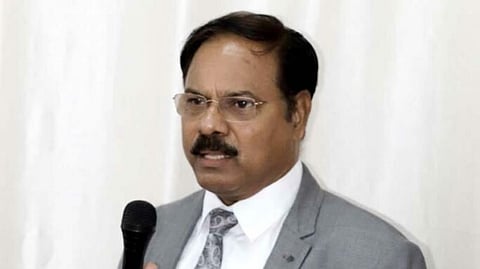
A sitting judge of the Allahabad High Court has sparked controversy by drawing comparisons between two religious communities, claiming that one “instills values of kindness and non-violence in children,” while the other “fosters intolerance by exposing children to animal slaughter”. Justice Shekhar Kumar Yadav made the comments without naming any communities, at an event organised by the legal cell of the Vishva Hindu Parishad (VHP) in Prayagraj on Sunday, December 8.
Introducing himself, Justice Shekhar said that any description of himself would be incomplete without mentioning that he hails from the country where River Ganga flows. “My country is one where the cow, the [Bhagwad] Gita, and the Ganga form the culture, where every idol embodies Harbala Devi, and where every child is like Ram,” he said, equating Hindu religious symbols with the cultural identities of Indians.
“In our country, we are taught not to harm even the smallest animals, not to kill ants — this lesson is ingrained in us. Perhaps that is why we are tolerant and compassionate; we feel pain when others suffer. But you do not have this,” he said, in a thinly-veiled reference to Muslims.
The judge went on to give his reasoning for why there was a difference between the communities. “Here, from childhood, children are guided towards god, taught Vedic mantras, and told about non-violence. But in your culture, from a young age, children are exposed to the slaughter of animals. How can you expect them to be tolerant and compassionate?” he said.
Justice Shekhar insisted that the Uniform Civil Code (UCC) is a necessity, saying that it is “unacceptable for a man to have four wives”, in yet another barely-disguised reference to the Muslim community.
“I have no hesitation in saying that this is Hindustan, this country will function as per the wishes of the bahusankhyak (majority) living in Hindustan. This is the law. You can't say that [I am] saying this despite being a High Court judge. The law works according to the majority. Look at it in the context of family or society … Only what benefits the welfare and happiness of the majority will be accepted,” he said. He added that since India has one Constitution and one set of penal laws, it is logical to unify civil laws.
The judge also spoke about the Ram Mandir in Ayodhya, which was constructed at the site where Babri Masjid stood before it was demolished.
“Did you imagine you would be able to see the Ram Mandir with your own eyes? Many of our ancestors made sacrifices in the hope of seeing Ram Lalla freed and witnessing the construction of a grand temple. They couldn't see it but they did their part, and now, we are witnessing [the temple],” he said.
He further insisted that children should be taught to be Hindu first. “You could be an advocate, a businessman, or a student, but you are a Hindu first. Anyone who says that this land is his mother and he is its child, is a Hindu. Vivekananda also believed that only a Hindu can make this country the world leader and no one else would. Never let this desire die," he said.
