
Subscribe
On September 13 2026, Umar Khalid’s still images filled many of our timelines. It was this day, six years ago, that Dr Umar Khalid was jailed and put in the Tihar prison. Prisoner number 626710 is Present, Lalit Vachani’s film, narrates and narrativises the wrongful and unjust journey in which the bright scholar, also a passionate activist, and a playful, humorous friend to many, was easily deemed an ‘anti-national’.
The film chronicles how, through mainstream media and organised cyber cell-constructed narratives, the struggles of resistance led by students and citizens of this country were vilified. It cautions against the robbing of a dream– a dream of an independent country, built on the principles of equality, liberty and fraternity, enshrined in the Constitution.
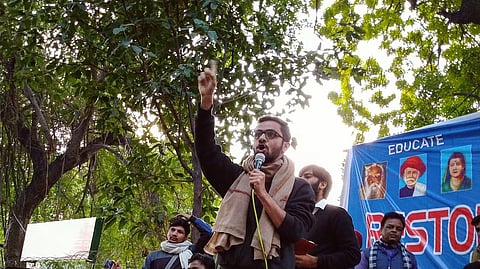
The most alive parts of the film are undoubtedly Umar Khalid addressing various crowds across the country, holding onto every opportunity in the making of a public that is aware, or fundamentally, even in the making of a discerning public as against a mob.
In all of these speeches, not strategically, but passionately, he professes his love for this country and its democratic traditions that stand on the Constitution’s ideals. In fact, Shuddhabrata Sengupta, an artist part of the RAQS Media Collective, writer, the “messy older brother” friend of Umar Khalid (as he describes himself in the film later), points this out: “Umar, when he says, 'If they spread hatred, we will respond with love’, really means it in an empirical sense and not rhetorically.”
Yet, even a screening of the film is banned from public universities and campuses; screenings get cancelled at the very last minute, in the name of strategy, anonymous and informal pressure from the top, and the measured limits of dialogue. The fear is real, and it looms above and around us.
But I wonder if any of the teachers, scholars, or even students who do not want to screen the film to initiate a dialogue, have given it a chance before deciding what it is about or what it can do. In fact, this film would help explain, historicise, and recall what has changed or transformed in the last decade in this country. It can elucidate why self-censorship is increasingly taking on an intellectual status in our academia, as opposed to feeling freely and critiquing pointedly.
‘Political’, ‘agenda’, ‘sloganeering’ are the new cuss words in institutional spaces, that only those who want to screen a film, read a book, or engage with the functionings of their institution have the good fortune of being labelled with.
When a documentary film is being denied a screening or exhibition within an institutional space, what gets erased first is the obvious: the presences in the films that were transferred through the recording device onto memory cards and then onto hard disks and light particles on the screen and sound waves in the hall, far away from where it was shot. For instance, Prisoner number 626710 is Present, shot in New Delhi and assembled from footage of Umar’s speeches from around India and other events, could become alive, present, on a campus in the south of India when screened.
What the prevention of the screening also does is prohibit the formation of a public who is offered the chance to listen to this account, absorb and immerse in the experience of the bodies of the people who live in the film in their interviews, speeches, photographs, silences, pasts, wishful presents, and presences. The irony is that, purposefully or not, you/we are part of a structure that is making Prisoner number 626710 absent.
This is also possible because of the surety that whatever comes, you/we are never going to be imprisoned. And the desire for any human being to not become a prisoner is, of course, fundamental and very strong– it is the desire for freedom. But so is the desire to express and exchange our truths.
In the film, Umar Khalid is shown quoting Rohith Vemula on being reduced to his immediate identity. But in Umar’s own case, by absenting him from our sanctified spaces without any critical thinking being taught or nurtured, and a complete lack of rigour in theorising or analysing, and protecting a ‘public’ we claim to exist, we are not even giving him a chance to be reduced to any kind of person at all!
The absurdity of objectivity in knowledge production or the positionality of a researcher, in respect to the inquiry that he/she/they choose to do, is all reduced to our methodology classes.
Theoreticians and scholars of cinema have written about cinema as a historical method, an archive that hinges on the promise of the indexicality of moving images. Prisoner Number 626710 is Present becomes the historic method, an archive, not by simply bearing witness, documenting or assembling.
Inside a car, Shuddabrata Sengupta talks about an aggressive procession that took place in Delhi, just a few days before the day they were filming that interview in the car, where more than 3000 people marched the streets with tridents, despite having no police permission. Banojyotsna Lahiri, Umar’s dear friend and comrade, recounts the incident when she and Umar were out for a cup of tea, and a man attempted to shoot at Umar with a gun. That remembrance, its value, is what is made absent by not standing up for the attempt to make a film an archive.
We live an everyday life of ironies. From contradictions to ironies, the journey has been smooth. Have our elite academic spaces ever initiated dialogue in the last few years for it to disappear? If political action is the only agent provocateur, are the demonic things that must be left behind from our sanctuaries of learning—demolitions, an oppressive transgender Bill, a genocide, and instances of violence on our own campus against migrant labourers, women, Dalit students, etc.—being adequately addressed?
Have there been academic events, panel discussions, or talks organised to historicise these events, to help us comprehend and analyse them, and to enable dialogue? Have we created spaces that will teach us how to study and analyse societies and social behaviour in the face of such events?
We are not sure whether these university departments will even survive the onslaught of instrumentalised education, customised for new dietary considerations. If there is an unsaid prohibition to even organise an academic event, what do we think we are doing in the classrooms that is so great that it will compensate for this silence? I am very aware that I write this as a research scholar, and that the reality is different for faculty members who are now part of the power structure of the institution.
The sad part is we are very much part of the system, in our imaginary strategies, that defends imaginary freedoms, that makes Prisoner Number 62610 more and more absent from our consciousness. By barring, or by enabling the cancellation of the screening of that film, following institutional pressure or systemic compromise, that film, which is an account of how a research scholar from JNU, with a Muslim identity, gets categorised as anti-national and seditious, we are invisibilising him in a space, discarding his images and sounds away to the waste basket of delusory strategy, from public memory.
And it looks like hands are tied because it even becomes a question for a department or for certain disciplines to continue existing; it is an existential question then. But the irony is, we do not fret about critiquing private universities and their supposed hypocrisies as against a public university’s autonomy. Yes, it makes for good analysis and full marks for examples of capitalism, civil society, etc but let us be honest and sit down and have a conversation on higher education, the crisis of humanities and social sciences, which we act like does not exist, before we make our departments just about organising “programmes”.
Let us also be honest about the mental health crises that plague our public institutions. Most research scholars of these departments, marked by caste, gender, and class, are struggling to breathe in that environment. Let us not make it fodder for study alone, but examine why we are all the more depressed, anxious and hopeless on a campus. Let us at least stop individualising it and stop marking it out to be a matter of idiosyncrasies and sensitivities alone, in staffroom and tea conversations.
Umar Khalid, in a speech in the film, thanks and congratulates the comrades amongst teachers who are part of the struggle for a better tomorrow for this society, for this country. In fact, he was trying to fight the public university from becoming a space which would prevent the screening of a film, never nurture an environment of dialogue, but only nourish fear and fester hatred.
Maybe the non-screening of the film is an event in itself. But will we at least make the non-screening of the film visible and own up to it? As far as to my knowledge, the film has not been banned in this country. Do we now have autonomous republics that will dictate, above the State and the legislature of this country, what can and cannot be shown?
The film, in fact, leaves us flummoxed at the absurd Kafkaesque state of affairs: a young PhD student who professes his love for the country and wants to create a reading list for young Muslim activists who will discover the many heritages and lineages of Islam in this country, rooted in socialist, democratic principles. Umar, who professes his love for the country’s flag, for its songs, for its sport, for its people, for its Constitution, is jailed for being anti-national.
Someone who has never owned a passport is accused of going to Pakistan by the republic's television channels. Are our autonomous, self-censoring republics any better than news anchors who shouted Umar Khalid down for appearing on a TV debate, and tried to reason with them, who also led the targeted campaign, scripting the narrative of him as being seditious, putting words in his mouth that he never even accidentally uttered, just because his name is Umar Khalid? These are things that I could gather from watching the film.
To find out, each of us will have to watch the film, discuss, and debate. But alas, we have made Prisoner Number 626710 absent from our class today. Thankfully, he had already submitted his PhD.
For those who have watched the film, the photos of him presented from the interim bail period, when he came to attend his sister’s wedding, will stay with you: his stance on an open terrace with an inquilab in his fist, him amongst friends and comrades, him eating home-cooked food, will remind us that he is a person who deserves a chance, a full-bodied chance, like you and me, to be present.
The author requested to remain anonymous, fearing backlash. Here is a note from the author to readers:
NB: I hope that this does not hurt anyone’s sentiments and that my speaking or writing will not be met with disciplinary action. Advance apologies for being gullible, emotional, political, and for anyone’s sentiments being hurt. If this is met with punitive action, even further down my educational journey, I hope we all know what to do. I write this because that is how Prisoner Number 626710 is Present, begins. Umar Khalid looks straight into the camera, that is, right into us and says: “If you are watching this, I have already been arrested”.
Views expressed are the author’s own.
