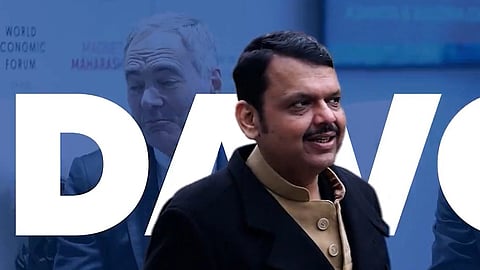

The Davos Enigma: Why did our ministers fly 6,000 km to sign deals with Indian firms?

What's the point of Davos, if our elected representatives seem to be going all the way there only to hobnob and sign deals with other Indians?
The Davos Enigma: Why did our ministers fly 6,000 km to sign deals with Indian firms?
Written by:
Published on

Follow TNM’s WhatsApp channel for news updates and story links.

“What’s the point of Davos” and “Davos is dead / out of touch / irrelevant” are sentiments typically taken out and aired when the World Economic Forum’s (WEF) annual summit of the global elite rolls around each January.  

These arguments are not without merit, starting with how a gathering of the wealthy and powerful in a Swiss ski resort could live up to the WEF’s lofty motto of “committed to improving the world”. In his interaction with the editor of The Economist, JPMorgan Chase CEO Jamie Dimon said as much when he told the gathering of “intellectual elite”, “You didn’t do a particularly good job of making the world a better place.” 

Still, this year, with Donald Trump headlining the event and not holding back on anything, from his determination to appropriate Greenland to tearing into Europe to brandishing his weapon of choice i.e. tariffs, those existential questions about Davos were heard less frequently. 

Back here in India, however, we, the less elite, had to contend with another question, in a similar vein. With India’s current ambitions on the global stage, economic and geopolitical, it is not entirely surprising that the country sent its largest delegation to date to mark our presence at the 2026 edition of WEF. But what’s the point of Davos, if our elected representatives seem to be going all the way there only to hobnob and sign deals with other Indians? 

If one wanted to be particularly generous, you could argue that there is comfort and warmth in seeking out the familiar and perhaps that’s what was playing in the minds of our ministers in the rarified and literally freezing environs of the Swiss town, dubbed the playground of the rich.  But as large-minded as one may want to be, that still does not seem to justify what was playing out, going by the social media feeds of various state government representatives at Davos, from Maharashtra to Karnataka. 

This year, the chief ministers of Andhra Pradesh, Assam, Telangana, Maharashtra, Madhya Pradesh and Jharkhand were all in attendance at Davos, as well as the deputy CM of Karnataka and industries ministers of Karnataka and Kerala, among others. 

Much of their posts on X were peppered with phrases about “productive discussions,” “engaging meetings,” “substantive interaction,” “insightful conversation” and, my favourite, “forward-looking interaction.” 

But the  pointless corporate-speak aside, the bigger source for bemusement was who these meetings were with. Many, it turned out, were with Indian corporations. 

Karnataka’s delegation, which also included Bangalore Development Authority chairman and Shanthinagar MLA NA Haris, met with executives from Tech Mahindra, Ramky Group, Sify Technologies and Jubilant Bhartia Group. Other meetings included those with existing investors, such as Nokia and Schneider Electric. Jharkhand, which was debuting at Davos, announced meetings with Ramky Group, Infosys, Welspun, Tata Steel and former BJP minister Jayant Sinha, who now heads Everstone Group and private equity firm Everstone Capital. The Madhya Pradesh delegation also met Sinha as well as Indian clean energy firm ReNew. Telangana announced its life sciences policy and MoUs with Kolkata-based Rashmi group for a steel plant, among others. 

Much of this was cast into the shade by Maharashtra’s MoU announcements. The state government declared that it had secured “investment commitments” of Rs 14.5 lakh crore on its very first day at WEF. 

But consider that these included : 

-A Rs 1050 crore MoU with Yeoman Marine Services. Corporate office, Lower Parel in Mumbai

-A $20 billion agreement was signed with SBG Group. Its CEO, present at the signing, is based in Mumbai

-An investment of $10 billion by K Raheja Corp. Headquarters, Bandra Kurla Complex

-An investment of $25 billion by Alta Capital / Panchshil Realty. Corporate office, Pune

-A Rs 4,000 crore investment by Yoki Green Energy. Registered office, , Kandivali West

The piece de resistance, though, was the announcement of a Rs 1,00,000 crore by Mumbai-based real estate group Lodha Developers for a data centre project. The deal was inked by CEO Abhishek Lodha and Chief Minister Devendra Fadnavis. Abhishek’s father, Mangal Prabhat Lodha, is currently a minister in the government led by Fadnavis. What was the need, many pointed out, to go all the way to Davos when the same deal could have been inked in the offices of Fadnavis or Lodha, conveniently located in the same city, not too far from each other? 

Confronted with this question by India Today consulting editor Rajdeep Sardesai in Davos, Fadnavis’s explanation was that all deals signed have at least 60% Foreign Direct Investment (FDI). On the Lodha deal specifically, he said Lodha would be providing the land and that 80% of the money would be coming in as FDI. By the end of the five-day summit, Maharashtra said it had signed investment commitments worth Rs 30 lakh crore. 

All of this should be enough to verify once the states report actual investment numbers in the following months (and years). As would be the question of how many of the MoUs signed with fanfare translate into actual investment – not dissimilar from the global investor summits every other state now hosts. Last year, for instance, a spokesperson of the opposition Shiv Sena (UBT) wrote that the cost of a similar Davos expedition led by Fadnavis in January 2025 was expected to be Rs 50 crore, while the follow-through on the agreements worth Rs 3.5 lakh crore signed the previous year “remains questionable”. 

After all, MoUs may be good for headlines or social media posts, but are not legally binding commitments

But all this –the reporting of the data, the verification – would take place long after the Davos dust – or snow – has settled. By then, it would be time for the next WEF gathering. 

Subscriber Picks

No stories found.
The News Minute
www.thenewsminute.com