
Subscribe
At dawn, before the city had fully awoken, Divya (name changed) walked wearily down a Bengaluru road holding a small, tightly wrapped bundle in her arms. Inside was the dead foetus she had delivered hours earlier, at nearly 24 weeks of gestation. The staff at the hospital where she underwent the abortion had handed it to her, demanding that she return with a municipal burial certificate before her final medical clearance was processed.
Beside her, her sister made repeated attempts to hail an auto-rickshaw. Driver after driver took one look at the two exhausted women cradling a bundle wrapped like a corpse, and sped away in fear and disgust. Forced onto her feet after 11 agonising hours of unmedicated, forced labour, Divya had no choice but to walk miles in the cold morning to a distant graveyard.
This was the final, devastating leg of a drawn out institutional nightmare.
Recalling her horrifying ordeal at the hospital, Divya told TNM, “The staff kept piercing me with sharp words again and again, but who benefits from that? Did scolding me give them peace of mind? Hearing those harsh words, in just five seconds a woman might go to the extreme of thinking her life is not worth living.”
Weeks earlier, Divya, a widow raising her eight-year-old son on the meagre wages of a grocery store job, had walked into a government hospital seeking help after an over-the-counter abortion pill failed. Instead of receiving care, she met a doctor who allegedly shamed her in front of a crowded waiting room and scrawled ‘Widow, Illicit Pregnancy’ in bright red ink across her official chart. Divya said the doctor refused treatment unless she brought her deceased husband’s family or her mother “to witness her disgrace”.
Terrified that her in-laws would take custody of her son or that a public scandal would affect her elderly parents, Divya hid inside her home for weeks, refusing to eat or speak, until her family realised she was slipping away. By the time a healthcare advocate intervened, she was 24 weeks pregnant, the absolute statutory limit for medical termination of pregnancy in India.
At the government hospital, she endured hours of intense uterine contractions, while staff allegedly withheld basic pain relief and called her a “prostitute”. When the delivery finally ended in the dead of night, they shook her awake, shoved the foetus into her face, and shouted: “Look, look, it has fingers, it has a heartbeat! You made us commit this sin too! Before you think of engaging in sex in the future, you should remember this!”
Before discharging her, Divya alleged, they non-consensually inserted an Intrauterine Device (IUD) into her body, handed her the foetal remains, and sent her out into the street.
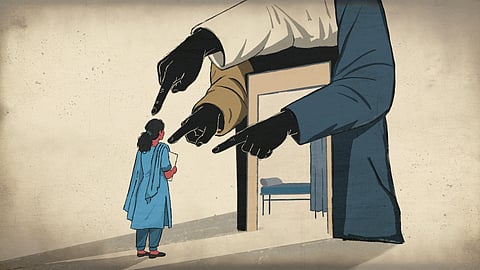
Divya’s story is far from unique. It shows the brutal reality of a system that routinely punishes women for exercising bodily choice.
Tara (name changed) was 18 when she found herself with an unwanted pregnancy. Her immediate fear was not the procedure itself but the social fallout. Unmarried and terrified of her family finding out, she avoided stepping into a hospital.
“My partner sourced abortion pills through informal networks,” the Pune resident said. She swallowed the tablets at night, enduring hours of excruciating abdominal cramps and heavy bleeding alone in her room.
Years later, when faced with another unplanned pregnancy at 24, she chose to seek formal clinical care. She called a prominent specialty hospital in Pune, explicitly stating that she needed an abortion. The hospital turned her down twice. “The staff gave vague excuses saying doctors are ‘unavailable’ and offered appointment dates weeks later, which created a crucial delay in a procedure where timing is critical,” Tara said.
Recognising the silent rejection for what it was, she turned to small private clinics.
When she eventually found a private clinic through online reviews, the gynaecologist subjected her to an exhaustive interrogation about her career, family background, and relationship status before agreeing to administer the pills. Tara said she felt that the consultation was less about clinical evaluation and more about the doctor assessing her own legal liability.
On paper, India’s abortion laws are among the most progressive in the world, permitting terminations up to 24 weeks of pregnancy. In reality, reproductive care exists in a treacherous legal grey zone where a woman’s bodily autonomy is reduced to a medical provider’s discretion, turning a fundamental healthcare right into an exercise in persuasion.
The barrier is not merely legal gatekeeping or administrative denial, it is a cohesive machinery of institutional violence. Behind the progressive promises of the Medical Termination of Pregnancy (MTP) Act, healthcare providers actively weaponise care through public shaming, forced procedures, financial extortion, and moral trial, treating a fundamental healthcare right as a crime and women’s bodily autonomy as an offence.
What the law says and what doctors recommend
Enacted in 1971, the MTP Act was hailed as a landmark piece of progressive legislation. Designed primarily to reduce maternal mortality caused by unsafe, clandestine abortions, the law established that women could seek legal terminations under specific statutory grounds, including threats to physical or mental health and contraceptive failure. Amendments to the Act in 2021 extended the legal gestation limit from 20 to 24 weeks for vulnerable categories, including unmarried women, survivors of sexual assault, and those with foetal abnormalities, while explicitly establishing that an adult woman’s consent alone is required to undergo an abortion.
Beyond statutory abortion provisions, Indian constitutional jurisprudence firmly establishes health, reproductive choice, and bodily autonomy as fundamental rights guaranteed under Article 21 (the Right to Life and Personal Liberty).
In landmark rulings such as X v Principal Secretary (2022), which concerned an unmarried woman seeking permission to terminate her 24-week pregnancy, the Supreme Court unequivocally declared that every woman regardless of her marital status possesses an absolute right to bodily and decisional autonomy, affirming that forcing an unwanted pregnancy to term constitutes a direct violation of her dignity and mental health.
Other judicial precedents explicitly guarantee privacy, confidentiality, and informed consent in medical care, establishing that an adult woman’s choice is paramount and legally independent of spousal, parental, or third-party permission.
From a clinical standpoint, the timing of an abortion determines both its legal complexity and physical toll on the patient. Senior obstetrician and gynaecologist Dr Geeth Monnappa emphasised that early intervention is key to avoiding unnecessary surgical procedures.
“We generally advise that women come to us early on, prior to 12 weeks of pregnancy, as far as possible,” Dr Geeth said. “The ideal time is prior to nine weeks when we can carry out the abortion with medicines. According to Indian law, any pregnancy that goes beyond nine weeks has to be surgically managed or done under strict hospital care. The patient cannot be given medication and sent home.”
Explaining the rationale behind extending the legal gestation limit from 20 to 24 weeks under the MTP Act, Dr Geeth highlighted how delayed clinical diagnoses of foetal anomalies necessitate women to access abortions at a later stage in the pregnancy.
“A lot of the time, serious abnormalities cannot be picked up as early as 20 weeks. We do anomaly ultrasound scans around 18 weeks, but many heart issues especially will not be apparent that early. Doing an ultrasound at 22 weeks allows us to detect most structural abnormalities. That is why the medical council extended the limit to 24 weeks.”
Beneath this progressive statutory surface lies a fundamental structural flaw: the MTP Act does not frame abortion as an absolute, rights-based entitlement for women, but as an exception to criminal law that can be granted only at the discretion of registered medical practitioners.
At its core, Indian criminal law treats abortion as a crime first and healthcare second. Under the Bharatiya Nyaya Sanhita (BNS), causing a miscarriage remains a criminal offence carrying up to seven years in prison, unless done in “good faith” to save a woman’s life.
Beyond personal prejudices, this criminal framing is also a reason why doctors practise ‘defensive medicine’, where they prioritise shielding themselves from legal liability over providing timely care. This turns them into suspicious legal gatekeepers who demand unnecessary paperwork and family consent just to protect themselves.
Within this framework, the MTP Act doesn’t actually legalise abortion for women; it just protects doctors from criminal charges. But that protection only applies if doctors follow every strict administrative rule and gestational limit. If a physician makes a single documentation error, they can face police investigation.
Relying on this legal web are real women whose lives can be wrecked by a system meant to protect them.
For Anjali (name changed), a working professional in Kochi, seeking an abortion at six weeks turned into an exhausting trial of explicit moral accusations across multiple private and public facilities. When she approached a prominent government hospital in Kochi expecting standard public care, the attending senior doctors allegedly threw her medical paperwork onto the desk and interrogated her in front of the staff. “They started grilling me, asking: ‘How inhumane are you? Are you using us to commit murder?’” Anjali recalled.
“I was so triggered when they used the word ‘murder’,” Anjali said. She had responded that it was not a pregnancy in an advanced stage and was just a group of cells at the point. To this, she was allegedly asked, “What if your mother had done this to you?”
“When I explained my socio-economic situation and the fact that I had just been offered a job, they tried to invoke religion, saying god will punish me.” The hospital then allegedly insisted that she bring a husband and family members, adding, “In private hospitals, do whatever you want!”
Institutional violence combined with moral policing
On the ground, the progressive promises of the MTP Act collapse against a wall of institutional fear, defensive medicine, and rampant moral policing.
For Divya, the Bengaluru woman who was handed the dead foetus in a small bundle, seeking standard medical care meant walking straight into a gauntlet of public humiliation and institutional violence. “If you can’t control your desires, why don’t you go do some other work?” the first doctor she met allegedly shouted at her.
“To make a decision about our own body, such as ‘I don’t want this now’, doctors often say, ‘Bring your father, bring your mother, bring your husband’. They don’t let us speak about our situation,” Divya said.
“Instead of thinking about me or the unborn child, they ask: ‘Why did you make a mistake? Was it good when you were making the mistake?’ When a woman comes, they ask her why she made a mistake, but when a man is there, they don’t ask him that question.”
By the time Dr Malu Mohan, Fellow and Assistant Professor at the Centre for Commercial Determinants of Health in the Institute of Public Health, Bengaluru, who is also a healthcare advocate, intervened through personal networks, Divya was nearly 24 weeks pregnant, and had missed the window for early-stage abortion options.
Up to 12 weeks, a pregnancy can be terminated safely at home using a two-drug regimen: mifepristone to block progesterone and detach the uterine lining, followed by misoprostol to contract the uterus and expel tissue like a heavy menstruation.
“These medicines cause strong contractions and open up the mouth of the uterus so that the uterine contents come out. It is essentially inducing an abortion using medical agents to trigger pain and contractions,” said Dr Geeth.
Between 12 and 14 weeks, it requires D&C (Dilation and Curettage), a minor surgical procedure in which the cervix is widened so that the lining of the uterus can be gently scraped or suctioned to remove tissue to clear the uterine contents.
Addressing widespread fear and confusion regarding clinical abortion methods, Dr Geeth explained what happens during surgical evacuations versus medication-induced terminations.
“Early stage surgical procedures are very different from a delivery,” Dr Geeth said. “When done after nine weeks, it is a minor procedure called suction evacuation done in an operation theatre under short anesthesia. It takes about half-an-hour and the patient can go home the same day.”
By 24 weeks, the foetus and placenta are fully formed; suction evacuation (also called simple aspiration, which is a common, safe procedure that uses gentle suction to empty the contents of the uterus) is no longer clinically possible. The only remaining medical option is a labour-induction abortion, a process biologically identical to full-term childbirth. High doses of hormones are administered to force the cervix to dilate while triggering intense, hours-long uterine contractions until the foetus is delivered. It requires inpatient care, epidurals or analgesics for severe pain, and continuous medical support.
For Divya, reaching 24 weeks meant facing this complex, high-risk procedure that many doctors were eager to stall. Private hospitals quoted between Rs 50,000 and Rs 1,00,000 to her for the abortion.
Dr Malu managed to secure the two official medical clearances required for late-term abortions under the MTP Act from an empathetic senior doctor at a government hospital. “When Divya arrived for preliminary blood tests, the doctor had already finished her rounds. The nursing staff shoved Divya into a crowded outpatient clinic run by junior male doctors,” she said.
In front of dozens of onlookers, the staff allegedly mocked Divya and her son, who had to be brought along because her home environment was unsafe, asking if she “didn’t care to look at her own child’s face” before getting pregnant.
Dr Malu said it was her speaking to them in English that finally made them back down. “I don’t speak Kannada. The moment they heard me speaking in English, they backed down and stopped their comments. English carries power and class privilege in these spaces. They started saying, ‘Oh, we didn’t know she had the senior doctor’s recommendation, we thought it was just these other doctors.’ It was only because I could step in with that privilege that they finally honoured her admission,” she recalled.
Labour was induced. But the moment the senior doctor left the floor, the junior doctors, post-graduate students, and nurses allegedly turned hostile. As Divya endured 11 hours of escalating, unmedicated labour pain, the staff allegedly subjected her to relentless verbal abuse.
As the labour induction drugs took effect and the uterine contractions began, the staff allegedly withheld basic medical care deliberately. As her pain escalated, she said the nurses and attending junior doctors ignored her cries and refused to check her progress or offer any form of pain relief. Instead, they waited for her to beg for their attention, forcing her to plead with them through tears just to be examined. Still, she said, they offered her no support.
Divya recalled how, as her labour pain escalated, they kept calling her a “prostitute”. When the delivery finally ended in the dead of night, they allegedly shook an exhausted, bleeding Divya awake and shoved the foetus in her face.
They continued their alleged harassment of Divya’s family, leading her sister to believe that she was complicit in a sin, until the sister, overwhelmed by guilt and exhaustion, slapped Divya across the face as she lay broken in the recovery bed. Only then did the attending medical team allegedly step back, satisfied.
What happened after her discharge was the final, devastating leg of her ‘punishment’.
Under the Bio-Medical Waste Management Rules, 2016, foetal tissue and remains from early-stage medical terminations (under 12 weeks) are legally classified as biomedical waste, requiring disposal in specialised yellow/red category containers at registered facilities.
Once a pregnancy crosses 12 weeks, the disposal of foetal remains requires strict sealing, labelling, detailed register logging, and intimation to local or police authorities to rule out illegal concealment or foeticide.
In medico-legal or underage cases, strict chain-of-custody protocols dictate that biological tissue/products of conception (POC) be preserved for forensic science laboratories and DNA testing. Unauthorised or informal disposal at any stage carries severe criminal penalties under BNS.
Because Divya’s pregnancy termination occurred at nearly 24 weeks, the foetus was legally classified under municipal birth and death registration laws as a late-stage stillbirth rather than routine clinical medical waste. Divya was asked to dispose of the corpse and bring back an official death certificate as proof before her final medical clearance could be processed.
When Divya and her sister tried to hail passing auto-rickshaws, driver after driver sped away. Healthcare advocates say that drivers routinely refuse to transport foetal remains due to deep cultural superstitions surrounding death, the terror of being stopped by the police for carrying an undocumented body, and the intense social stigma attached to unmarried or unsupported pregnancies.
Eventually, she walked for miles to reach a municipal burial ground, and handed over the foetus. Only after securing proof of burial were they able to return to the hospital, submit the certificate, and end the ordeal.
“You don’t have to be so cruel. Women have wombs, they get pregnant, there is nothing unnatural about it. The system scars people. Unmarried, widowed, or married, it’s a secret from parents, husbands, offices, and doctors, because female desire itself is criminalised,” Dr Malu said.
“Even in a government hospital, you only get respect if you are educated or have money,” Divya observed. “When educated people ask for something, they give them so much respect. But those who go to government hospitals are often uneducated or poor people who cannot afford private care. Why don’t they give them that same respect? Once I was admitted, I saw doctors take great care of others — their attention was on them, they were checking the IV drip every 10 minutes. But why don’t I get that value when I enter the hospital? They should not make people feel hesitant to come. Both rich and poor should feel that a government hospital gives respect.”
A pattern of institutional abuse
Before sending her off to dispose of the corpse, the medical staff had allegedly subjected Divya to yet another violation of her bodily autonomy, by non-consensually inserting an Intrauterine Device (IUD) into her body, without even explaining the procedure.
While IUDs are a standard, highly effective form of long-term reversible contraception, medical ethics and the regulatory framework require that it should be an informed choice with explicit, voluntary consent.
The non-consensual insertion of contraception and/or sterilisation after MTP is also not an experience unique to Divya. For low-income women who already have children, access to late-term abortion care is often made conditional on accepting permanent, irreversible sterilisation, even though the practice directly violates national guidelines on voluntary family planning.
When Meena (name changed), a mother of three employed as a domestic worker in Madurai, sought a termination at 19 weeks of pregnancy at a public hospital, doctors allegedly refused to perform the procedure unless she agreed to undergo a tubectomy – surgical procedure to block or seal the fallopian tubes to permanently prevent pregnancy – at the same time.
“They told me ‘You already have three children, why do you need more? We will perform the abortion only if you agree to get your tubes tied’,” Meena recalled.
Dr Malu called it blackmail disguised as medical advice. “The State’s target-driven population control mindset is enforced on the bodies of poor women when they are at their most vulnerable.”
For younger, unmarried women, the primary barrier is often not the physical procedure, but the illegal threat of exposure. Despite the MTP Act explicitly stating that an adult woman’s consent alone is legally sufficient, healthcare providers frequently demand parental or spousal authorisation.
When 21-year-old Ananya (name changed) sought an abortion at a government hospital in Chennai, the medical officer allegedly refused to proceed without her parents present, threatening to call them directly from her records.
“They treat adult unmarried women like minors who have committed a crime. The doctor told me to bring my father so he knows ‘what his daughter is up to.’ When I refused, they threatened to inform the local police station that an unmarried girl was seeking an abortion,” Ananya said, adding that the fear of social ruin drives women straight into unsafe, unvetted private clinics or dangerous self-medication
In urban settings, hospitals frequently employ ‘soft denial’ tactics, like deliberately delaying appointments, stalling blood tests, or shuffling patients between departments until they pass the legal 24-week statutory limit, effectively forcing them to carry the pregnancy to term.
This was the experience of Anu (name changed), a 23-year-old university student who approached a tertiary government hospital in Tamil Nadu’s Tirunelveli at 18 weeks of gestation. She was married but was not ready for a child at that point.
“They didn’t refuse directly. Instead, they repeatedly asked for unnecessary ultrasound scans, made me wait three weeks for an ethics committee review that wasn’t legally required for my stage of pregnancy, and repeatedly claimed that senior doctors were unavailable. By the time all the paperwork was ‘complete’, I was past 24 weeks. Then they said it was illegal and they couldn’t help.” Anu carried the child to term.
“Whether it is slut-shaming, blackmailing, threatening, or giving false information, the mechanism is the same: female desire and bodily autonomy are treated as criminal,” Dr Malu pointed out.
Cost of misinformation and self-management
When formal medical institutions shut their doors, women are driven into a shadowy maze of self-managed care, informal networks, and predatory private pricing. For many young and unmarried women, the financial burden alone creates an insurmountable barrier.
While medical abortion pills can be sourced over the counter or through informal channels for a few hundred rupees, accessing comprehensive clinical care, necessary ultrasound scans, and post-procedure follow-ups can cost upwards of Rs 8,000.
If complications arise, such as Retained Products of Conception (RPOC) – where some pregnancy tissue remains in the uterus after an abortion – requiring a surgical D&C or suction evacuation, costs may exceed Rs 40,000. For those without the financial means, including college students and youth, these out-of-pocket expenses often mean availing high-interest informal loans, selling personal belongings, or relying on partners who may abandon them mid-process.
This commercial exploitation was vividly experienced by Anjali during her search for pills at six weeks pregnancy across private clinics in Kochi. “A private hospital insisted on doing an invasive D&C even though it was not required at that stage of pregnancy. They said it would cost around Rs 60,000,” she said.
Anjali recalled that she was shocked when she was asked to pay Rs 24,000 in another private clinic. “The doctor told us to our faces that we were doing something that goes against moral values, and that very few doctors carry out ‘these kinds of things that aren’t moral’, and when they do, they should gain something monetary. She also said that they don’t recommend abortion to even rape victims. She wasn’t bothered about life, she just wanted money,” Anjali alleged.
Savitri (name changed), a private firm employee, was nearly four weeks pregnant when she allegedly faced predatory pricing and artificial delays at private specialty hospitals in Kochi. “They made me come back after a week, claiming the medicines wouldn’t work yet,” she told TNM.
“When I returned, they said, ‘You’ll have to be admitted, and it will cost around Rs 20,000’. None of this was mentioned initially. I had already paid Rs 4,000 for scans and blood tests. It felt like a total scam, like they intentionally delayed the process so it would escalate into a more expensive procedure. For someone who is panicking, the demand of Rs 20,000 makes them feel trapped.”
Apsara (name changed), a student from Chennai who underwent a medical abortion at 19, recalled the terror of navigating incomplete medical information. She said that her procedure was delayed inordinately by the hospital despite her approaching them at an early stage of pregnancy.
“When I took the pills, no one explained to me what normal bleeding meant versus a medical emergency,” Apsara shared. “When the cramps became unbearable and I kept passing heavy clots, I thought I was dying. I was too afraid to go to a hospital because of the social stigma, so I just lay on my bathroom floor for hours. Weeks later, an ultrasound showed retained tissue that had caused a severe uterine infection. I had to pay nearly Rs 40,000 for an emergency D&C at a private facility. The financial strain was devastating, but the emotional isolation was far worse.” Healthcare experts say that the average cost of a D&C is Rs 20,000, but can range from Rs 20,000 to Rs 80,000.
Apsara’s case highlights a critical gap in public health messaging. While medical abortion drugs (mifepristone and misoprostol) are considered safe, the absence of user-friendly, non-judgemental guidance, such as clear pictorial instructions on pill packaging, leaves women unable to distinguish standard side effects from clinical complications.
Archanaa Sekhar, a reproductive rights activist who runs a support network in Chennai, said that this informational void directly feeds into institutional exploitation and medical trauma. “Women are left in the dark about what to expect during a medical abortion,” Archanaa told TNM. “When they experience normal bleeding or severe cramping, they panic because no one told them this was part of the process. Private clinics and unsupportive doctors take immediate advantage of that fear. Instead of reassuring them or offering basic clinical guidance, they push for costly, invasive procedures like D&Cs that aren’t sometimes medically necessary. What should be a safe, routine process turns into a big expense and physical trauma.”
Highlighting how fear of hospital systems leads to dangerous delays or illegal quackery, the senior obstetrician and gynaecologist Dr Geeth reflected on the clinical spectrum of septic abortions, while identifying common systemic triggers like irregular periods and contraceptive failure.
“Historically, we have seen many cases of ‘septic abortions’, especially in rural areas where quacks inserted objects into the uterus to induce abortion, causing severe, life-threatening infections,” Dr Geeth explained. “Early in my career, I had a case where the infection was so bad that I had to remove the uterus. While patients are more aware today and extreme quackery is less prevalent, we still see many women coming to us far beyond nine or 12 weeks. When care is delayed, the morbidity – amount of bleeding, pain, duration of the procedure, and need for surgical interventions – is significantly higher.”
“A major reason for delay is that many young girls experience irregular periods due to PCOS,” Dr Geeth added. “They assume a missed period is just another regular delay and don’t check for pregnancy until it is advanced. Furthermore, we must repeatedly advocate for regular contraception, not emergency pills like the I-Pill. Emergency contraceptive pills are strictly for emergencies, not routine birth control. Using regular contraception and checking for pregnancy the moment a period is missed is vital to receiving safe, early care.”
Self-made support systems: Digital communities and grassroots activism
Faced with institutional hostility and official silence, women, activists, and researchers have bypassed official channels to build their own informal collectives and community-led support networks. Groups like Safe Abortion Keralam, a collective formed following extensive field research under The YP Foundation’s SAFE Fellowship, have emerged as crucial battlegrounds against institutional violence. By documenting gynaecological abuses, supporting patients, and holding healthcare providers publicly accountable, these informal groups expose how India’s progressive legal promises crumble inside actual examination rooms.
Women have also constructed their own parallel support infrastructure. Online forums, including Reddit threads, Twitter/X networks, and anonymous Quora groups, have become vital hubs for peer-to-peer survival strategies. Here, women crowdsource vetted lists of non-judgemental gynaecologists, share warnings about hostile hospitals, and exchange practical advice on post-abortion physical recovery.
“When the big hospitals turned me away with vague excuses and endless delays, I knew I couldn’t trust official channels. I went online and spent hours reading through reviews and personal accounts on forums. Finding a private clinic through those shared experiences was the only reason I was able to get care without being completely turned away. Without those anonymous threads and peer warnings, women like me would be totally lost,” said Tara, the Pune resident who had to undergo two abortions.
In Tamil Nadu and neighbouring states, feminist activist networks step in to provide direct hand-holding. Activist Archanaa has accompanied dozens of women through clinical consultations, emergency care, and legal navigation.
“Women shouldn’t have to perform FBI-level background checks on doctors just to get standard medical care,” Archanaa said. “Our network constantly receives desperate messages from young women who have been lied to by doctors, told that pills will make them permanently infertile, or threatened with police action. We spend hours verifying clinics, accompanying women to appointments so doctors know they aren’t alone, and providing the basic emotional reassurance that the medical system completely refuses to offer.”
The legal paradox: Defensive medicine and the conflict of laws
To understand why doctors act as gatekeepers rather than healthcare providers, one must examine the legal minefield governing Indian medicine.
According to medical and legal expert Dr Alka Bardhan Barua, healthcare providers operate under the shadow of three conflicting legislations: the MTP Act, the Pre-Conception and Pre-Natal Diagnostic Techniques (PCPNDT) Act, and the Protection of Children from Sexual Offences (POCSO) Act.
While the MTP Act permits terminations, the PCPNDT Act, enacted to combat sex-selective female foeticide, subjects gynaecologists and radiologists to aggressive audits and criminal prosecution for paperwork discrepancies. Fearing false accusations of performing illegal sex determination tests, many doctors adopt an attitude of ‘defensive medicine’.
“The regulatory climate has turned doctors into defensive bureaucrats,” Dr Alka noted. “Because abortion remains framed as an exception to a crime under penal law rather than an absolute healthcare right, physicians view every MTP patient as a potential legal liability. To protect themselves, they demand unnecessary judicial approvals, force patients to bring family members, or simply refuse service altogether.”
“According to the law, as long as the woman is above 18, she can go ahead on her own, it is not legally mandatory to bring a partner or family,” emphasised Dr Geeth. “However, if she is undergoing a surgical procedure under anesthesia, doctors prefer having an escort present, purely for post-anesthesia support.”
The legal friction is further compounded for minors. Under POCSO, medical professionals are legally mandated to report any sexual activity involving individuals under 18 years of age to the police. This requirement directly clashes with the MTP Act’s promise of confidentiality, forcing pregnant adolescents to choose between an unwanted pregnancy and entering the criminal justice system.
Dismantling the barrier
The systemic barriers, medical harassment, and financial extortion women face are not accidental failures of an otherwise sound system; they are the logical outcome of a medical framework rooted in patriarchal control and moral policing.
As Firsha V, a research scholar from the Madras Institute of Development Studies who is part of Safe Abortion Keralam, emphasised, true reform cannot occur until the medical establishment stops treating abortion as a moral crime or a commercial opportunity.
“Until we strip away written and unwritten moral mandates, dismantle illegal consent demands, and hold hospitals strictly accountable, progressive laws under the MTP Act will remain nothing more than empty words on paper,” she said.
Grounding their work in these lived experiences, collectives like Safe Abortion Keralam and reproductive rights advocates argue that systemic transformation requires confronting several interconnected fronts.
First, the State must pursue the complete decriminalisation of abortion by removing it from general penal statutes like the BNS.
“Framing abortion as an exception to a criminal offence forces doctors into defensive gatekeeping, where every patient is viewed as a legal liability. Full decriminalisation shifts the dynamic from a provider-centric model, where physicians ‘grant’ terminations, to a rights-based model grounded in Article 21 of the Constitution, guaranteeing privacy and absolute decisional autonomy,” medical and legal expert Alka said.
Secondly, public health infrastructure must be stripped of its “arbitrary administrative hurdles”, as Udayaswani S, project consultant at the Indian School of Development Management, and Firsha said in an article published by TrueCopyThink. The third requirement includes rigorous clinical oversight and price regulation of private healthcare.
Finally, Alka added, “Dismantling systemic barriers requires equipping women with transparent information to bypass institutional traps altogether. Distributing non-stigmatising, user-friendly pictorial guidance on self-managed medical abortion pills allows women to manage early terminations safely and identify genuine complications without falling prey to predatory private clinics.”
Until the State confronts the penal framing of reproductive choices, regulates commercial exploitation, and dismantles patriarchal gatekeeping inside gynaecology clinics, women will continue to bear the physical, psychological, and financial trauma of a system that treats their medical needs as a crime and their bodily autonomy as a topic of debate.
With editing inputs from Maria Teresa Raju.
