
Subscribe
In June this year, Mohan Bhagwat offered many reasons for refuting demands that the Rashtriya Swayamsevak Sangh (RSS) be registered.
The sarsanghachalak—supreme leader—of the RSS argued that it is only a “body of individuals”; that the government already knows it exists because it has been banned multiple times since its inception; and that “Hindu Dharma is not registered” either. Bhagwat also said that the RSS did not need to be legally registered because only “those who seek funds from the government require registration”. The Sangh has long claimed that it has no such requirement. In its telling, it sustains itself on the tax-free contributions that volunteers make as gurudakshina—offerings to a teacher.
But the RSS’s financial trail is opaque. The amounts it receives through the gurudakshina system are not publicly disclosed. Apart from this, a vast network of registered and unregistered organisations affiliated to the Sangh rely on various funding channels, some of which include foreign sources. How these funds circulate through the sprawling ecosystem is largely unknown.
What is clear, however, is that at least some of the registered Sangh-affiliated organisations are raising funds through government sources.
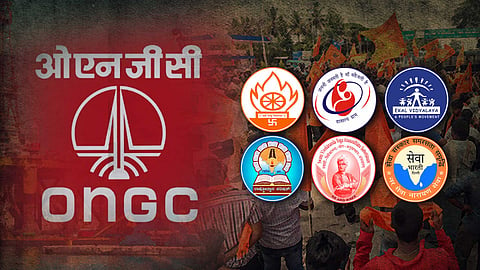
A TNM investigation reveals that the state-owned Oil and Natural Gas Corporation (ONGC)—one of India’s top Public Sector Undertakings—donated Rs 670.97 crore to 20 Sangh-linked organisations, starting from 2013. Of the total amount, a little less than three crores was given to three of the 20 organisations between 2013 and 2015. The rest of the funds were disbursed over the ten years that followed.
ONGC made these contributions from its Corporate Social Responsibility funds, through which it gives hundreds of crores to various organisations every year.
From the first quarter of 2015 until the first quarter of 2025, ONGC donated Rs 4,531 crore to over 2,000 organisations and projects across India, its CSR annual reports show. Of this amount, a little over 14.7% or Rs 668.01 crore, went to the 20 organisations that TNM identified as having links to the RSS. The main findings of this investigation do not include Sangh-linked organisations that received less than Rs one crore from the PSU.
The 20 organisations that TNM identified fall into three broad categories: nine are directly affiliated to the Sangh, nine were either started by or are led by individuals with ties to the RSS, and two have worked with the Sangh.
We identified a majority of these RSS-linked beneficiaries by mapping them to ‘Seeing the Sangh.’ This is the world’s first comprehensive map of over 2,500 organisations affiliated to the Sangh, which was released in late-2025. The database was compiled by a research team led by Dr Felix Pal, a political science and international relations lecturer at the University of Western Australia. It has been fact-checked by The Caravan; and is hosted by the French University Science Po’s Centre of International Studies.
ONGC did not respond to TNM’s multiple requests for comment.
Among the 20-RSS linked organisations that we identified, the biggest beneficiary of ONGC’s CSR contributions is Swargadew Siu-Ka-Pha Hospital, a 300-bed multi-speciality hospital in Assam’s Sivasagar district.
The hospital is co-managed and operated by ONGC along with the Dr Babasaheb Ambedkar Vaidyakiya Pratishthan (BAVP), an Aurangabad-based charitable trust “driven by the philosophy of RSS,” according to an online brochure. Started in 1989, the BAVP runs a number of medical institutions. This includes the Dr Hedgewar Hospital, named after the RSS founder Keshav Baliram Hedgewar, in Aurangabad—which is “run by RSS swayamsevaks,” according to an article in the RSS mouthpiece, The Organiser.
The chairman of Siu-Ka-Pha Hospital, Dr Anant Pandhare, is on the BAVP’s board of trustees. He was appointed the president of AIIMS Nagpur in February 2025. He mentions spending time at an RSS shakha in a LinkedIn post from that year. Speaking about the Assam hospital with the Economic Times, Pandhare said, “We are a RSS affiliated organisation and service is our motto.”
ONGC signed a Memorandum of Understanding with the BAVP over Siu-Ka-Pha Hospital in 2017. The PSU started giving money for the facility a year earlier, records reviewed by the TNM show. It spent a little over Rs 434 crore from its CSR funds for the hospital between 2016 and 2024.
(A government press release from 2023 notes that Siu-Ka-Pha Hospital was built at a total cost of Rs 483 crore—it is unclear whether ONGC bore the entire amount.)
The hospital as it stands today—a large 300-bedded facility, with 21 specialities and 23 doctors—was inaugurated on November 4, 2023. Its stated aim is to “provide affordable, accessible, quality healthcare and treatments to every commoner” so that such facilities are available to patients “irrespective of people’s status.” Tariff cards reviewed by TNM reflect that a bed in the general ward the hospital costs around Rs 800. A semi-cabin, cabin, and suite are priced at Rs 2,000, Rs 3,000 and Rs 5,500 respectively.
Siu-Ka-Pha Hospital is empanelled under the Indian government’s flagship health insurance scheme, Ayushman Bharat Pradhan Mantri Jan Arogya Yojana (PM-JAY), Anchul Dutta, a senior marketing executive from the hospital, told TNM. The scheme covers around 264 services, including those related to neurology and cardiology. The hospital provides a discount of 40% on the total bill for patients who are below the poverty line and a 20% discount on the pharmacy bill, said Anchul.
The second highest RSS-linked beneficiary of ONGC’s CSR funds is located in Nagpur. This is a trust called Dr Aabaji Thatte Seva Aur Anusandhan Sanstha. It takes its name after the personal assistant of MS Golwalkar, the second sarasanghachalak of the RSS. Between 2017 and 2022, ONGC gave this trust Rs 140 crore for the establishment of the National Cancer Institute in Nagpur.
Shailesh Joglekar—the general secretary and chief executive officer of this cancer institute—is also the general secretary of the Dr Aabaji Thatte Seva Aur Anusandhan Sanstha. He is an RSS member who was once the president of the Bajrang Dal’s Vidarbha chapter and is actively involved with the Vishwa Hindu Parishad (VHP), noted Felix Pal in an essay for The Caravan. Joglekar’s LinkedIn profile also lists him as an honorary chairman of the Bhonsala Military School, which has been linked to attacks by Hindu right extremists, according to news reports.
The National Cancer Institute was jointly conceived by Joglekar—who lost his wife and childhood friend to cancer—and Maharashtra’s current Chief Minister Devendra Fadnavis, whose father had also succumbed to the illness, noted one report. Built on land stretching across 25 acres, the facility has a capacity of 470 beds.
Sunil Manohar, the former advocate general of Maharashtra, who once described his grandfather as being a “devoted RSS cadre and a friend of second sarasanghachalak Madhav Golvalkar Guruji,” is the president of the National Cancer Institute. Its vice-president is Ajay Sancheti, a Bharatiya Janata Party politician and former Rajya Sabha Member of Parliament, whose family reportedly had close ties with the RSS across generations.
The cancer institute was inaugurated in April 2023. Those in attendance included Mohan Bhagwat; Devendra Fadnavis; Eknath Shinde, then the chief minister of Maharashtra; Nitin Gadkari, the union minister for road transport and highways; and Gautam Adani, the billionaire founder-chairperson of the Adani Group.
Apart from the BAVP and the Dr Aabaji Thatte Seva Aur Anusandhan Sanstha, ONGC also gave funds to 18 other RSS-linked organisations. These organisations received relatively smaller amounts compared to the top two beneficiaries. Even so, the grants ranged from Rs one crore to over Rs 15 crore.
ONGC gave Rs 15.53 crore to Swami Vivekananda Yoga Anusandhana Samsthana (S VYASA)—a deemed-to-be university based in Bengaluru—to build hostels in Karnataka, and conduct yoga camps in Odisha and Assam. S VYASA’s founder-chancellor HR Nagendra has been Prime Minister Narendra Modi’s yoga ‘consultant’ for nearly four decades. In 2015, the institute worked with the RSS to conduct yoga camps across the country.
Various branches of the Sewa Bharati, which falls under Rashtriya Sewa Bharati—the RSS’s social-services arm—received Rs 13.95 crore for medical equipment, flood relief, building yoga centres, as well as student welfare hostels across India.
As with the BAVP, Bharat Vikas Parishad too received funds to build a multi-speciality hospital—this one in Rajasthan. The organisation, which aims to cultivate a “physically, economically and morally strong India,” was founded by a surgeon called Suraj Prakash. Its first president was Lala Hans Raj Gupta, a former mayor of Delhi and a senior RSS leader. In 2022, Prakash’s birth centenary was marked by a function at which Bhagwat reportedly said that “India should not imitate other countries.” The event’s guest of honour was industrialist Kumar Mangalam Birla.
Seven among the 20 RSS-linked organisations that TNM identified received ONGC funds to build or run schools.
The Rashtrotthana Parishat, which received Rs 11.6 crore, describes itself as a public service voluntary organisation “dedicated to promoting values of patriotism, integrity, commitment, and affection within society.” It was co-founded by senior RSS leader MC Jayadev, and is a listed associate of the Rashtriya Sewa Bharati, the social-services arm of the RSS.
Schools run by the Ekal Vidyalaya Foundation received Rs 8.69 crore. These are modelled on a concept outlined by Murlidhar Dattatreya Deoras—popularly known as Bhaurao Deoras—who was reportedly a younger brother of the third RSS sarsanghchalak Madhukar Dattatreya Deoras, and an RSS organiser himself. The foundation was established in the mid-eighties; and by 1989, Shyam Gupta, a senior RSS pracharak, took over. RSS leader Rajneesh Arora contributed to the initial development of Ekal Vidyalayas. In 2018, the Punjab Vigilance Bureau arrested Arora in connection with allegations of serious financial fraud and administrative malpractices at the Punjab Technical University (PTU), of which he was the vice-chancellor. He was also accused of “pushing RSS ideology” through courses he introduced at the PTU and of “making recruitments from families of saffron ideology.” The case was dropped by 2020.
Vivekananda Kendra describes itself as a “spiritually oriented service mission” that is centred around the twin objectives of “man-making and nation-building.”This organisation received Rs 3.96 crore. Founded by Eknath Ranade, the former general secretary of the RSS, Vivekananda Kendra aspired to “encompass…the entire length and breadth of Bharat,” so that it could “arouse all Hindus and all India,” noted one article.
Four of the seven schools that received donations are affiliated to the educational wing of the RSS, Vidya Bharati Akhil Bharatiya Shiksha Sansthan. These include Netaji Subhash Chandra Bose Military Academy in Silvassa, which received Rs 4.5 crore to build staff quarters. Saraswati Shishu Vidya Mandir received Rs 2.09 crore to run schools and hostels across Odisha, Andhra Pradesh, and Gujarat among others. Rajju Bhaiya Sainik Vidya Mandir, an “RSS Army school” to train students for the armed forces, received Rs 2.20 crore; and the Shishu Shiksha Samiti Assam received Rs 1.93 crore for building classrooms, a science lab, and installing a water purifier. Manav Seva Pratisthan, which received Rs 1.6 crore to build a school hostel in West Bengal, is listed as a partner organisation to a programme called Support a Child USA, a VHP America project. A school run by Manav Seva Prathisthan in West Bengal hosted an arms training camp, organised by the Bajrang Dal in 2017, according to news reports.
Apart from S VYASA, ONGC also disbursed funds to four other organisations for residential facilities.
Ekalavya Foundation received Rs 4.72 crore to build student dormitories at an organic agriculture training centre in Telangana. The foundation was founded by P Venugopal Reddy, a former RSS worker. Bhagwat made an appearance at a Eklavaya Foundation event a few years ago, where he performed a prayer, addressed a gathering of about 1,500 farming families, and praised Reddy’s work, news reports show. Samarpan Charitable Trust, listed as an associate by Rashtriya Sewa Bharati, received Rs 4.3 crore to build hostels for tribal girls in Kandhamal, Odisha.
The Param Shakti Peeth, founded by Sadhvi Ritambhara, received Rs 2.49 crore for a residential and day-care centre for children. The UP-based organisation works in the areas of children's education and health. Ritambhara is the founder of Durga Vahini, the women’s wing of the VHP. Known for her documented role in the 1992 demolition of the Babri Masjid in Ayodhya, as well as her inflammatory speeches against Muslims and Christians, Rithambhara was conferred with the Padma Bhushan in 2025.
Vivekanand Medical Research Trust (VMRT), which received Rs 7.47 crore, was established by the BJP leader, RSS worker, and former chief minister of Himachal Pradesh, Shanta Kumar.
The three remaining Sangh-linked organisations that the ONGC gave a crore or more to include the Mokshda Paryavaran Evam Van Suraksha Samiti, listed as an associate of Rashtriya Sewa Bharati, which received Rs 5.12 crore to install energy-efficient ‘green’ crematoriums in Delhi, Uttar Pradesh and other locations. The Deendayal Research Institute—named after the prominent RSS ideologue Deendayal Upadhyaya—and founded by the RSS pracharak, former Rajya Sabha member, and Bharat Ratna awardee Nanaji Deshmukh, received Rs 1.13 crore. Maharaja Shivachhatrapati Pratishthan Trust, which received Rs one crore for a five-day cultural program on Maratha warrior-king Shivaji in Delhi. The organisation was established by Babasaheb Purandare, a well-known RSS swayamsevak.
Over the last few years, individuals closely associated with the BJP have held positions on the ONGC board and its CSR committee.
In 2017, BJP MP and spokesperson Sambit Patra was appointed a non-official director of the board for a period of three years. Critics questioned his eligibility for this role and alleged that ONGC had not followed proper procedure in appointing him. Reena Jaitly, who recently completed a four-year-long tenure as an independent director on ONGC’s board, also headed its CSR committee from 2021 to 2026. Jaitly was the president of BJP’s Punjab State Mahila Morcha at the time of her appointment. In 2024, she was the state secretary of BJP’s Punjab unit. Syam Chand Ghosh, a BJP leader from West Bengal, was also appointed an independent director at ONGC in late-2021.
ONGC’s other donations include Rs 300 crore to the Prime Minister’s Citizen Assistance and Relief in Emergency Situations, or PM-CARES, fund. It also gave Rs 130 crore to Auroville Unity Fund, described on its website as “the channel for grant, donation, and contribution income that comes to Auroville.” The PM-CARES Fund, established during the onslaught of the COVID-19 pandemic, has been repeatedly criticised because of the government’s opacity over how much money it generated, and how this money was then used. As several news reports have documented, over the past few years, the RSS and BJP have increased their influence over Auroville.
In the financial year 2023-2024, ONGC also gave Rs 1.12 crore to an organisation called Deen Dayal Cow Science and Training Center in Mathura. (TNM was not able to ascertain specific details about this center, which is why it has been excluded from the current list of Sangh-linked organisations.)
Five oil PSUs—ONGC, India Oil Corporation Limited, Hindustan Petroleum Corporation, Bharat Petroleum Corporation Limited, and Oil India Limited—reportedly gave Rs 146 crore for the Statue of Unity in Gujarat. Between 2016 and 2019, ONGC gave around Rs 100 crore for the construction of the statue to the Sardar Vallabhbhai Patel Rashtriya Ekta Trust, which is chaired by the Chief Minister of Gujarat, its annual records reflect.
This statue, built at a cost of Rs 2,989 crore, is touted to be the tallest in the world. It commemorates India’s first Home Minister Vallabhbhai Patel, who is among the Congress leaders that the Hindu right has sought to appropriate over the last several years.
Modi first conceived of the statue in his tenth year as Gujarat’s chief minister in 2010, and its foundation was laid in 2013, noted the academic Rahul Rao, who has authored the book The Psychic Lives of Statues: Reckoning with the Rubble of Empire. Modi inaugurated the statue in 2018, just before he began his campaign for a second term as prime minister. “A day before the inauguration, nearly three hundred activists, many of whom were Adivasi farmers, were detained to pre-empt a massive protest against the statue, the construction of which had resulted in the expropriation of their land,” Rao added.
That same year, the Comptroller and Auditor General of India (CAG) pulled up ONGC and the other oil PSUs for their contributions to the Statue of Unity. These donations, the government auditor said, did not qualify as a CSR activity because the project was not a “heritage asset”.
All Oil PSUs, including ONGC, come under the administrative control of The Ministry of Petroleum and Natural Gas. Between 2014 and 2021, this ministry was headed by India’s current Education Minister Dharmendra Pradhan. In May 2021, Pradhan posted an enthusiastic tweet about the development of Badrinath Dham, a Hindu pilgrimage site in Uttarakhand. “It is a matter of great pride for our oil PSUs to be associated with the redevelopment of one of the holiest shrines of Sanatan Dharma. We are committed to the development of Badrinath Dham in alignment with PM @narendramodi’s vision of retaining the pilgrimages spiritual legacy.” ONGC later gave Rs 4.6 crore for this project.
The oil ministry is now under the charge of Hardeep Singh Puri.
ONGC CSR Donations to RSS-linked organisations between 2013 and 2025
(Of this amount, ONGC donated only Rs.2.96 crore between 2013 and 2015)
With inputs from Kongkon Bora
Follow TNM's WhatsApp channel for news updates and story links.
