
Subscribe
The Supreme Court, on Monday, August 3, clarified that its July 28 interim order does not prevent State governments from closing or withdrawing FIRs registered against students who participated in the July 20 protests, in accordance with law. The court also clarified that the expression "criminal antecedents", used in its earlier order while granting protection from coercive action, refers only to "grave and heinous offences".
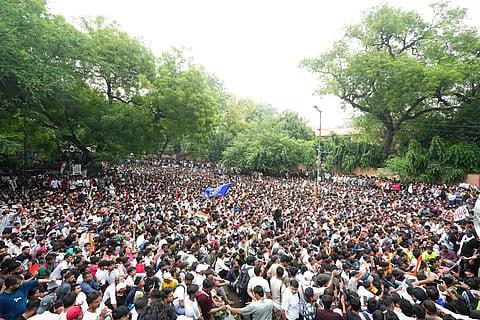
A Bench comprising Chief Justice of India Surya Kant, Justice Joymalya Bagchi and Justice V Mohana issued the clarification while hearing a batch of petitions relating to the July 20 'Chalo Sansad' protests, which include allegations of excessive police force against protesters as well as allegations of violence against police personnel.
The clarification came after petitioners argued that the July 28 order, which allowed States to continue investigating FIRs while restraining coercive action against students without "criminal antecedents", could impede the Union government's assurance of amnesty for protesters.
The Chief Justice suggested that authorities undertake a "classification" exercise to distinguish peaceful student protesters from "hardened criminals" who may have infiltrated the demonstrations.
Solicitor General Tushar Mehta, appearing for the Union government and Delhi Police, told the court that the government remained committed to its assurance but was working out the appropriate legal mechanism to bring criminal proceedings against protesters to an end.
Mehta submitted that criminal law does not provide for the withdrawal of an FIR as such, and that legally permissible options include filing closure reports, seeking withdrawal of prosecution or approaching courts for quashing proceedings. He said the government was "prepared to address the cases against the student protesters" while excluding those facing serious criminal charges.
Advocate Vrinda Grover, appearing for the petitioners, argued that individual applications for withdrawal of prosecution would be cumbersome and uncertain, particularly in cases involving large FIRs naming thousands of unidentified persons. She said the issue was whether the cases should be withdrawn or quashed and emphasised that the protesters were young people whose futures should not be burdened by criminal cases.
Justice Joymalya Bagchi observed that the court could facilitate a solution, stating, "If both of you agree, we can engineer and enable that process... These FIRs should not be left hanging over the students." He also suggested that investigating agencies could file closure reports under the Bharatiya Nagarik Suraksha Sanhita, 2023.
Senior advocate Abhishek Manu Singhvi sought clarification of the expression "criminal antecedents", contending that minor violations or politically motivated cases should not deprive students of protection. The Bench accepted the concern and clarified that the expression would apply only to "grave and heinous offences".
The court also indicated that it was considering an independent mechanism to examine allegations against both protesters and the police.
Chief Justice Kant said the court was considering either constituting a Special Investigation Team comprising police officers or appointing a committee headed by a retired judge to investigate allegations from both sides.
The Bench stressed that police personnel accused of using excessive force should also be held accountable.
The Chief Justice observed, "A police officer involved in excessive force should not be unduly protected. And it should not be that a hardened criminal under the garb of student protest is also getting protected."
During the hearing, senior advocate Gopal Sankaranarayanan sought directions requiring the Delhi Police Commissioner and the Rapid Action Force Director to explain the decision to permit lathi-charge and the use of pellet guns during the protests. Petitioners also raised concerns over the alleged use of facial recognition technology to identify protesters and alleged assault of an advocate at the Nizamuddin Police Station.
The Bench also heard submissions challenging the use of pellet guns against civilian protesters. Advocate Vrinda Grover argued that there was no standing order of the Delhi Police authorising their use in such situations and described the weapon as unsuitable for crowd control.
Chief Justice Kant said the Supreme Court would frame a protocol governing the use of pellet guns, and posted the batch of petitions for further hearing on August 18.
