
Subscribe
There are moments that can wither away with fleeting attention, or even when captured, get frozen in clichéd frames. Only in a few hands do they retain the dignity of detail in their ordinariness.
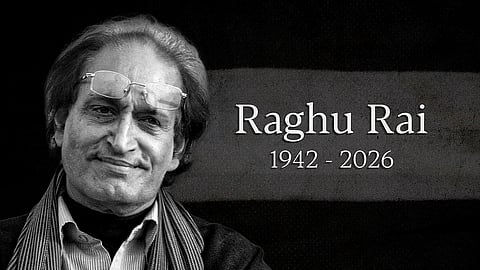
A winter morning in Delhi, a narrow lane, uneven and alive, opens into a passing moment. A man bends over a roadside stove, coaxing a flame; a child watches from a doorway; a cyclist slips through without breaking the rhythm of the street. Nothing here announces importance. Yet the frame holds. It asks the viewer to stay, to register the dignity of lives that rarely enter official narratives. For Raghu Rai, such moments formed the ground from which a larger vision emerged.
In an age when millions carry a phone with a high-resolution camera and the act of photographing has become constant, it is easy to forget a different moment in media history. During the decades when print journalism was the principal medium through which a society encountered itself, images carried a distinct authority. They were deliberate acts of seeing. Within that world, a photographer like Rai helped shape how events would be remembered.
That same eye moved, without altering its discipline, into the decisive passages of history. Refugees crossing during the Bangladesh war of 1971, faces marked by exhaustion and uncertain hope. The aftermath of the Bhopal gas tragedy, where suffering resisted any attempt at simplification. Political figures, including Indira Gandhi, caught not as distant icons but as participants in charged, human spaces. Across these varied scenes, Rai’s work created a continuum. The everyday and the historic belonged to the same unfolding reality.
In that sense, his photographs came to function as a visual memory of the nation. When India looks back at itself, at its fractures and its forward movement, many of the images that surface carry his imprint. Not because he sought to define the nation in any singular way, but because he remained present across its changing landscapes. His camera stayed with life as it revealed itself.
Born in December 1942 in what was then the undivided Punjab province of British India, Raghu Rai arrived at photography through an unexpected route. Trained as a civil engineer, he turned to the camera in his early twenties. The shift was not tentative. By the mid-1960s, he had joined The Statesman, where the demands of daily reportage shaped his instincts. Deadlines sharpened his ability to recognise moments that carried weight without announcing it.
Recognition came early, though it never altered his trajectory. An exhibition of his work in Paris drew the attention of Henri Cartier-Bresson, who saw in Rai a rare clarity of observation. His nomination to Magnum Photos placed him within an international tradition of documentary photography. Yet his work remained firmly anchored in India, attentive to its particular rhythms and contradictions.
The years that followed were marked by both historical upheaval and quiet continuities. Rai moved through them with a consistency that is difficult to overstate. His photographs from the Bangladesh war capture not only displacement but also the fragile persistence of human presence. His work in Bhopal confronts the viewer with the scale of industrial tragedy, refusing both sensationalism and distance. These images have endured because they retain the complexity of lived experience.
At the same time, he returned again and again to the ordinary. Streets, markets, railway platforms, moments of pause and movement that rarely find their way into formal accounts of history. A man eating by himself at the edge of a crowd. Children at play in a space that offers little comfort but does not extinguish energy. A passerby glancing briefly toward the camera. Such images extend his larger project. They suggest that the life of a nation is shaped not only by crises and leaders, but also by gestures that unfold without recognition.
His association with India Today during its formative years expanded the scope of his work. As picture editor and visual storyteller, he helped shape how photographic narratives were constructed in Indian journalism. The photo essay, in his hands, became a way of thinking. Images were not isolated instances. They spoke to one another, building layers of meaning across pages. This editorial and narrative impulse found a fuller, more enduring form in the books he produced over the decades. Works such as Delhi, Raghu Rai’s India, and Mother Teresa gathered his images into sustained visual meditations rather than dispersed reportage. In these volumes, the city, the nation, and the individual life were allowed to unfold through sequences, not headlines. The books deepened his photographs, giving his work a slower, reflective space where the viewer could move through India as he had seen it, attentive to both its density and its silences.
The question of black-and-white photography runs through any serious engagement with Rai’s work. His preference was neither nostalgic nor rigid. He worked in colour when the situation demanded it. Yet he remained wary of its excess. Colour, he believed, could draw the eye too quickly, offering an immediate satisfaction that risked bypassing deeper engagement. Black and white imposed a different kind of attention. It stripped away distraction, directing the viewer toward form, light, and the human presence within the frame. The result was a clarity that aligned with his broader intent.
This approach shaped the emotional register of his photographs. Instead of shock or overt drama, they build their force through composition and restraint. A glance, a gesture, a relationship between figures within a frame. Meaning emerges gradually, often requiring the viewer to return to the image. In a visual culture increasingly defined by speed, this insistence on patience stands out.
Rai’s influence extended beyond his own work. Those who worked with him often recall a demanding but generous mentor. He engaged closely with younger photographers, sometimes working alongside them in the darkroom, guiding decisions that might otherwise have gone unnoticed. For him, photography was not only an individual pursuit. It was a practice shaped by conversation, by the passing on of ways of seeing.
Recognition, both national and international, followed across decades. The Padma Shri, awarded in 1972, acknowledged his early contributions, particularly his coverage of conflict and displacement. His photographs appeared in major global publications, including National Geographic, Time, and The New York Times. Awards and honours accumulated, but they never seemed to define his relationship with the medium. He continued to work with the same attention to the ordinary, the same refusal to separate the everyday from the historical.
The phrase “visual chronicler” is often used in relation to Rai, and it carries weight when understood in its full sense. He did not document events in a linear or exhaustive manner. Instead, he built a body of work that allows the viewer to move through fragments of a larger whole. Politics, suffering, resilience, and routine coexist within this archive. The nation appears as an ongoing process.
There is a line often associated with his reflections on photography: that images should reflect “life’s longing for itself”. The phrasing is inward, almost meditative. It suggests that the act of photographing is also an act of recognition. The people and places before the camera are not distant subjects. They are part of a shared condition. This perspective informs the dignity that runs through his work, even in its most difficult moments.
In later years, as photography entered a digital phase, Rai adapted without abandoning his core principles. Technology changed, but his approach did not yield to immediacy. The emphasis remained on waiting, on allowing a moment to resolve itself before pressing the shutter. That continuity offers a point of reflection in a time when images are produced and consumed at unprecedented speed.
Rai’s work resists compression into a simple sequence of milestones. Its significance lies in the continuity of attention it represents. Over decades, he returned to similar spaces and themes, each time finding new alignments, new ways of rendering what might otherwise pass unnoticed. The repetition was a sustained inquiry into how a society reveals itself.
The Delhi street returns here, not as a single image but as a method: to stand within a space without imposing upon it; to recognise the weight of a moment that does not declare itself; to move, when required, into the centre of historical events without abandoning that same discipline. This continuity, from the smallest gesture to the largest upheaval, defines Rai’s place in Indian photography.
Raghu Rai did not set out to define India. He allowed it to appear, in fragments that resist closure. In an age when the eye seems to have become the central form of narration as well as memory, his visual register will be sought time and again to recall India of the last few decades in its many moods and frames – lending dignity to both the ordinary and the not-so-ordinary.
This story was originally published in Newslaundry; you can read it here.
