
Subscribe
The Inside Deutsche Bank leak was obtained by Indian author and journalist, Josy Joseph, and South African investigative journalist, Khadija Sharife. The investigation was coordinated by Barracuda Media in South Africa, with technical support from the Data and Research Center (DARC) in Germany.
As the world eased into the new year in January 2022, a committee at Deutsche Bank headquarters in Frankfurt prepared to discuss if the bank should go ahead with deals which could hurt its reputation.
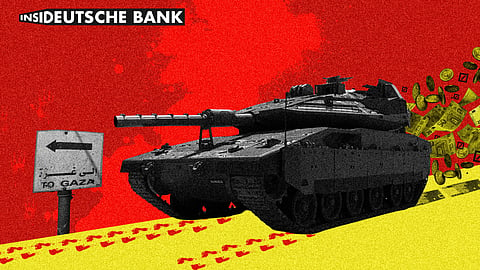
On its agenda for the Jan. 12 meeting was EUR 11.4 million euros advance payment guarantee to German defence manufacturer Renk GmbH, to fund a contract with the Israel Ministry of Defence that would continue until 2027.
Renk was to make gearboxes for its Merkava 4 tanks, with the first of the products to be delivered in September 2024.
A document weighing up the deal had been on the tables of Deutsche Bank’s decision makers since Dec 16, 2021.
An assistant general counsel for the bank was among those who contributed his views. He thought the deal involved a “plain vanilla trade finance product which does not carry any remarkable RepRisk in itself.”
He said the likelihood of the deal becoming public was “very low”. But the risk would be even lower if the financing guarantees could be made via an Israeli bank on Deutsche Bank’s behalf, he said.
The gearboxes, he added, were not considered weapons under the German Military Weapons Act, and Renk will secure a license to export them.
“I am supportive of the transaction,” he said. The deal went ahead.
Merkava 4 against civilians
Two years later, in January 2024, six-year-old Palestinian Hind Rajab was on the phone to emergency services, pleading to be rescued. Rajab and six family members were fleeing Israeli attacks in Gaza when the car they were travelling in was shot at. By that point, she was the only one still alive.
After hours of negotiation for safe passage, an ambulance crew heading to rescue the preschooler was intercepted. It would be days before the bodies of the first responders, Hind and her family could be reached. A total of 335 bullet holes were found on the family’s car.
The Israeli government initially said none of its forces were present, and later claimed the bullet holes came from crossfire. However, satellite imagery and audio analysis of the incident by Forensic Architecture, a research group at Goldsmiths, University of London, found only the presence of the Israeli Defence Force (IDF) at the scene. In an October 2025 filing to the International Criminal Court, the Hind Rajab Foundation alleged that the tanks were Merkava 4. A tank round was found among the remains of the ambulance crew that had attempted to rescue Rajab.
Initially, the IDF denied being in the area at the time, then said it "conducted raids on terror targets" in the neighbourhood. On Aug 19, 2026, more than two years after the incident, the IDF confirmed that its soldiers had opened fire on the car Rajab had been in, as well as at the rescue ambulance. It blamed the shooting on “failures in the co-ordination of the movement of the Palestine Red Crescent Society ambulance, a claim the PRCS refuted. The IDF said a criminal investigation would be undertaken.
This wasn’t the first documented event where Merkava tanks - the main tanks used in Gaza - were used against civilians since January 2022, when the bank’s Reputational Review committee supported the deal.
Among the most high profile cases involving Merkava tanks include the siege on Gaza’s Al Shifa Hospital in November 2023 and the fatal attack on civilians waiting for food aid at the Al Tahliya roundabout, as the famine in Gaza worsened in June 2025. This was about nine months after the stated delivery date of the new Renk gearboxes and a month after the IDF published photos of the Renk gearboxes being prepared for mounting.
Sufian Kawareh, 43, had no choice but to go to the relief aid distribution route east of Khan Yunis, in the southern Gaza Strip, to wait among the crowds for trucks loaded with flour.
At the “Al-Tahliya” roundabout—where Kawareh and thousands of starving people sat waiting for the trucks to arrive—shells fired from Israeli Merkava tanks struck the area.
Kawareh felt “an iron saw cutting through his leg” and soon collapsed. After a week of suffering, doctors amputated his foot to keep him alive.
Khaled Walid, 40, who was injured in the Al Tahliya incident, recalled a Merkava 4 tank shooting at the crowd. It was easily distinguishable from other tanks used by the Israeli army, he said. “It had a turret, a cannon, a machine gun and metal structures surrounding its body,” he said in an interview.
Palestinian authorities said at least 59 people who had been waiting for aid were killed in the incident. The IDF said a crowd had gathered near a stuck aid truck close to its troops, that the details were under review, and that it “regrets any harm to uninvolved individuals.
Nasser Medical Complex, the hospital that treated victims of the Al Tahliya roundabout attack, itself came under shelling from a Merkava tank a couple of months later, on Aug 25, 2025, killing Reuters journalist Husam al-Masri. When rescue workers and journalists rushed to the scene, the same tank returned and shelled the hospital again, according to eyewitness and journalist Osama Hisham, whose tent was opposite the Nasser Medical Complex. IDF officials cited by Israeli media at the time also said the same tank had fired twice. A total 22 Palestinians, including five journalists, some from Reuters and the Associated Press, rescue workers, and a health worker, were killed.
The next day, the IDF said it was targeting a camera used by Hamas, but Reuters confirmed the camera belonged to the news agency.
Shown photos of the shells from this incident during an interview, explosives engineer Mohamed Salem, who has experience in explosives disposal in conflict zones, confirmed the attack was the result of 120 mm artillery ammunition designed for the smooth bore guns of the Merkava tanks. The standard marking “CRTG 120” is visible on the projectile wall.
Several of the high profile incidents involving the Merkava 4 happened before the first batch of supply supported by Deutsche Bank, was scheduled to be delivered in September 2024. According to our information, the incidents in Gaza did not affect the Deutsche Bank-Renk deal.
The Merkava 4, the mainstay of Israel’s tank fleet, has played a significant role in ground operations inside Gaza since October 2023.
According to Alwan Al-Abousi, an expert interviewed by Daraj media, its primary armament is a 120-mm smoothbore cannon that fires shells and laser-guided missiles, and is equipped with three 7.62-mm machine guns on the roof, in addition to a 60-mm grenade launcher; it has a maximum speed of 64 km/h and a range of 500 km. According to Al-Abousi, the most important feature of the Merkava 4 tank is its protection system for detecting anti-armor missiles, called “Trophy”, which fires a projectile to detonate them before they reach the tank.
“Merkava 4 Main Battle Tanks (MBTs), being the most advanced variant, are typically fielded by active Armored Brigades of the Armored Corps of the IDF - the 7th, 188th and 401st Brigades. Merkava 3 MBTs are typically deployed by one of seven reserve Armored Brigades or with a reserve Company of three Companies making up an Armoured Battalion,” explained Leone Hadavi, a senior arms and weapons specialist working as an open source investigator internationally.
In Gaza, this tank operated as part of armored formations working in coordination with infantry, engineering, reconnaissance, and aviation units. Its primary role was to provide direct fire support to advancing Israeli forces, protect attacking units in residential areas, breach Hamas and allied groups’ defenses, and engage positions firing on Israeli forces. However, the war has also revealed that the tank’s technical superiority does not make it immune to losses, particularly when operating in a complex urban environment and under threats from multiple directions, according to Abbousi.
When contacted on various defence deals including the one involving Merkava 4 gearboxes, the bank said that it does not comment on specific clients or transactions and assesses defence sector businesses “on a case-by-case basis in accordance with applicable laws and internal guidelines”.
“The review considers, among other factors, the goods and their intended purpose, end users, the situation in the recipient country, including any armed conflict, and relevant human rights and reputational risks. Where heightened concerns are identified, the bank applies enhanced due diligence and may decline a transaction where the risks cannot be appropriately mitigated.”
Negative press
In the December 2021 internal Reputational Risk memo, it was noted that given a rise in Israel-Palestine and Israel-Lebanon tensions across that year, “including cross-border strikes and violent treatment of protestors,” the deal was not without risk.
However, declining such a deal might also invite “negative press” for the bank, given the “historic relationship of Germany and Israel”.
“If non-participation becomes public, we could face criticism from media/government that we deny necessary support to Israel to allow its self-defense,” the memo reads. “Former Chancellor Angela Merkel just stated during her last visit to Israel in Oct. 2021 that the security of Israel is part of our “reason of state” and Germany is not neutral regarding the question of Israel’s security.”
Every Deutsche Bank department consulted in the review said that on balance, the deal should go ahead.
As the violence escalated in Gaza, Deutsche Bank remained committed to Renk.
On Feb 7, 2024, when Renk went public on the Frankfurt Stock Exchange, Deutsche Bank acted as one of the coordinators of its Initial Public Offering alongside Citigroup, Goldman Sachs and JP Morgan.
Court case
One of the justifications given by Deutsche Bank to support the Merkava 4 deal in 2022 was that the exports would still need to be approved by the German government.
However, for most of 2024, hardly any export licences for Israel were approved in Germany, something that affected Renk and Rolls-Royce, who manufactured the Merkava 4 supply engines, sources familiar with the industry said. They said the supply issues jeopardised the Israeli ground offensive. Israel had ramped up its offensive significantly after the Hamas-led Oct 7, 2023 attack on South Israel that killed 1,200 people, including 815 civilians.
In August 2025, the German government suspended the export of weapons to Israel.
Around the same time, a regional appeals court in Hesse, Germany was considering a challenge brought by a Palestinian man in Gaza, who sought to halt German export licences for Renk tank transmission parts bound for Israel. He argued that the licences breached Germany’s constitutional duty to protect his right to life. A Frankfurt court had rejected his application in December 2024, finding he had no standing, and in September 2025 the appeals court upheld that ruling.
Two months later, the German government lifted its partial military exports suspension to Israel, citing the ceasefire announced the month before.
A year on, a UN inquiry found Israel continued committing “genocidal acts with the genocidal intent to destroy, in whole or in part, the Palestinians in Gaza”. Israel rejects this characterisation. More than 1,600 Palestinians - mostly civilians - have been killed in Israel attacks since the ceasefire.
When contacted, Renk declined to comment. Rolls Royce declined to comment.
A bomb made to penetrate forts
Renk is not the only defence manufacturer whose products were used by the IDF against civilians, nor the only one supported by Deutsche Bank, posing a question on compliance with the bank’s own human rights policy.
“Our principle is not to engage in any business activities where Deutsche Bank has substantiated evidence of material adverse human rights impacts and where it is determined through the bank's internal processes that such adverse human rights impacts cannot be avoided or appropriately mitigated,” the bank says in its statement on human rights.
Another defence manufacturer with ties to Deutsche Bank is the Italian arms manufacturer Leonard S.p.a (partially State-owned). By October 2018, the bank was involved in a multi-million-euro Israel-related deal with Leonardo. The bank had been asked to issue trade-related guarantees to the Italian defence firm which was described internally as a “platinum client”.
Leonardo produced the 76/62 Super Rapid Multi Feeding Naval Gun Mounts, a weapon that can fire 120 rounds a minute, for Israel’s Sa’ar 6-class corvettes–Israel’s newest and most advanced warships. The IDF has used these warships to shell Gaza from the sea since 2023. The 76/62 Super Rapid Multi Feeding Naval Gun Mounts were produced and delivered in a deal guaranteed by Deutsche Bank.
Leonardo, via a subsidiary, also makes automatic loaders for the Trophy APS system that protects ground vehicles against potential attacks, including the Merkava 4.
Leonardo is currently facing a lawsuit by a Palestinian citizen and several Italian advocacy groups, for breaching the Italian Constitution, by allegedly supplying weapons to Israel that were used to violate human rights.
Leonardo, via a subsidiary, also makes automatic loaders for the Trophy APS system that protects ground vehicles against potential attacks, including the Merkava 4.
Leonardo’s CEO last year refuted accusations that his company was complicit in the Gaza conflict. In a response to questions from Barracuda Media, the company acknowledged its relationship with Deutsche Bank.
It said it has always operated in strict compliance with national and international regulations governing the export of defense equipment and dual-use goods, as well as in accordance with authorisations granted by the competent authorities.
It noted that following the escalation of the Israeli-Palestinian conflict, Italian authorities have suspended the issuance of new licenses for the export of defense equipment to Israel.
In 2024, BankTrack and 18 other civil society organisations published a report detailing how commercial banks were financing companies that arm Israel weapons. Deutsche Bank, it found, had extended about EUR4 billion in loans and underwriting to defence manufacturers Boeing, Leonardo, Lockheed Martin, Rolls Royce, RTX Corp and General Dynamics between January 2021 and August 2023, although not all their products were used in Gaza.
One of the bombs made by Boeing, with key components provided by the French MBDA, a joint venture 25% owned by Leonardo, is the GBU Small Diameter Bomb. The bomb was used by the IDF via its air force to strike homes and urban areas. According to two weapons experts who reviewed photos of the aftermath, it was likely used in the attack on the Al-Mutanabbi School near Khan Younis in July 2024 that claimed the lives of 29 Palestinians.
Analysing photos of the aftermath of the attack, explosives engineer Muhammad Salem said bomb fragments seen at the scene certainly came from precision-guided bombs of the GBU-39 type, or to its fine suspension and control system, based on the serial number printed on the metal.
The fragments also revealed the manufacturer code registered to Woodward Inc, one of the suppliers of electromechanical systems and guidance actuators for the Boeing. In addition, the numbers showed the exact manufacturing date of the part on March 31, 2022 (2022-03-31), Salem said. He added that the bomb was designed to penetrate forts.
Arms expert Hadavi agrees. In photos of the aftermath, at least one of the GBU Small Diameter Bomb’s four tail-mounted control surfaces, or the “tail wing”, can be seen, he said.
Boeing also makes the bigger and stronger GBU-31, which was dropped on displaced peoples in tents in the al-Mawasi area of Khan Younis on July 13, 2024. That attack left more than 300 injured and killed 91 Palestinians, according to statistics from the Palestinian Ministry of Health at the time.
On November 12, 2026, the US-made 250-pound GBU-39/B bomb was used in an IDF airstrike against Nasser Medical Complex, killing at least six people including a child and prominent surgeon Dr Rizk Abu Shaira, and wounding 52 others. In a statement, the IDF said it was targeting Hamas militants hiding inside the hospital but Hamas denied this.
Since Oct 7, 2023, Israel has killed more than 75,000 people in Palestine and more than 3,000 in South Lebanon. The deaths include hundreds of journalists and aid workers, more than 1,700 healthcare workers and medical personnel and at least 20,000 children. According to a UN inquiry, children were deliberately targeted “using quadcopters, drones, and sniper rifles…to their head and upper body”.
BankTrack’s human rights lead Ryan Brightwell said that financial institutions have clear human rights responsibilities. “They need to show how they respect human rights and they're expected to use their leverage over clients to ensure that they're not causing or contributing to harms,” he said.
If a bank engages with an arms company, “it should be considering divesting or ending the relationship if the client doesn't change its behavior,” he added.
Boeing, RTX Corp and General Dynamics did not respond to our questions.
In a statement, Lockheed Martin said: “We continue to advance global security through technologies that enable the defense forces of our primary customers, the U.S. Government and its allies, to promote deterrence and defend human rights by adhering to U.S. Government oversight and policy objectives for all international sales.” The company also referred reporters to its online statement on human rights.
Controversial weapons
In March 2019, Deutsche Bank expanded its defence policy, which it said “makes clear” it would avoid “entering into, or continuing, any kind of business relationship” with entities that have “clear, direct links” to controversial weapons.
Controversial weapons policies “can include landmines, cluster munitions, nuclear weapons or any kind of weapons that are likely to cause indiscriminate harm. And white phosphorus would clearly fall into that bracket,” said Bank Track’s Brightwell. White phosphorus is known for setting buildings on fire and burning flesh to bone.
As of June 30, 2026, the bank owns 0.14% of ICL Group, a white phosphorus supplier, through shares worth US$8.98 million. It also held Israel Chemical Ltd (ICL) bonds as late as August 2019, months after its policy expansion. Two ICL subsidiaries, ICL Performance Products and ICL-IP Americahave supplied white phosphorus to a US Army plant in Arkansas that fills artillery shells, on multiple occasions since 2008, according to published Army contracts. The Washington Post and Amnesty International have reported that shells from that plant were exported to Israel.
Since 2023, the IDF has deployed projectile artillery made with white phosphorus in Gaza and South Lebanon more than a dozen times, HRW reported.
Deutsche Bank internal correspondence suggest how the bank could be employing a loophole in its own policy, by differentiating a parent company and wholly-owned subsidiaries, when defining “direct links” to companies involved in the production and supply of controversial weapons.
In December 2019, a Deutsche Bank reputational risk officer in London told colleagues that transactions involving multinational giant Bayer Group, did not have to be flagged for controversial weapons. Instead, only transactions involving Monsanto Co, a fully-owned Bayer subsidiary, needed to be flagged. ICL provides phosphate to Monsanto for production of white phosphorus, later used to make munitions, according to arms trade watchdog Corruption Tracker.
ICL, the Bayer Group, the IDF and Deutsche Bank did not respond to our questions on white phosphorus.
A lucrative deal
After spending about two decades researching global arms procurement, Andrew Feinstein believes that when it comes to defence deals, financial institutions are primarily motivated by only two things: profit and reputation.
“They honestly don't care a damn about how many people might get killed, violations of international humanitarian law, war crimes [...] unless it's going to have an impact on their reputation,” said Feinstein, who is executive director of Shadow World Investigations, a UK-based non-profit investigating corruption in arms trade.
At the operational level, he said, this could see bank officers clashing with often “junior” compliance officers, in order to secure their own annual bonuses.
“If you’re generating a certain income [for the company], that is reflected in your annual bonus. So you're talking about people who are making decisions that are going to personally determine whether they personally make tens of thousands of euros or millions of euros at the end of that financial year,” he said in an interview.
In January 2021, Deutsche Bank mulled over a potential lucrative deal with Israeli defence maker Israel Aerospace Industries (IAI), even though the Israeli defence maker was off-boarded because it produced controversial weapons.
IAI produced the Harpy in the 1980s, a drone which flies over battlefields searching for enemy radar signals before autonomously attacking the targets. The Harpy was one of the Lethal Autonomous Weapons Systems (LAWS) flagged by the bank’s internal intelligence unit in April 2019, when the Industry Reputation Risk team considered developing a LAWS policy ahead of the bank’s AGM that year. In December 2019, an internal policy was put in place to exclude “human out of the loop” LAWS, the bank said. But in 2021, a senior corporate relationship manager for Central Europe and Israel pushed for IAI to get a second chance. One of the reasons: EUR 1.5 million in annual revenue.
At first, he took the case to two of the bank’s reputation and risk specialists, but both declined due to IAI’s exposure to controversial weapons. Undeterred, he sought senior management support.
“We are currently working on a potential US$150 million AR business opportunity with the US$4.1 billion major defence manufacturer Israel Aerospace Industries Ltd. (IAI) as seller and Government of India / Agencies as obligors. The annual revenue potential of this transaction is EUR 1.5mn and additional AR business opportunities could arise later on,” he wrote to a head of trade finance.
“We are reaching out to you to get your view as this is a sizable transaction and a sensible reputation risk topic, which would require senior management support in the reputation risk committees,” he said.
He said the CEO of IAI had given assurances that the company was not involved in making controversial weapons and would not be doing so in the future.
“We need to appeal the decision to a Regional Reputational Risk Committee and then to the Global Reputational Risk Committee,” he wrote to yet another trade finance specialist.
But following what appeared to be offline discussions, the trade finance specialist emailed back: “We should pass this one given the public allegations and the uncertainty of the outcome of the BIU report.”
“Cc the rep risk team,” he concluded. “Thanks and good luck.”
In a response to reporters’ questions, Deutsche Bank did not comment on IAI. IAI did not respond to requests for comment. The IDF declined to comment.
–
The Inside Deutsche Bank investigation was coordinated by Barracuda Media NPC in South Africa with technical support from the Data and Research Center (DARC) in Germany.
Follow TNM's WhatsApp channel for news updates and story links.
