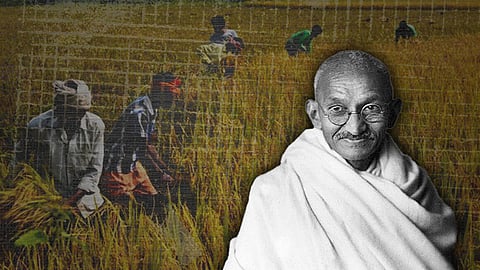

Signalling a major political shift, the Mahatma Gandhi National Rural Employment Guarantee Act (MGNREGA) was renamed the Viksit Bharat-Guarantee for Rozgar and Ajeevika Mission-Gramin (VB-GRAM G) in 2025. The choice to replace Gandhi’s name is more than just a bureaucratic adjustment. It indicates a deeper ideological change and how the Indian state narrates welfare, history, and national identity.
Governments seek to leave behind a symbolic legacy. The current Bharatiya Janata Party-led (BJP) government is no exception. Since coming to power in 2014, there has been a trend of renaming roads, cities, and museums. Politically, this aligns with their broader ideological project of reshaping India’s public memory.
This time, however, the focus has shifted to something more fundamental to the country’s identity: Gandhi and the social welfare act that supports millions of rural households providing livelihood security during lean seasons.
The name Mahatma Gandhi, associated with MGNREGA in 2005, symbolised a commitment to social justice, rural dignity, and the state’s moral responsibility towards its poorest citizens. Gandhi’s inclusion in the act was not incidental. Rather, it tied the programme to his ideas of non-violence, trusteeship, and moral responsibility instead of charity. MGNREGA reflected the idea that the state must provide work for its citizens as a matter of justice and not as a favour.
Welfare framed as a benevolence
While the name VB-GRAM G does not invoke any religious figure, the phonetic emphasis on ‘Ram’ has sparked political debates. This, combined with the removal of Gandhi’s name, is being seen as a symbolic move from constitutional morality to religious symbolism.
Ram, a key figure in Hinduism, has been rapidly mobilised in contemporary politics as a marker of cultural nationalism, replacing social ethics. This shift from Gandhi to Ram shows a trend in which welfare schemes are no longer guaranteed by the constitution but rather are benevolent offerings rooted in religious and cultural heritage.
The implications extend beyond symbolism.
MGNREGA was formulated as a rights-based programme, legally guaranteeing employment to its citizens and placing accountability on the state through institutional mechanisms such as social audits and Gram Sabha meetings. Detaching Gandhi’s legacy risks weakening the rights-based approach and turns beneficiaries into mere recipients of the state’s generosity rather than rights-bearing citizens.
Gandhi’s association with social equality, caste critique, and moral protest is now replaced by a symbol that resonates with religious identity — limiting the inclusive ethos that welfare programmes are meant to uphold.
A dilution of rural democracy
The transition from MGNREGA to VB-G RAM G represents a paradigm shift in the architecture of India’s welfare legislation. Although the new law has increased the guaranteed employment period from 100 days to 125 days, it has altered the fundamental philosophical backbone of the 2005 legislation. This marks a departure from the earlier rights-based framework.
MGNREGA served as a tool for strengthening democracy at the grassroots level by empowering gram sabhas to determine their own development priorities. This fostered a sense of political agency among the rural poor and also contributed to the higher participation of social groups like women and marginalised communities.
In contrast, under the VB-G RAM G, an ‘aggregate plan’ at the block level is created by consolidating village plans to fit a broader national infrastructure framework. While this may improve administrative efficiency, it risks diluting local autonomy as control shifts from the village council to a centralised administrative system. The emphasis moves from participatory democracy to managerial coordination.
The moral inversion of ‘Hey Ram’
There is a notable change in how labour itself is conceptualised.
MGNREGA followed the minimum wage principles, and employment was an instrument of livelihood support.
Under VB-G RAM G employment is primarily driven by productivity and economic needs. According to section 16, payments will be made based on measurements “recorded digitally through systems integrated with the designated management information system”.
In effect, this makes wage disbursement conditional upon digital verification of work done. Rather than payment for days worked, workers may be paid only after validation through online systems. This only increases reliance on bureaucratic and technological processes.
The new legislation also incorporates technological measures such as biometric authentication, geotagging, and AI oversight.
Digitisation is often justified in the name of transparency and efficiency. However, in rural areas where digital literacy is low and infrastructure is limited, such systems can be exclusionary. Under the earlier framework, the right to work was unconditional, but under the new set of rules, the right is contingent upon the successful functioning of digital systems. When technology fails, rights can become inaccessible.
The irony of the acronym’s echo of “Ram” becomes sharper when read alongside what is believed to be Mahatma Gandhi’s final words: “Hey Ram”. The phrase is often described as both spiritually and morally appealing. For Gandhi, Ram was not a political or religious slogan but a moral idea, linked to truth, compassion, and self-discipline. A symbol that Gandhi used to restrain power is now widely read as a marker of political identity.
Renaming MGNREGA to VBRAM-G is not merely about nomenclature. Rather, it is about who the Indian state chooses to be remembered as, the values associated with it, and how it sees the relationship between its citizens and authority. The entire picture reveals less about rural employment policy and more about the emerging ideological foundations of governance in contemporary India.
Sumanta Roy is studying anthropology at Washington State University, USA
Spandan Roy Basunia is a Graduate student, WBNUJS, Kolkata
Views expressed are the authors’ own.