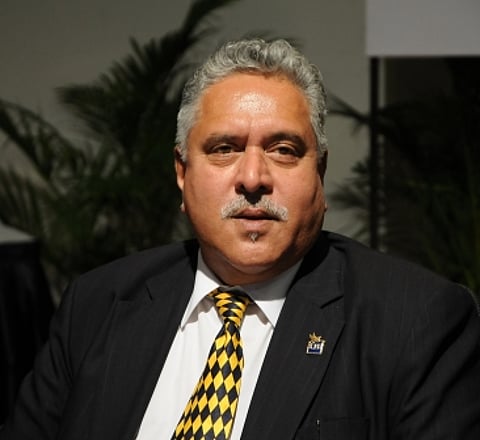

The News Minute| September 2, 2014| 4.35 pm IST
Liquor baron Vijay Mallya got no relief from the Supreme Court on Tuesday, as the court refused to intervene in his plea against United Bank of India’s (UBI) decision to declare India’s him a ‘wilful defaulter’. The Supreme Court has directed Mallya to get redressal from a high Court.
Mallya and three other directors of the Kingfisher Airlines, AK Ganguly, Subhash R Gupte and R Nedungadi, had failed to turn up for a grievance redressal panel meeting that the bank had scheduled exclusively for the airline company on 1 September. The UBI took exception to this and declared the company as a wilful defaulter. The bank had extended an overdraft of Rs. 7.5 crore which the company had not returned. In total, the airline company owes Rs. 7,000 crore to 17 banks.
Who is a wilful defaulter?
A wilful defaulter is one who defaults in repayment obligations even when he has the capacity to honour the said obligations.
Consequences
1. The decision can lead to Mallya ceding control over two of his profit-making companies, the United Breweries and the Mangalore Chemicals and Fertilizers (MCF).
2. Mallya's status as a company director or chairman can be under threat as he may not meet the criterion of 'fit and proper' as prescribed in the Companies Act. Diageo and Heineken, his partners in United Breweries Ltd. may mount pressure on him asking him to step aside.
3. Mallya find it extremely difficult to access working capital loans from the open markets as the bank will notify its decision formally to the market regulator SEBI.
4. Wilful defaulter declaration will now expose these companies to the banks and they may attach any of these.All of Mallya’s companies are under the holding company, UB Holdings that had guaranteed Rs. 6,000 crore of the total Rs. 7,000 crore loans taken by the airline company. His United Spirits Ltd., United Breweries Ltd. and the Mangalore Chemicals and Fertilizers are also under the UB Holdings.
5. UBI's decision will encourage other banks, too, to declare him as a wilful defaulter, which will make it difficult for him to access any loan.
6. Penal measures will also be initiated by the banks on the wilful defaulters.
7. Defaulters will also be debarred from institutional finance and also from floating any new venture for a period of 5 years from the date on which it is declared a wilful defaulter.
Mallya had earlier been served with a notice by the bank asking him, along with the three directors, to be present before a grievance redressal meeting on 9 July. Instead, Mallya approached the Calcutta High Court seeking a direction from it to the bank asking it to drop its plan to declare him as a wilful defaulter and also to hold the recovery proceedings that the bank was set to begin. He had also requested the court to permit him to be represented by an external legal practitioner in the grievance redressal meeting. However, Justice Dipanker Dutta on 10 July rejected his plea.
He further appealed before a divisional bench of the same court to set aside the single judge’s order. However, the divisional bench comprising of Justice Jayanta Biswas and Justice Iswar Chandra Das rejected it.
The same Calcutta High Court had earlier refused to interfere in a case filed by the lenders against Mallya and his companies which was pending before the Debt Recovery Tribunal (DRT) in Bengaluru.
The series of orders came as a continuous setback to Mallya. When his legal recourses failed, the bank served another notice on him asking to be present on 1 September. It was this meeting that he and other directors chose to not attend, forcing the bank to declare him as a wilful defaulter.
Mallya now will have the dubious distinction of being the first major Indian businessman to be declared a ‘wilful defaulter.’
