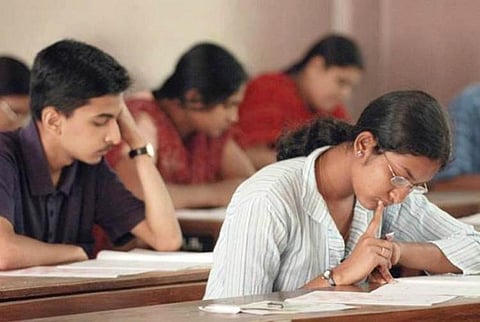

The National Testing Agency (NTA) has cancelled the NEET-UG 2026 examination conducted on May 3 after evidence emerged suggesting that the question paper had been leaked. More than 22 lakh candidates who appeared for the country’s biggest undergraduate entrance exam for entry to medical courses will now have to take a re-test on fresh dates that are yet to be announced.
The controversy has triggered investigations by the Central Bureau of Investigation, protests by student groups, and renewed criticism of the NTA’s ability to conduct secure national-level examinations.
The NTA said the decision was taken after inputs from investigative agencies indicated that the integrity of the examination process had been compromised. The agency received a whistleblower complaint on May 7, four days after the exam, regarding a “guess paper” circulating on messaging platforms. Investigators later found that more than 100 out of 200 questions in the circulated material allegedly matched the actual NEET paper.
NTA Director General Abhishek Singh told the media that cancelling the exam was necessary to preserve public trust in the system. “Any move short of cancelling exams would signal that those who are trying to beat the system, scam the system would have succeeded,” he said. In its statement, the NTA said the “present examination process could not be allowed to stand” and added that allowing the exam to continue would have caused “greater and more lasting damage” to the credibility of the system.
The investigation initially began with Rajasthan Police’s Special Operations Group (SOG) before the Union government handed the matter over to the CBI. Officials said they traced a WhatsApp group called “Private Mafia”, where a PDF containing more than 400 questions was allegedly being circulated among members who had paid money to access it. According to investigators, around 120 questions matched those in the actual NEET paper.
Police suspect the leak may have originated in Maharashtra. A medical student from Nashik, identified as Shubham Khairnar, was detained after investigators alleged that he obtained the question paper from an associate in Pune and circulated digital copies to others. Officials suspect the paper was bought for Rs 10 lakh and later sold for Rs 15 lakh. The leaked paper allegedly reached students and counsellors in Rajasthan, Kerala, Bihar, Uttarakhand, Jammu and Kashmir, and other states.
The CBI has now registered a case under multiple provisions relating to criminal conspiracy, cheating, destruction of evidence and offences under the Public Examination (Prevention of Unfair Means) Act, 2024.
The NTA has said a fresh NEET-UG 2026 examination will be conducted in the “minimal possible time”, although no official date has been announced yet. Revised exam dates and fresh admit cards are expected to be notified through official channels in the coming days. Students have been advised not to rely on rumours circulating on social media.
The agency clarified that no fresh application will be required. Existing registrations, candidature details and examination city preferences will automatically be carried forward to the re-test. No additional examination fee will be charged, and the NTA has also promised to refund fees already paid by candidates.
The uncertainty around the re-exam has left many students anxious. Divya*, a Bengaluru-based aspirant, questioned the authorities over repeated paper leak allegations. She said stricter safeguards should have been put in place after the 2024 controversy. “In 2024, when the paper leaked, they didn't cancel the exam, but in 2025, they made the paper tougher. It's not just about making the paper tough; they should make sure that it does not leak,” she said, adding, “There's no point in making the paper tough” if the integrity of the exam cannot be ensured.
The NEET 2026 controversy comes two years after a similar paper leak controversy in 2024, when demands for a re-test were rejected by the Union government and the Supreme Court. At the time, the Union government maintained that there was no evidence of a large-scale breach.
This time, however, the NTA itself concluded that the examination process had been compromised. The cancellation has triggered protests by student organisations in Delhi and Kerala, while Opposition leaders have accused the Union government of failing to protect the interests of students.
Leader of the Opposition in the Lok Sabha Rahul Gandhi said the “paper mafia gets away scot-free” while students bear the consequences. He alleged, “The hard work, sacrifices, and dreams of more than 22 lakh students have been crushed.”
Students have also questioned why repeated leaks continue despite additional safeguards introduced after 2024, including biometric verification, GPS-enabled transport of question papers and police escort for examination materials.
Another NEET aspirant, Sapna*, who had been preparing for the examination for the last two years, said the sudden cancellation of the exam had left students anxious and uncertain about their future. “It feels a bit stressful, and I don't know when we will have the re-test as well and when the results will come.” The uncertainty has thrown her plans into disarray. "We had already planned other options based on my marks. Now we are confused about whether to go forward with them.”
NEET, Sapna said, had always been her "main priority”. She has since resumed preparation, but the confidence she once had is harder to hold on to.
The latest controversy has revived demands for major structural reforms in the examination process. The Federation of All India Medical Association (FAIMA) has moved the Supreme Court seeking restructuring or replacement of the NTA and has demanded that the re-examination be conducted under judicial supervision.
The petition also seeks a shift to computer-based testing (CBT) and digital locking of question papers to reduce the risk of leaks during physical transportation. However, NTA Director General Abhishek Singh said moving NEET entirely online would be a massive logistical exercise because nearly 22 lakh students appear for the exam every year, while existing infrastructure can handle only around 1.5 lakh candidates per day.
He added that the NTA would review recommendations made by an expert committee constituted after the 2024 controversy to identify what went wrong this year despite enhanced security measures.
