
Subscribe
In late July 2026, an online storm upended the life of a 15-year-old girl. The teenager had joined the student demonstrations that forced the former Education minister Dharmendra Pradhan to resign. Like many young protesters around her, she directed her ire at Prime Minister Narendra Modi. A video clip of her comments went viral. Then came the targeted harassment campaign.
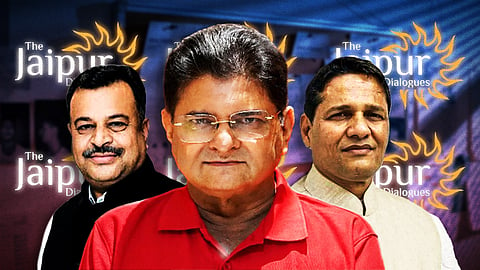
Leading the charge was an organisation called The Jaipur Dialogues. Founded by Sanjay Dixit, a former Indian Administrative Services officer, it describes itself as a “vibrant online platform that aims to promote Indic knowledge systems.” In a series of posts on X, The Jaipur Dialogues’ handle sought the girl’s identifying details, branded her “most wanted”, and eventually, doxxed her.
The 15-year-old protester faced threats of rape, murder, and acid attacks. Strangers showed up at her home. Her family and she went into hiding.
The Jaipur Dialogues defended its actions as those of a “responsible nationalist platform” in an article it published on August 1. “We posted those images on our X handle, demanded public identification of those who crossed every line of decency, and were fully prepared to back legal action,” the article said. “If demanding accountability for open contempt of the Prime Minister of India makes Jaipur Dialogues guilty in the eyes of the left, we wear that guilt proudly.”
The organisation’s conduct towards the teenager brought its wider content under scrutiny. The Jaipur Dialogues’ website—which has sections such as “Islam” and “Sanatana”—publishes stories that are often propagandist and communal. Consider some recent examples: a piece that is headlined “Demographic Jihad claims another locality in Gujarat”, and another that frames Tamil Nadu Chief Minister Vijay’s decision to challenge the state ban on cow slaughter as a “blatant nod to minority vote-bank appeasement”.
Its social media handles routinely target public figures who are Christian or Muslim. In November 2025, for instance, when the Indian cricketer Jemimah Rodrigues was dismissed after 24 runs during the final match of the ICC Women’s Cricket World Cup, The Jaipur Dialogues attacked her faith. Its post on X featured a photo of Rodrigues with the caption, “Being Sunday, Jesus is on a holiday.” In February 2026, the same account shared a video that linked Mamdani’s mother, filmmaker Mira Nair, to the American financier and child sex offender Jeffrey Epstein. “Sources claimed New York City Mayor Zohran Mamdani is Jeffrey Epstein's biological son,” read the accompanying post. (The images used in the video were fake: several news reports found that they had been generated using AI.)
We looked beyond the content that The Jaipur Dialogue publishes to trace the corporate structure behind it. This trail led us to two entities: Jaipur Dialogues Forum, a not-for-profit organisation that Dixit founded in November 2016, and JD Digital Private Limited, a private, for-profit media and content company he founded in September 2020.
The records show that this structure has political connections. At least two Bharatiya Janata Party (BJP) politicians serve as the directors of Jaipur Dialogues Forum, according to its financial documents.
We contacted Sanjay Dixit with a detailed questionnaire for this story. He did not respond to any of our queries. Instead, he told us that his wife Shruti Dixit is a “senior lawyer of standing in Rajasthan High Court, Jaipur.” He added, “So be very careful of what twist you give to whatever information you have, right or wrong. You have no right to ask any leading questions. If you publish any wrong information, be prepared for legal action.”
Jaipur Dialogues Forum, Dixit’s not-for-profit organisation, was incorporated on November 24, 2016. The objectives of Jaipur Dialogue Forum include organising events, publishing books, as well as extending support to associations, artists, and intellectuals on subjects such as literature, science, arts, music, culture, history, strategic affairs, military, economics, and education. The organisation also aims to “help, assist and work for the promotion and enhancement of the ethical standards of advertising, by all practical means”.
During a decade-old interview with Swarajya magazine, Dixit offered a more pointed description of the forum’s work. He spoke about organising a multi-day speaking event—also called The Jaipur Dialogues—through Jaipur Dialogues Forum. “Marxist narratives”, he argued, downplayed the “harsh jihadi nature” of India’s Islamic rulers. “This leftist modern narrative tries to put the onus of tolerance almost exclusively on the majority, expecting it not to react even to jihadi terrorism as a real danger. We intend to recognise and balance such narratives…” he added.
The current directors of Jaipur Dialogues Forum are: Dixit; a businessman named Vishnu Bihani; and the BJP politicians Sunil Kothari and Pankaj Joshi. When we contacted Kothari and Joshi—who have both been directors with the organisation since its inception—they confirmed these positions to us. The company’s director’s report from January 16, 2026 mentions that “it has not employed women employees during the year under review”.

Sunil Kothari has held multiple positions within the BJP’s Rajasthan unit over the last two decades. He was first appointed as one of its secretaries in July 2010, and then became its vice-president in 2018. By 2020, he was appointed the BJP district president for Jaipur city, a post he later resigned from, citing personal reasons.
Around this time, an official letter signed by JP Nadda—who was then the BJP’s national president—shows that Kothari was authorised to be the party’s legal and lawful signatory in Rajasthan for the purchases of land or immovable property anywhere in the state. According to this letter, Kothari could sign documents on behalf of the BJP for these transactions, and liaise with government authorities over construction approvals and other permissions for the BJP’s district office building.
Kothari also headed the BJP’s Office Construction Committee in Jaipur, according to news reports. In June 2024, he applied to the Jaipur Development Authority (JDA)—the city’s urban planning and development body—for the allotment of a 6,000-square-metre plot to build the BJP’s state headquarters. The JDA granted this allotment a month later. In August that year, news reports identified Kothari as a “dummy candidate” when he withdrew his nomination for a Rajya Sabha seat, paving the way for BJP leader Ravneet Singh Bittu to be elected unopposed.
Pankaj Joshi—the other director with political connections at Jaipur Dialogues Forum—is an old BJP hand too. In 2004, during Jaipur’s municipal polls, he was elected a ward councillor from the party. He went on to serve, first as the city's deputy-mayor, and then its mayor in 2009.
By July 2021, Joshi was appointed the state media coordinator of the BJP in Rajasthan. He no longer holds the post. His profile on X mentions that he is an independent director at PNB, presumably the state-owned public sector bank, Punjab National Bank. A PNB document shows that Joshi was appointed as a part-time non-official director to PNB’s board in December 2021 for a period of three years.
Between September 2019 and August 2023, Congress leader Sunil Sharma was a director of Jaipur Dialogues Forum. In March 2024, after his association with Jaipur Dialogues Forum became public, the Congress dropped him as a candidate for the Lok Sabha polls that year. When we contacted him over the phone, he refused to comment.
Bihani, the businessman who is the company’s fourth current director, frequently appears on The Jaipur Dialogues’ podcasts and videos. His timeline on X reflects posts and retweets that attack opposition parties and make unverified claims about conversions to Christianity. He did not respond to our request for comment.
Both JD Digital and Jaipur Dialogues Forum are registered to the same address: a house in Palm Court, an upscale residential neighbourhood in Jagatpura, located in southeast Jaipur.
Over the last few years, most of Jaipur Dialogues Forum’s revenue has come from donations.
In the financial year 2024-’25, its income stood at about Rs 28 lakh, all from donations; in 2023-’24, this figure was about Rs 39 lakh, of which Rs 29 lakh was from donations. in 2022-’23, it was about Rs 25 lakh, of which Rs 16 lakh was from donations; and in 2021-’22, its income stood at about Rs 3.3 lakh of which Rs 2.9 lakh was in donations, according to the organisation’s financial statements submitted to the Registrar of Companies. (The latest year for which Jaipur Dialogues Forum’s financial statements are available is 2024-’25.)
The website of The Jaipur Dialogues—which is linked in its social media accounts—solicits Indian and international donations. A link titled, “support us”, on this website leads to a page on JD Digital’s website, which provides payment links for donors, both from within India and abroad.
The directors of JD Digital are Sanjay Dixit and his son, Shrauteya.
This company—which handles The Jaipur Dialogues’ website and social media accounts—earned about Rs 6.6 crore in revenue during the financial year 2024-’25. That year, it spent about Rs 83 lakh on employees, and about Rs 1.72 crore on production. It made a profit of Rs 1.13 crore after tax. Since JD Digital was formed in 2020, it has cumulatively paid just under Rs 4 crore to Sanjay Dixit, his son Shrauteya, and his wife Shruti.
Its revenue sources appear to be subscriptions on the website of The Jaipur Dialogues; as well as monetised content, digital advertisements, and events across its website and social media audience of over three million on YouTube, Facebook, Instagram, and X.
The company’s financial statements reflect that it has received some payments in foreign currency since it was formed in 2020.
These foreign payments account for about 53% of JD Digital’s total revenue between the financial years 2020-’21 and 2024-’25. In its annual returns, the company describes the payments as “earnings” in foreign exchange, which form a portion of its revenue from operations.
A May 2025 investigation by the website Bellingcat, noted that The Jaipur Dialogues has an American counterpart called “Jaipur Dialogues USA” on YouTube. A recurring host on this channel, the investigation added, was Vibhuti Jha, a businessman who unsuccessfully ran as the Republican candidate in the New York State elections of 2022, and “appeared to have a close relationship with the VHP [Vishwa Hindu Parishad] America.”
JD Digital’s financial statements show that the company paid significant amounts to Sanjay Dixit and his family. These are recorded as payments made to the company’s Key Managerial Personnel and their relatives. Since it was founded in September 2020, it has paid Sanjay Dixit; Shrauteya, his son and co-director in the company; and his wife Shruti just under Rs 4 crore.
These amounts are: Rs 21.3 lakh in 2020-’21; Rs 51.5 lakh in 2021-’22; Rs 75.7 lakh in 2022-’23, Rs 83.5 lakh in 2023-’24; and Rs 1.67 crore in 2024-’25. These payments include salaries, fees for legal or management consultancy, fees for use of trademarks, honoraria, event expenses, content expenses, and rent.
JD Digital’s financials also reflect amounts payable to Sanjay and his family members, as well as a firm called 5 Dots Thought Process LLP, in which his son Shrauteya is a co-director. The filings describe these as payments due to “sundry creditors.” Between the financial years 2021-’22 and 2024-’25, the total amount recorded as payable to these entities is about Rs 66.5 lakh. From the financial statements, it is unclear whether these particular payments include those made to the Dixits as Key Managerial Personnel and relatives of Key Managerial Personnel. (Shrauteya Dixit did not respond to a detailed questionnaire for this story.)
Between 2022 and 2026, the company has bought three cars. Loan documents signed by Shrauteya show that JD Digital took a loan of about Rs 35 lakh for a Skoda Kodiaq L&Q SUV in 2022; Rs 12 lakh for a Windsor Exclusive EV in 2025; and Rs 45 lakh for a Mercedes Benz C300 AMG Line luxury sedan in 2026.
JD Digital’s clients appear to include a Public Sector Undertaking. The state-owned Oil and Natural Gas Corporation (ONGC) owed the media company about Rs 1.69 lakh at the end of the financial year 2025-’25, the company’s financial statements show. (The documents do not reflect what exact service ONGC was to make this payment for.)
We requested an ONGC spokesperson for details of the PSU’s association with JD Digital. This article will be updated if we receive a response.
After we sent requests for comment to Sanjay Dixit and his son Shrauteya, The Jaipur Dialogues’ social media account on X posted that The Wire, Newslaundry, and The News Minute—which it identified as “the above Left Leaning”—were preparing a “Hit Job on Jaipur Dialogues.” This, the post claimed, could be a “way of getting back at the Nationalist ecosystem” that had “exposed” the Cockroach Janata Party and its funding. The post tagged the accounts of right-wing commentators Abhijit Iyer Mitra and Office of Vijay Patel to claim, with no evidence, that they “are the next Target.”
With inputs from Ayush Joshi and Maria Teresa Raju.
Follow TNM's WhatsApp channel for news updates and story links.