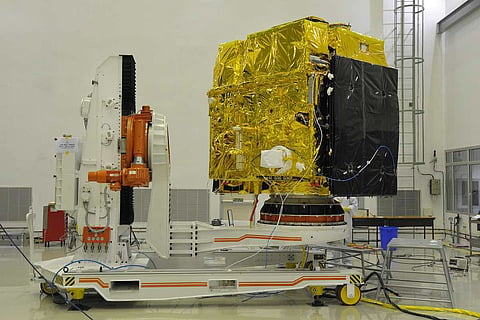

A team of astronomers have discovered one of the farthest star galaxies in the universe with the help of AstroSat, India's first multi-wavelength space observatory, which detected extreme UV light from this galaxy located 9.3 billion light-years away from Earth.
The galaxy, called 'AUDFs01' was discovered by a team of astronomers, led by Dr Kanak Saha from the Inter-University Centre for Astronomy and Astrophysics (IUCAA) situated in Pune, a release from the government said on Tuesday.
The galaxy was observed by Saha's team within the patch of sky called the Hubble eXtreme Deep Field (XDF), which sits at the centre of the Hubble Ultra Deep Field (HUDF). The HUDF is a small area in the Fornax constellation, which is created using Hubble Space Telescope data from 2003 and 2004. It consists of thousands of galaxies, and became the deepest image of the universe to have ever been taken at the time.
Director of Inter-University Centre for Astronomy and Astrophysics (IUCAA) Dr Somak Ray Chaudhury regarded that this discovery is a very important clue to understand how the dark ages of the Universe ended and that there was light in the Universe. He also said that finding the earliest sources of light has been very hard.
Union Minister of State of Atomic Energy and Space, Dr Jitendra Singh has hailed this achievement and called it a matter of pride as Indian astronomers were part of the research team. He also congratulated India’s space scientists, saying that threat once again proved to the world that India’s capability in space technology has risen to a distinguished level from where India's scientists are now offering cues and giving leads to the space scientists in other parts of the world.
India’s first space observatory, AstroSat was launched by the Indian Space Research Organization (ISRO) on September 28, 2015, during the first term of the Narendra Modi government. It was developed by a team led by ShyamTandon, Ex-Emeritus Professor, IUCAA, along with support from ISRO.
The observatory has five telescopes seeing through different wavelengths simultaneously — visible, near UV, far UV, soft X-ray and hard X-ray. It can observe the same target in visible, X-ray, and UV wavelengths together.
