
Subscribe
What does it mean to invoke women's rights to deny an already marginalised community the right to its identity, dignity, and recognition? A petition filed in the Supreme Court by a self-described feminist organisation, Women's Declaration International India (WDI India), has put that question at the centre of a contentious legal battle over transgender rights in India.
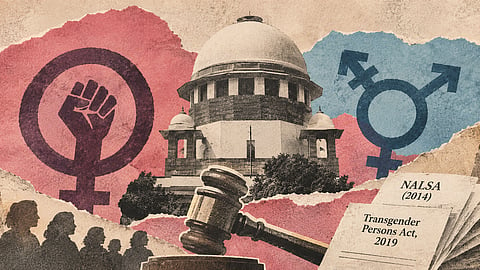
Arguing that recognising transgender women as women threatens the rights, safety, and entitlements of cisgender women, the organisation wants the Supreme Court to reconsider its landmark 2014 judgment in National Legal Services Authority (NALSA) vs Union of India, which established the constitutional right to legal recognition of gender identity. It also seeks to strike down provisions of the Transgender Persons (Protection of Rights) Act, 2019, that enable transgender people to obtain official documents reflecting their gender identity.
While WDI India claims that it is not questioning transgender people's right to identify as they wish or their right to protection against discrimination, the reliefs it seeks go considerably further.
Among other things, it wants the legal framework enabling transgender persons to obtain documents reflecting their gender identity declared unconstitutional. It also challenges a provision that criminalises verbal and emotional abuse of transgender persons, arguing that it could restrict speech by women advocating for sex-based rights.
The petition was filed on October 8, 2026, under Article 32 of the Constitution. On October 28, a Supreme Court Bench comprising Chief Justice of India Surya Kant and Justices Joymalya Bagchi and V Mohana issued notice to the Union government and tagged the petition with the ongoing batch of cases challenging the 2026 amendments to the Transgender Persons Act.
The central argument raised in the petition is that gender identity and biological sex are distinct, and that recognising someone as a woman on the basis of their gender identity should not automatically entitle them to every protection or benefit specifically intended for women. It argues that the legal framework has allowed people assigned male at birth to obtain documents identifying them as female, and that this undermines women's reservations, employment opportunities, privacy, safety, and access to sex-segregated spaces.
The petition, however, does not establish how recognising transgender women's identities has resulted in a systemic threat to cisgender women's rights. Instead, it uses a series of individual court cases involving elections, sports, employment, and accommodation to build a broader narrative of transgender women encroaching upon women's rights. Its underlying premise also raises a more fundamental question: whether the rights of transgender people and cisgender women must necessarily be in conflict.
What is the petition asking for?
The petition challenges Section 7 of the Transgender Persons (Protection of Rights) Act, 2019, as amended in 2026, and Rule 7 of the Transgender Persons (Protection of Rights) Rules, 2020. It also challenges other provisions of the Rules and administrative practices that allow changes to gender markers in official documents.
Under the original 2019 Act, Section 6 provided for a certificate recognising a person as transgender. Section 7 allowed a trans person who underwent surgery to change their gender to male or female to apply for a revised certificate from the District Magistrate. The original Section 7(3) also allowed the person to change their first name in their birth certificate and other official documents.
Rule 7 of the 2020 Rules laid down the procedure for updating gender, name, and photographs in official documents following the issuance of a revised certificate.
The 2026 amendment substantially changed this framework. It narrowed the definition of transgender persons under Section 2(k), omitted Section 4(2), which expressly recognised the right to self-perceived gender identity, and introduced a medical board into the certification process. It also deleted the original Section 7(3), which provided for first-name changes following the issuance of a revised certificate, while introducing a separate provision under Section 6(4) concerning name changes for persons recognised as transgender under the amended definition.
The amendment came into force on May 25, 2026.
WDI India argues that the amended law continues to allow people assigned male at birth to obtain documents identifying them as female, despite the changes. It contends that Rule 7, read with other provisions of the Rules, goes beyond what the amended Act permits. It also challenges the Unique Identification Authority of India (UIDAI)'s Standard Operating Procedure for name and gender updates, arguing that the administrative practice of changing gender markers in official documents is unconstitutional.
The petition wants the Supreme Court to strike down Section 7 of the Act and remove several rules that it argues go beyond what the law allows. It also wants the court to rule that documents issued under these rules cannot be used by trans persons to claim rights and benefits specifically meant for women.
Importantly, the petition also asks the court to strike down a statutory protection against abuse of transgender persons.
It challenges Section 18(d) of the Act, which makes verbal and emotional abuse of trans persons punishable by law. The provision covers different forms of abuse, including physical, sexual, verbal, emotional, and economic abuse that harm or threaten a trans person’s safety and well-being. WDI India argues that making verbal and emotional abuse punishable could restrict freedom of speech and expression, as well as religious freedom. It claims this could penalise women for expressing opposition to gender identity claims.
An attempt to dilute NALSA
The most consequential aspect of the petition is its challenge to NALSA, the 2014 Supreme Court judgment that established the constitutional foundation for the legal recognition of transgender identities in India.
In NALSA vs Union of India, the Supreme Court held that discrimination on the ground of sex under Articles 15 and 16 of the Constitution includes discrimination based on gender identity. It recognised gender identity as an essential aspect of dignity and personal liberty under Article 21, and held that an individual's own understanding of their gender must be given primacy.
The court also expressly held that no person should be forced to undergo gender affirmation surgery, sterilisation, or hormonal treatment as a prerequisite for legal recognition of their gender identity. Its directions required the Union and state governments to recognise trans persons as male, female, or third gender, according to their gender identity.
WDI India, however, argues that NALSA did not decide whether legal recognition of a person's gender identity automatically places them within the constitutional or statutory category of the opposite sex, or entitles them to every benefit reserved for that category.
It wants the Supreme Court to read down the judgment, particularly its directions recognising self-determined gender identity, and clarify that transgender status or gender identity does not override biological sex or automatically confer access to protections specifically intended for biological women.
Using individual cases to construct a threat narrative
To substantiate its argument that transgender women's legal recognition undermines women's rights, the petition cites several judicial decisions involving women's-reserved electoral constituencies, sporting competitions, educational institutions, and employment.
It presents these cases as examples of transgender women accessing opportunities and spaces designated for women. However, the orders notably concern different circumstances and do not, in themselves, establish that cisgender women were denied rights or that their safety, privacy, or opportunities were compromised.
Among them is Anjali Guru Sanjana Jaan vs State of Maharashtra (2021), in which the Bombay High Court allowed a transgender woman to contest a gram panchayat election from a constituency reserved for women. Her nomination had initially been rejected because of her gender identity. The court overturned that rejection, relying on the right to self-perceived gender identity recognised under the then-existing 2019 Act.
It also cites decisions of the Kerala State Election Commission in November 2025 that reportedly permitted two transgender candidates, Amaya Prasad and Arunima M Kurup, to contest local body elections from constituencies reserved for women.
WDI India frames these decisions as instances of people assigned male at birth being allowed to contest elections from seats intended for “biological women”. But neither of these cases, by itself, establishes that a cisgender woman was displaced from an elected position or deprived of the opportunity to contest.
The petition also mentions Hina Haneefa vs State of Kerala, in which the Kerala High Court allowed a transgender woman to enrol in the Girls Division of the National Cadet Corps (NCC). The court held that the NCC Act could not be used to defeat the rights and protections recognised under the Transgender Persons Act. A subsequent Division Bench upheld her entitlement to enrolment, while modifying the direction requiring the government to amend the NCC Act.
Another case cited is Anamika vs State of Kerala (2022), in which a trans woman’s application to participate in a district-level judo competition was blocked after she was informed that transgender persons would not be allowed to compete. With no separate category for transgender athletes, the Kerala High Court held that organisers could not exclude her from the competition altogether. It directed the Kerala Judo Association and the Kozhikode District Judo Association to accept her application and allow her to compete provisionally in the female category, subject to the final outcome of the case. WDI India cites the case to argue that allowing transgender women to compete in women's sporting categories raises questions about competitive fairness.
The petition further invokes a November 2025 Madras High Court order in S Mani vs Additional Chief Secretary to Government. The case concerned Mani, who had been appointed as a male nursing assistant at the Central Prison in Cuddalore before she underwent gender-affirming surgery. But after her surgery, she was not allowed to resume work, and her salary was stopped. The court directed the Tamil Nadu government to depute her to a vacant post of female nursing assistant at a government hospital in Cuddalore, and to pay her pending salary.
WDI India, meanwhile, argues that the court's order failed to account for the privacy of female patients who may require intimate care, such as bathing, toileting, catheterisation, and wound care. It uses this concern to question the appointment of transgender women in roles involving the care of female patients. However, the petition does not establish that Mani's appointment resulted in any breach of patient privacy or that she was unable to perform the duties of the post.
Taken together, these cases are presented as evidence that recognising gender identity has allowed people assigned male at birth to access rights and spaces intended for women. But individual judicial decisions concerning electoral participation, employment, education, and sports do not, by themselves, establish that transgender women's inclusion poses a systemic threat to cisgender women. Nor do they establish that transgender persons have systematically displaced women from reservations or endangered women in sex-segregated spaces.
Women's organisations reject the petition
The petition has also drawn criticism from established women's organisations. The All India Democratic Women's Association (AIDWA), in a statement issued on October 30, strongly condemned the plea and rejected the suggestion that recognising transgender people's rights undermines those of cisgender women.
“The exclusion of trans women is misogynist and defeats the feminist movement,” the organisation said. It described the petition as “discriminatory, contemptuous and a complete violation of human rights,” adding that it stood in solidarity with the transgender community and supported the legal challenges to the 2026 amendments.
The All India Feminist Alliance also issued a statement on November 10, rejecting WDI India's trans-exclusionary position and asserting that women's rights and transgender rights are not in conflict.
The criticism also raised questions about WDI India's claim to represent feminist interests. While its petition presents its position as one taken in defence of women, its proposed restrictions would deny transgender women legal recognition and challenge protections against their abuse. As feminist researchers and activists have pointed out, the history of women's movements in India has involved challenging narrow and exclusionary definitions of womanhood, including those shaped by caste, class, and gender norms.
The stakes are particularly high because the petition is being heard alongside challenges to the 2026 amendments, which have already substantially narrowed the statutory recognition of transgender identities. While those amendments removed the express statutory right to self-perceived gender identity and introduced a medical board into the certification process, they did not overrule the Supreme Court's constitutional judgment in NALSA.
WDI India's petition seeks to take that challenge further. Its argument is that transgender people can be protected against discrimination without being legally recognised as belonging to the gender with which they identify. But legal recognition is not an incidental benefit separate from dignity and equality. It is central to the ability of transgender people to access public institutions, employment, healthcare, and ordinary social life without being forced to repeatedly defend their identities.
The Supreme Court has not yet adjudicated the constitutional questions raised by the petition. But the attempt to frame the recognition of transgender identities as an encroachment on women's rights risks legitimising precisely the exclusion that the Constitution's guarantees of equality and dignity are meant to prevent.
