
Subscribe
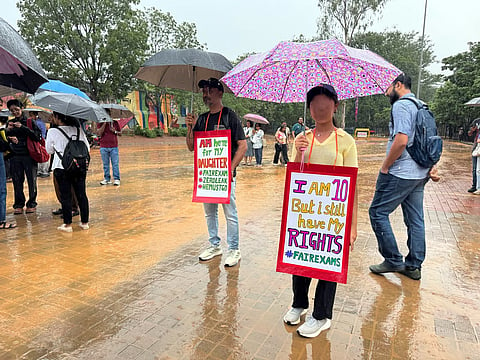
The nationwide agitations over alleged NEET-UG paper leaks have quickly become something larger: An organised effort by a new generation to hold the Union government accountable.
As thousands of students sat in at New Delhi's Jantar Mantar, a project of delegitimation began. Protestors were portrayed as anti-nationals and as “foreign funded”. Their struggles were made light of. The state’s violence was presented as both fitting and necessary. The students were mocked viciously. Unsurprisingly, women protestors became the target of the trolls both in mainstream newsrooms and on social media.
For a generation that never quite learned to defer to its elders, irreverence, satire and humour have turned into chosen tools of protest. When the powerful make absurd accusations, how else to respond but laugh in their faces?
For instance, Urwashi Palandurkar, a student, was mocked and called ‘Babar ki Virasat’, implying that by dancing at a protest, she had destroyed Indian culture as the right-wing believes Mughal emperor Babar did.
she had brought disrepute to Babar’s legacy. (It’s anyone’s guess why India’s right wing is suddenly defensive of a Mughal emperor.)
Following the onslaught of such similar media coverage about her, many reached out to Urwashi in solidarity, enquiring if she was okay. At the start of her reel, Urwashi somberly observes that she is not, indeed, okay. And then she bursts into laughter.
“I’m so sorry. I can’t take this seriously,” she chuckles. Referring to the media channels targeting her, she said, “Point number 1: Your caption game is very weak … what is ‘Babar ki virasat’? It’s unrelatable, guys.”
Using a spoof PowerPoint presentation, she also points out that one can excel in both academics and extracurricular activities. She shows off her own medals as an example.
Another post refers to Prime Minister Narendra Modi as Mowgli from The Jungle Book. While the literary subtext is not immediately apparent, the names do sound vaguely similar to each other.
In the video, a group of young women stage a mock rally in praise of ‘Mowgli’, chanting that the nation is with him even when airports and the railway sector are privatised; when gas and fuel prices skyrocket; when exam papers are leaked; and critiques are branded as traitors.
Others sarcastically spoke of the PM’s “glow up”. Harking back to his tenure as Gujarat’s Chief Minister, a student says, “He needs to tell us his skincare routine.”
Making a parody of the Union Government's efforts at damage control, yet another post lists potholes, policy failures, farmers’ protests and crony capitalism as achievements.
Even this irreverence is too often dismissed as a lack of gravitas or depth. Gen Z seem to have realised that they’d be damned both ways. When highlighting misogyny or casteism is met with accusations of ‘playing a victim card’, when the aim is to intimidate and silence, humour becomes a means to reduce the trolls to mere jokes.
Where self-important trolls hope for fear, they’re met with intentional and bemused disregard.
But do note that this is not the first time in history that anyone has fought authoritarianism with jokes. Even with respect to the BJP, this is not the first time. But it is certainly unmatched in its sheer scale.
Some may recall the viral ‘fairy’ comments that beset Modi around 2022. Born on the now-banned TikTok, fairy comments are replies to posts that start off sounding like a compliment but end with a sting. Such comments are often peppered with friendly emojis like sparkling stars and hearts for an additional edge of satire. These were originally social media 'take-downs' between individual content creators. The trend did not start off as a political commentary.
At the time, in India, it became a means of critique, spilling over into X and Instagram. One example: “Haters can hate, but Modi stopped the second wave of Corona by not stopping the first wave.”
Another quipped about common sense among the right-wing. “Like trans rights in India, it doesn’t exist.”
Humour, it appears, is the counter to hubris.
Yet, it’s worth remembering that despite the inexcusable violence done to protestors, caste and class continue to function as shields. Affluent Gen Zers can still get away with memeing a government that has taken legal action against marginalised people for their social media posts.
Our youth don’t deserve to be demonised when they speak up for their rights. But while we celebrate their irreverence, we also can't forget those for whom satire isn’t an option.
Views expressed are the author’s own.
