How old is Monalisa Bhosle? Two states & many truths behind an interreligious marriage

Monalisa Bhosle first became an internet obsession at the Maha Kumbh. Months later, her marriage triggered an NCST inquiry, abduction allegations, conflicting birth records, and a political battle stretching from Kerala to Madhya Pradesh.
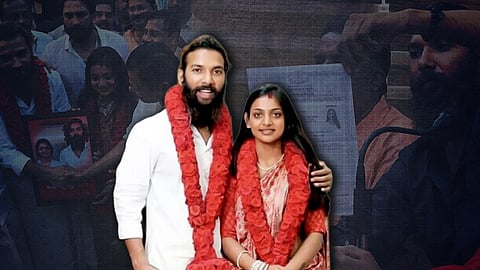
Composite image of Monalisa Bhosle and Farman Khan wearing red flower garlands after their wedding ceremony. The couple stands in the foreground, while faded background visuals show crowds, cameras, and documents, reflecting the public and political controversy surrounding their marriage.
Monalisa Bhosle and Farman Khan after their wedding in Thiruvananthapuram.
Written by:
Published on

Follow TNM’s WhatsApp channel for news updates and story links.

On March 11, 2026, when Monalisa Bhosle married Farman Khan at a temple in Thiruvananthapuram, the facts seemed settled, at least on paper. She had approached the Kerala police, stated that she was acting of her own will, and produced documents showing she was an adult. The marriage was registered with the local authorities, seemingly after due process was followed. For the state, that was enough to recognise her as someone capable of making her own choices.

But this was Monalisa, the young Banjara tribal woman whose life had already become a public spectacle long before her wedding to a Muslim man. 

In January 2025, during the Prayag Maha Kumbh Mela, videos of her selling rudraksha beads had all but exploded online. Her striking eyes became the subject of endless reels and reposts and even television reports, turning her into a viral sensation almost overnight. In many of those early accounts, she was casually described as a teenager, often said to be around 16, though few seemed interested in verifying the details.

In the meantime, as is often the case, the heightened attention had also turned invasive. Monalisa’s stall began drawing crowds more interested in filming and photographing her than buying anything. Videos from the mela showed people surrounding her for selfies, while groups of men followed her through the grounds as she tried to move around or work. Reports later documented how the constant attention eventually disrupted her ability to work altogether, forcing her family to leave the Kumbh Mela.

In hindsight, it is difficult not to see the irony. Long before her marriage became a national talking point, Monalisa’s virality had already cost her privacy, safety, and the ability to exist in public without being constantly watched, filmed, and interpreted by strangers.

So when Monalisa arrived in Thiruvananthapuram for her wedding a year later, the cameras followed her there too. By then, she had become more than just a viral face from the Kumbh. She was a public character onto whom people were projecting their fantasies and political narratives, and even ideological anxieties.

The wedding itself quickly became something larger than the couple at its centre. Senior leaders of the Communist Party of India (Marxist) [CPI(M)] — including then Kerala Education Minister V Sivankutty, party state secretary MV Govindan, and Rajya Sabha MP AA Rahim — attended the ceremony and publicly endorsed the couple. Invoking the idea of the “real Kerala story”, they positioned the marriage as a rebuttal to The Kerala Story, the controversial film that portrayed the state as a site of organised religious radicalisation. 

Monalisa Bhosle and Farman Khan, both wearing red flower garlands, stand surrounded by CPI(M) leaders and supporters during their wedding event in Thiruvananthapuram. The couple are seen shaking hands with a leader while holding a framed photograph of themselves as a crowd gathers around them.
CPI(M) leaders including MV Govindan, V Sivankutty, and AA Rahim attend the wedding of Monalisa Bhosle and Farman Khan in Thiruvananthapuram on March 11, 2026. The marriage was publicly hailed by Left leaders as “the real Kerala story”.

Within days, however, another version of Monalisa’s story began taking shape hundreds of kilometres away in Madhya Pradesh. 

An activist’s complaint before the National Commission for Scheduled Tribes (NCST) questioned whether she was even an adult. A hospital birth register surfaced, showing she was still a minor. An FIR alleging abduction was registered against her husband Farman who is from Bhagpat district in Uttar Pradesh.

The same marriage that Kerala’s political leadership had celebrated as proof of the state’s secular values was now being reframed in Madhya Pradesh as a case of child marriage, abduction, conspiracy, and “love jihad.” Very quickly, the relationship became part of a symbolic political confrontation between two states and their dominant ideologies.

In the months since, Monalisa and Farman have gradually vanished from the public eye. Though Farman has secured interim protection from arrest through a court order, the outcome of the Madhya Pradesh probe could still determine whether charges under the Protection of Children from Sexual Offences (POCSO) Act are eventually invoked against him.

While pursuing the story, TNM reviewed entries from the Madhya Pradesh government’s Samagra portal, an all-inclusive digital database that showed that Monalisa’s date of birth had been altered by her family in May 2025. This was months before the marriage, and even before she and Farman purportedly met in August that year. Who altered this and why remains unclear. And hospital records submitted to the NCST have further complicated the story.

The making of the ‘real Kerala story’

Despite the harassment she had to endure, the viral attention surrounding Monalisa also appeared to open doors for her. Modelling opportunities and film offers came knocking, including from outside Hindi cinema. Somewhere along that trajectory, she met Farman Khan.

According to the couple, they first met during the pooja ceremony of the Malayalam film Nagamma, which was held on August 26, 2025. “I was the lead villain in the film and she was the heroine,” Farman later told reporters in Thiruvananthapuram. “It was from there that Monalisa proposed to me.”

“Yes, it was me who proposed first,” Monalisa added with a giggle.

Monalisa Bhosle and Farman Khan shake hands during the pooja event of the Malayalam film Nagamma. Several people, including a child, stand around them on stage beside a ceremonial lamp.
Monalisa Bhosle and Farman Khan at the pooja ceremony of the Malayalam film Nagamma in August 2025. The couple later said this was where they first met before eventually marrying in Kerala months later.Screengrab / Manorama News
Loading content, please wait...
The News Minute
www.thenewsminute.com