
Subscribe
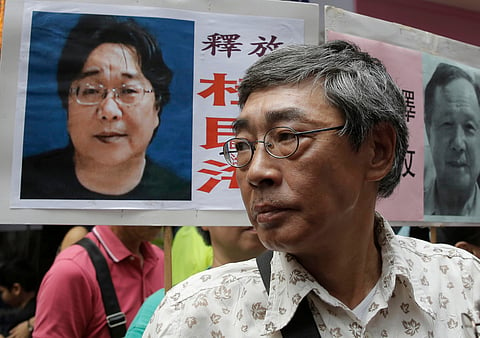
Lam Wing-kee, a former Hong Kong bookseller who became a symbol of resistance to Beijing's crackdown on speech freedom after he was seized by Chinese authorities in late 2015, has died in Taiwan, the island's official Central News Agency reported, citing an unnamed source.
The news agency didn't give a cause of death but said the 70-year-old Lam had a cancer relapse last year and was admitted to MacKay Memorial Hospital in Taipei on Tuesday. He fell into a coma on Wednesday and died Thursday evening, according to the report.
Lam, who was the manager of Causeway Bay Books in Hong Kong, moved to Taipei in 2019 over fears of legal troubles and reopened the bookstore under the same name in the Taiwanese capital in 2020.
Taiwan's President Lai Ching-te offered his condolences in a Facebook post.
“The passing of Mr Lam Wing-kee is deeply saddening, but the courage he left behind would not fade,” Lai wrote. “Taiwan will remember that a Hong Kong bookstore worker once told us in the most ordinary yet most steadfast way how precious freedom is and reminded us that democracy requires the efforts of generation after generation to defend it.”
Lam was one of five people affiliated with Causeway Bay Books who disappeared in late 2015. The store sold books and magazines that were not available in mainland China, including some that purported to reveal secrets about the inside lives of Chinese leaders and the scandals surrounding them.
The disappearances raised concern about Beijing's growing reach into Hong Kong and the erosion of freedoms in the city, which is part of China but has its own legal system and laws.
One of the five, Gui Minhai, a publisher who was a part-owner of Causeway Bay Books, went missing from his holiday home in Thailand. He was sentenced in 2020 to 10 years in prison in China on a charge of illegally providing intelligence overseas.
In an act of defiance, Lam gave an explosive account of his experience in 2016 that contradicted official Chinese accounts of what happened to the five booksellers.
He said that he was seized by Chinese authorities in October 2015 after crossing the border from Hong Kong to the city of Shenzhen on China's mainland, and that he was blindfolded for a 13-hour train ride to the eastern city of Ningbo, where he was kept under 24-hour surveillance in a room for five months by rotating two-person teams.
Speaking to a packed news conference in Hong Kong, he said he was later forced to appear on Chinese television to confess to crimes.
Last month, Lam told the Central News Agency that he had temporarily closed the bookstore in Taipei because of his health and that he couldn't say when it might reopen. A man from Hong Kong, who did not give his name, left a white rose outside the entrance to the shop on Monday.
Chinese and Hong Kong authorities have further tightened control over the city, shutting down virtually all dissent, following massive anti-government protests in 2019.
Hong Kong police, acting under a 2024 national security law, arrested two people in June who reportedly own a bookstore. They are suspected of selling seditious publications and receiving funds from foreign political organizations, police said.
Follow TNM's WhatsApp channel for news updates and story links.
