
Subscribe
Steinem has always been candid about the impact her early life had on the decisions she later made.
Ten years after she was born in Toledo, Ohio (March 25 1934), her parents divorced. Following the departure of her travelling salesman father, young Gloria was left taking care of her mentally ill mother until she graduated from high school and her sister took over.
Years later she reflected that she “became a grown-up too early, from ten to 17, a small person responsible for a big person”.
Rejecting marriage, she said she did not want to end up taking care of someone else (although much later, in 2000 at the age of 66, she did marry entrepreneur and activist David Bale, who died of lymphoma four years later).
Studying government at Smith College, Massachusetts, she graduated with distinction, then spent two years studying and researching in India thanks to a Charles Bowles Fellowship, an experience she credited with inspiring her interest in grassroots activism.
Like many female journalists starting out in the 1950s and 60s, Steinem’s initial assignments were limited to “women’s pages”. These typically reported on “women’s issues”, such as health and fashion.
When she suggested writing political stories to her editor at The New York Times Sunday Magazine, he “just said something like, ‘I don’t think of you that way’”.

She came to national attention as a journalist in 1963 with her expose, I Was a Playboy Bunny, based on the 11 days she worked undercover at Hugh Hefner’s Playboy Club.
Although she still wasn’t taken seriously as a reporter, the publicity raised by this experience showcased the sharp and uncompromising intelligence for which she would later become known. In an exchange between the two published a few years later, Hefner declared he was “all in favour of women being able to vote, own property, and all that. But I want women to be attractive to men”.
Steinem responded to this long overdue endorsement of rights that had been afforded to at least white women as far back as the late 19th and early 20th century, that she wanted “men to be attractive to women. But I don’t want their whole identity to rest on that”. She concluded: “what Playboy doesn’t know about women could fill a book.”
In 1971, frustrated by the mainstream press’s stymieing of feminist reporting, Steinem and fellow journalists established Ms. Magazine as an insert in New York magazine.
By 1972, Ms. Magazine had established itself as an independent paper, with which she maintained a close association throughout her life.
While Ms. became an influential platform for contemporary women’s politics, it also brought feminist history to life. In its series Lost Women, it introduced Women’s Liberation era readers to pioneering feminists from around the world whose achievements had gone unrecognised.
Steinem also authored books and memoirs including An Unexpected Life, The Truth Will Set You Free, But First It Will Piss You Off, and Outrageous Acts and Everyday Rebellions, among others.
Her lifetime of writing has been recognised with a multitude of awards.
But Steinem was not one to report from behind a desk. She became an iconic face of feminism, gracing magazine covers and TV screens, interviewing, speaking, marching, and advocating for girls’ and women’s rights for more than six decades.
In 1969, she addressed a crowd in New York State about legalising abortion. She told them about the abortion that she had had in London when she was 22.
Indeed, so dedicated was she to women gaining and retaining control over their bodies and reproductive choices that she dedicated her book, My Life On The Road, to the London physician John Sharpe, “who carried out her abortion back when it was illegal to do so”.
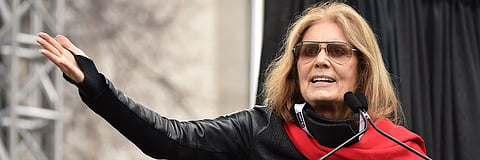
In 2017, she spoke at the Women’s March on Washington, galvanising anti-Trump demonstrators and urging younger generations to keep up the fight.
Steinem also believed in structural pathways to reform, helping fellow feminists to establish, among other activist organisations, the National Women’s Political Caucus (that works for gender equality in public office), the Women’s Action Alliance, (which promotes non-sexist, multi-racial children’s education), the Women’s Media Center (to promote positive images of women in media) and the Ms. Foundation for Women.
There is no doubt Gloria Steinem will be remembered for all of these remarkable achievements. Her life was one of seemingly boundless energy and enthusiasm, passion and frustration, action and activism.
After all, these accomplishments have been marked by high profile acknowledgements, from the Presidential Medal of Freedom that President Barack Obama presented to her in 2013, to the establishment in 2017 of The Gloria Steinem Endowed Chair in Media, Culture, and Feminist Studies at Rutgers University.
However, those closest to her, or even those just fortunate enough to have encountered her, say it is her ethos of connecting across groups, regions and time that will define her legacy.
Illinois Lieutenant Governor Juliana Stratton, the sixth Black woman senator in the US, got Gloria Steinem’s endorsement. Stratton said she would remember the iconic feminist for her inspirational work behind the scenes:
she made the case for intersectional feminism and for the fight for racial equality in New York magazine in 1969, in a popular article headlined ‘After Black Power, Women’s Liberation’ and continued that work throughout her life.
This was an essay in which Steinem declared that if the women’s movement could form alliances with the less radical middle classes, then it should be easy for them to do the same with “poor women of all colours”.
She also adopted a mixed approach to the emotional dimensions of feminism.
She embraced warmth and connection, viewing the women’s movement “like a big chosen family” and feeling “excited by young women now”.
But she wasn’t afraid to teach or correct those younger women.
The #MeToo movement, she said, was not an unprecedented event. It was the continuation of a long campaign that had begun in the early 1970s, “when women college students first coined the term ‘sexual harassment’ to describe what happened to them on summer jobs”. She highlighted the contributions of the Black women who had brought cases before the courts, thereby educating the nation.
At a packed Town Hall meeting in Melbourne in 2016, she told the young woman who asked her what the women’s movement had done wrong: “I think we’ve been too nice.”
Nice or not, Steinem believed the women’s movement would only survive and thrive if her generation was to prepare the next. While alive, she said she was not passing the baton:
I’m keeping my torch, thank you very much – and I’m using it to light the torches of others.
Follow TNM's WhatsApp channel for news updates and story links.