
Subscribe
As the Transgender Persons (Protection of Rights) Amendment Act, 2026 comes into force, activists and community members say provisions on “undue influence” and “coercion” could enable closer scrutiny of queer spaces and potentially affect community-led support systems.
The Act has drawn criticism for removing self-determination, introducing medical board verification of gender identity, and criminalising “coercion” to assume a transgender identity.
The law prescribes penalties for “compelling such person to assume, adopt, or outwardly present a transgender identity,” by means of “force, threat, coercion, allurement, deception, inducement, or undue influence.”
Mihir Rajamane, a Bengaluru-based lawyer and doctoral researcher on transgender rights, pointed out that terms such as “undue influence” and “allurement” are not defined within the Act. “Which means that it's up to distinct authorities, in this case the police, to interpret what that means,” Mihir said.
According to Mihir, this ambiguity could have implications for community networks that provide support to queer individuals. “Anyone who is transphobic, whether they be parents of a trans person or even vigilante groups known to target trans communities, all of them can file a complaint and the police can immediately arrest them, if they interpret the words broadly enough,” they said.
“We have never faced the issue of organisations coming under surveillance. That issue came up the minute the Bill was introduced,” said Jayant Iyer, aka Jojo, a community leader and founder of the Bengaluru- and Hyderabad-based NGO Queer Nilayam.
“It assumes that queer and trans persons do not have the agency to choose their own identity,” said Kanji, a non-binary student in Bengaluru. They noted that some have compared the Act to the Karnataka Protection of Right to Freedom of Religion Act, 2022, citing the use of terms such as “undue influence.” “It is another way of delegitimising trans people’s existence. It suggests you cannot have chosen this identity, that it’s more likely someone forced it upon you,” said Kanji.
“I've already started seeing the changes,” said Jojo. “Three-fourths of the trans community just vanished,” he added, explaining that many have reduced participation in queer events and shifted to less visible communication platforms.
Jojo founded Queer Nilayam to create a space where members of the community could meet and share experiences. “We have struggled so hard to build the space,” he said.
Organisations like Queer Nilayam also help connect queer individuals with inclusive legal, healthcare, and housing resources. “We made a list of brokers and landlords who are trans-friendly. We also got trans-friendly lawyers and doctors,” said Jojo. Following the passage of the Act, he said he has encountered instances where doctors and mental health professionals declined to take on transgender patients.
Some queer individuals are also reconsidering accessing healthcare, including Hormone Replacement Therapy (HRT) and other forms of gender-affirming care.
“As organisations, we focused on helping the community, but we never thought about how to protect the organisation itself,” Jojo said, adding that even with two decades of experience, he was uncertain how to respond when the Act was introduced.
According to the new Act, the punishment for “compelling” someone to “assume” a transgender identity ranges from five to ten years of imprisonment, along with a fine that can go up to Rs 1 lakh. The sentence may extend up to 14 years in cases involving minors.
Section 18 of the Act also outlines penalties for abduction followed by grievous hurt through “mutilation, emasculation, castration, amputation, or any surgical, chemical, or hormonal procedure,” with punishment ranging from 10 to 14 years and a fine of up to Rs 2 lakh.
“If someone has been hurt against their will, we already have the Indian Penal Code to address that,” Mihir said, noting that existing laws cover “grievous harm.” “What’s concerning is how the law includes, within the definition of severe injury and grievous hurt, procedures that trans people undergo to affirm their gender… it could also be seen as casting suspicion,” they added, referring to practices such as Nirvana, an initiation tradition in certain trans-feminine communities.
Kanji also pointed to concerns about public perception. “Even people who are neutral towards trans persons may read this law and assume such coercion is widespread, even though the government has provided no evidence for it,” they said. They added that there are no parallel provisions addressing situations where individuals may be forced into a transgender identity, arguing that the law singles out a minority community.
“We were never quiet, and we will be even louder,” said Ritash, a gender-fluid writer, peer counsellor, and educator based in Bengaluru. Ritash noted that “queer, trans, and gender-diverse persons have maintained community connections even during criminalisation.”
Historically, queer communities have developed ways to find and support each other even under restrictive conditions. Terms like ‘friends of Dorothy’ were used as coded language among homosexual men in the United States, while symbols such as a black ring worn on the middle finger are used within asexual communities.
An aromantic-asexual graduate student from a Karnataka-based private educational institution described a queer WhatsApp group at their university as largely “a space for venting,” though members also shared resources.
Despite what they described as surveillance and restrictions on campus, students said they were able to stay connected online. However, another student from the same group said she felt hesitant about attending in-person events organised by external groups following the Act’s passage.
Ritash noted that safe spaces can take many forms, from physical meeting places and counselling centres to online platforms and interpersonal networks. “The best thing about having a community is simply finding people who understand you and what you’re going through, and who can support one another,” Kanji said, adding that these spaces extend beyond formal systems of care.
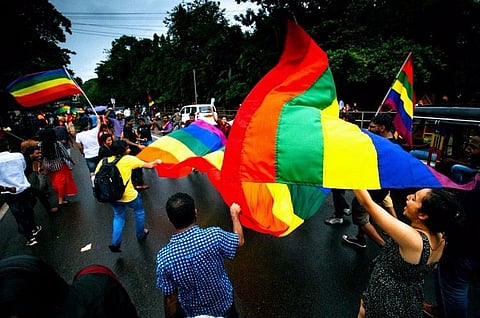
Despite concerns, community leaders say mobilisation efforts are ongoing, with multiple protests organised in Bengaluru since the Act was introduced in the Legislative Assembly. “You can't outlaw people out of existence, right? Trans communities will still keep thriving,” Kanji said. “Ensuring legal safety is important. But regardless, we will still be here, as we’ve always been.”
This article was written by a student interning with TNM.
Follow TNM's WhatsApp channel for news updates and story links.
