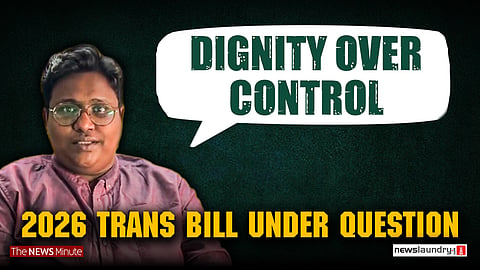

Intersex rights advocate Vino Dhan (they/them) has strongly opposed the proposed Transgender Persons (Protection of Rights) Amendment Bill, 2026, arguing that the legislation fails to protect intersex persons and raises serious concerns about bodily autonomy, privacy and medical surveillance.
Speaking to TNM, Vino, founder and executive director of The Voice of Intersex India and a member of the Tamil Nadu Trans and Intersex Welfare Board, said the bill “fails to address the fundamental human rights violations faced by intersex persons in India” despite claiming to protect marginalised communities.
The proposed amendment to the Transgender Persons (Protection of Rights) Act, 2019 has sparked widespread debate among activists, community organisations and legal advocates across the country. Critics say the bill weakens the principle of gender self-identification recognised by the Supreme Court of India in the landmark National Legal Services Authority v Union of India judgment and introduces new layers of medical and bureaucratic scrutiny.
Vino said one of the key concerns is that the proposed law conflates intersex variations with gender identity. “Intersex persons are born with variations in sex characteristics, while transgender identity relates to gender identity. These are distinct realities,” they said, warning that merging them under a single legal framework erases the unique challenges faced by both communities.
Another major issue raised by intersex advocates is the absence of a nationwide ban on non-consensual genital surgeries on intersex infants and children. According to Vino, medically unnecessary surgeries continue to be performed on intersex children in India without informed consent.
“Tamil Nadu has been a pioneer in recognising intersex rights,” Vino said, noting that the state has introduced separate identity cards, legal protections and a ban on surgeries on intersex infants and children. “Any law that claims to protect intersex persons must begin by banning such irreversible interventions.”
They also criticised the bill for failing to provide separate legal recognition, healthcare safeguards or social welfare provisions specifically tailored for intersex persons.
Vino further warned that the amendment introduces increased medical surveillance and bureaucratic control, which could compromise privacy and medical confidentiality. “Without self-respect or self-esteem, why should our bodies become mere data and public displays?” Vino asked, questioning why individuals should be required to disclose private medical details to magistrates and medical boards.
The advocate also cautioned against using intersex existence to justify restrictions on transgender rights, saying such framing risks creating divisions within gender-diverse communities.
“We therefore demand the immediate withdrawal of the bill, legal recognition of intersex persons as a distinct category, a nationwide ban on non-consensual intersex surgeries on minors, comprehensive intersex healthcare policies, and protection of bodily autonomy and human dignity,” Vino said.
The Transgender Persons (Protection of Rights) Amendment Bill, 2026, introduced in the Lok Sabha earlier this month, has drawn criticism from multiple community groups and rights organisations who argue that it could undermine protections established under the 2019 Act and the Supreme Court’s NALSA judgment.
Activists across the country have also called for wider consultations and inclusive policymaking to ensure that laws addressing gender and sex diversity respect autonomy, consent and dignity for all communities.
