
Subscribe
Follow TNM’s WhatsApp channel for news updates and story links.
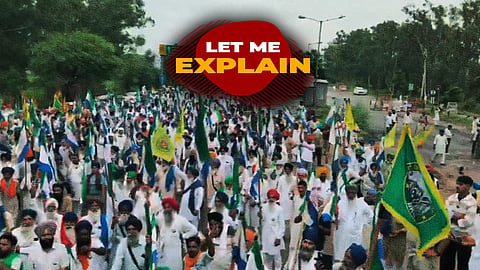
Farmers from Punjab, Haryana, Rajasthan, and several other states attempted to march to Delhi on July 21 to participate in a ‘Kisan Mahapanchayat’ against the proposed India-US trade agreement. Organised under the banner of the Desh Bachao Morcha (DBM), the protest saw heavy barricading at the Punjab-Haryana border, with Haryana Police stopping several farmer groups from entering the national capital.
Although the agreement has not yet been signed, farmer unions say the ongoing negotiations have raised concerns that India could lower tariffs on agricultural imports from the United States. They argue that any such move could expose Indian farmers to competition from heavily subsidised American agriculture.
The Union government, meanwhile, has said that agriculture remains one of India’s “red lines” in the negotiations and that no agreement will be signed if it compromises the country’s interests.
So, what exactly is the proposed India-US trade deal, and why has it become a flashpoint?
What is the proposed India-US trade agreement?
India and the United States are negotiating a Bilateral Trade Agreement (BTA) aimed at expanding trade and investment between the two countries. A BTA, for context, is a pact under which two countries agree to reduce tariffs and other trade barriers, making it easier for businesses to buy and sell goods and services across borders.
According to Reuters, both countries have been negotiating the first phase of the agreement for several months. The talks cover multiple sectors, including manufacturing, services, digital trade, and market access. Agriculture has emerged as one of the most contentious areas.
Negotiations have not yet concluded. The latest round of talks ended without a breakthrough after India refused to dilute its position on agriculture and sought assurances that the US would not impose fresh tariffs after the agreement is signed.
Commerce and Industry Minister Piyush Goyal has said India will sign the agreement only if it is “balanced, commercially meaningful” and beneficial to businesses, workers, farmers, and consumers in both countries.
Why are farmers protesting before the deal is even signed?
Farmer organisations say they do not want to wait until the agreement is finalised because, once tariff concessions or market access commitments are made, reversing them could be difficult.
According to reports, protesters fear that lowering import duties could allow cheaper American agricultural products to enter India, driving down domestic prices and reducing farmers’ incomes.
They argue that American agriculture enjoys significant advantages over Indian farming.
Large commercial farms in the United States often span hundreds or even thousands of acres and receive substantial government subsidies. In contrast, most Indian farmers cultivate small landholdings of around two to three acres and receive far lower financial support.
Farmer leaders say competing with subsidised imports would be particularly difficult for India’s small and marginal farmers.
The Desh Bachao Morcha has also argued that the agreement could eventually cover sectors beyond agriculture, including dairy, digital trade, e-commerce, government procurement, intellectual property rights, investment, and services.
Which farm products are at the centre of the dispute?
Although the final contours of the agreement are not public, reports suggest the negotiations involve discussions on greater market access for several American agricultural products.
These reportedly include dried distillers’ grains (DDGs) — a byproduct of ethanol production commonly used as livestock feed — along with red sorghum, soybean oil, tree nuts, and fresh and processed fruits.
Farmer organisations are also worried that broader concessions could eventually extend to politically sensitive sectors such as dairy, poultry, wheat, rice, sugar, and soybeans, although the Union government has not indicated that these products will necessarily be included in any final agreement.
The concern is not limited to crop cultivation. Farmer groups say cheaper imports could also affect livestock rearers, dairy producers, fisheries, small traders, and rural employment.
What is the Union government’s position?
The Union government has repeatedly sought to reassure farmers that it will not compromise on India’s agricultural interests. Agriculture has long been one of India’s most sensitive sectors in trade negotiations because it supports the livelihoods of millions of people, and Indian governments have historically been reluctant to open it up to large-scale imports.
Indian negotiators have described agriculture as a “red line” in talks with the United States.
Commerce and Industry Minister Piyush Goyal has also said India will sign an agreement only if it delivers benefits to businesses, workers, farmers, and consumers.
Trade Secretary Rajesh Agrawal has indicated that the framework for the agreement is ready but will be signed only “when it is the right time,” suggesting negotiations are continuing.
What are the farmers demanding?
Farmer organisations are demanding that the Union government abandon any provisions in the proposed agreement that would open India’s agriculture and allied sectors to greater foreign competition.
They have also sought greater transparency in the negotiations, arguing that farmers, livestock rearers, and other stakeholders have not been adequately consulted.
Protesters are demanding that documents relating to the negotiations be made public before any agreement is signed.
The July 21 Mahapanchayat is being projected by organisers as the beginning of a larger nationwide campaign. Farmer leaders have warned that if their concerns are ignored and the agreement proceeds without safeguards for agriculture, they will intensify their agitation.
Follow TNM's WhatsApp channel for news updates and story links.
