
Dhanya Rajendran| March 18, 2015| 6.30 pm IST
(Comment)
The death of Karnataka IAS officer DK Ravi is shrouded in mystery - it could be a suicide, or he may have been murdered. But even before his body had gone cold, rumour mongering had begun to sully his memory.
The Bengaluru Police Commissioner saying the death of IAS officer DK Ravi looked "prima facie" a suicide turned anger brewing in the state into fury. Later, the Chief Minister and state Home Minister informed the state assembly that he committed suicide due to personal reasons.
In the last few months, Ravi had raided many prominent builders and real estate giants in the state, and spoken to the media about further strict action against tax-evading builders.
Nobody knew what these “personal reasons” were until some Members of Legislative Assembly from the Congress Party and the Bangalore police got into their act of spreading two theories that could have led to the young officer’s death –
1. Ravi’s father-in-law (a Congressman) wanted him to go slow on a builder and was lobbying on behalf of another politician who had interests in a company.
2. Ravi had an affair with one of his IAS batchmates.
Journalists who usually cover the Assembly beat were “slyly” told that the relationship between Ravi and his father-in-law was hitting rock bottom, while his affair caused stress in his marriage. Another set of journalists who cover the police beat received similar information.
Times of India quoted a relative: “Puttanna rubbished theories floated by ruling party members that Ravi had a relationship with an IAS officer. ‘I've not seen Kusuma complaining about Ravi.We all went for dinner last week and they looked like a happy couple,’ Puttanna said. Some politicians had a different take on the matter. Senior Congress MLA Basavaraj Rayareddi said: ‘I suspect it's a case of a jilted lover committing suicide.’”
Meanwhile, the Deccan Herald was one of the few papers to report the angle about a politician exerting pressure, but no names taken. It said: “He also said that another influential politician wanted Ravi to reduce the Rs 40 crore penalty levied on his firm to Rs 40 lakh.”

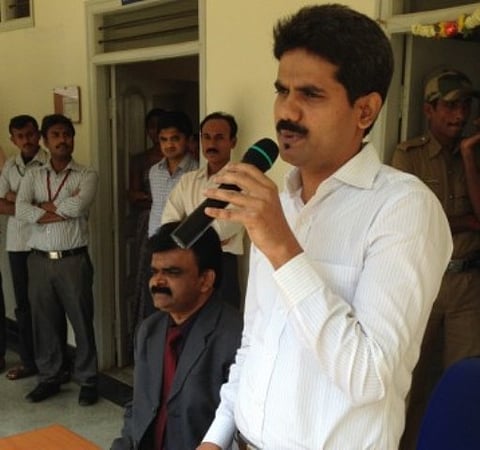
DK Ravi
However, many chose to not report the other rumour that Ravi’s father-in-law was pressuring him not to act against a particular group. The papers perhaps were aware that they could be sued for libel by the company in question.
Crime reporting in India appears to have settled into "patterns". Relevant questions are not answered in favour of juicy rumours that are guaranteed to sell more copies
Few appear to question clever "plants" by the police - gobbling it up without even going through the basic steps of verification.
Another case - around three years ago comes to mind - perhaps it can elucidate the point I make about patterns.
In May 2012, a Karnataka Administrative Officer S P Mahantesh was attacked by a group of men near a hotel in Bengaluru, just a few metres away from the Karnataka Chief Minister’s house. Mahantesh, a young officer who was the deputy director of the Directorate of Cooperative Audit, died five days later.
In the first week. media painted him as a whistle blower and upright officer who exposed corruption. The men who brutally attacked him were revealed as hit men hired by people who wanted him 'out of the way'. The documents he leaked to expose corruption formed the centre of many campaigns.
SP Mahantesh
Mahantesh’s case was tracked closely because of reports that he had audited BEML, formerly Bharat Earth Movers Limited, which was also facing a controversy at the time with regard to the purchase of Tatra army trucks.
When the Karnataka government and police found themselves facing several uncomfortable questions, they launched a clever 'counter-offensive' campaign - reporters were passed nuggets of information about how Mahantesh had extramarital affairs, which led to him being blackmailed.
I was one of the journalists given "off the record" information about Mahantesh's murky personal life and the existence of videos that recorded his numerous "affairs", alluding to questions over his murder and the reasons behind it.
A senior police officer claimed that Mahantesh’s personal life was murky and that unknown people had recorded videos of Mahantesh’s affairs. He hinted that he could have been killed due to that. When some of us asked for proof for this allegation, we were simply told that this was the truth.
Mahantesh’s family was troubled to no end and as the whispers became louder, they shunned the media. Although may reporters refrained from reporting the gossip, the gossip did have its effect on journalists’ own efforts to uncover the truth.
Finally, the men allegedly responsible for Mahantesh’s murder were arrested. They were people who wanted to kill him as he had discovered frauds in the audit of a co-operative society.
And what happened to the scandals, affairs and the videos? Not a word was uttered about them.
But by that time, avid followers of the case had moved on to the next sensational murder.
In both these instances, slanderous gossip officially became news.
In DK Ravi’s case, some pertinent questions arise:
1. Did the investigating officers show these call records to journalists? We checked with journalists and the answer was “No”.
2. How did the police know it was a suicide even before the post mortem report was revealed? No answers are forthcoming
3. How did the police deduce that he committed suicide due to personal reasons? No one knows.
I asked a crime reporter with a leading English daily why he reported the police’s version without any evidence. He replied: “We have only reported that people are denying the affair.”
But the fact remains that making someone deny the gossip, is just a clever way of reporting the rumour and cementing it in the conversation.
"Sex", "sleaze" and "debauchery" appear to be the most used story lines to tarnish and obfuscate the circumstances around the deaths of these officers. And since these story lines grab more reader eye-balls, an acquiescing media ends up playing into the hands of those that benefit from floating stories like these.
Perhaps DK Ravi's death could have been due to personal reasons. But nothing justifies spreading canards even before the post-mortem has been completed, viscera reports have been released, or the investigation has made some significant progress.
Meanwhile, the demand for justice for these officers grows weaker and weaker, as another sensational new scandal grabs media and public attention.