
Subscribe
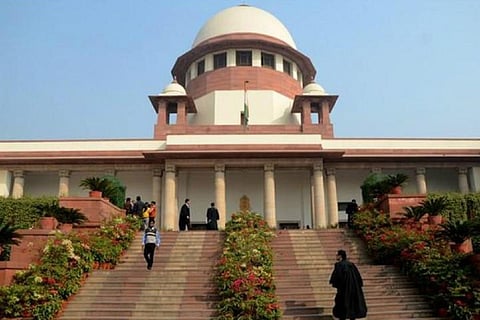
The Supreme Court, on Tuesday, February 3, made sharp observations against Meta Platforms and WhatsApp LLC over their 2021 privacy policy, saying it would not permit the companies to “play with the right of privacy” of Indians while hearing appeals against a Rs 213.14 crore penalty imposed by the Competition Commission of India (CCI).
A Bench comprising Chief Justice of India (CJI) Surya Kant, Justice Joymalya Bagchi and Justice Vipul Pancholi was hearing appeals filed by Meta Platforms and WhatsApp challenging the National Company Law Appellate Tribunal (NCLAT) order which upheld the CCI penalty, along with a cross-appeal by the regulator on limited relief granted to the companies.
According to a Live Law report, the Bench questioned the claim that users had a meaningful choice under WhatsApp’s policy, with the CJI remarking, “What is the choice? You have a complete monopoly in the market and you are saying I am giving a choice. It is either you walk out of WhatsApp policy or we will share the data.”
Warning the platforms against sharing user information, Chief Justice Kant said, “We may hear the appeal on merits. In the meantime, we will not allow you to share even a single piece of information… You cannot play with the right of privacy of this country… You are making a mockery of the constitutionalism of this country.”
Senior advocates Mukul Rohatgi and Akhil Sibal, appearing for Meta and WhatsApp, informed the court that the penalty amount had already been deposited. They also submitted that WhatsApp messages are end-to-end encrypted and that users had an option to opt out of data sharing.
However, the court remained unconvinced. When Sibal reiterated the existence of an opt-out option, the CJI questioned its effectiveness, observing, “A poor woman selling fruits on the streets, will she understand the terms of your policy? Can you imagine the language you use, very cleverly drafted… You might have taken the data of millions of persons. This is a decent way of committing theft of private information. We will not allow you to use it.”
Justice Joymalya Bagchi highlighted the commercial value of user data beyond privacy. He observed, “The DPDP Act only addresses privacy. We would like to examine the rent-sharing of data. Behavioural trends and tendencies can be utilised and monetised… your parent company can leverage it for the purpose of online advertising.” He added that judiciaries across the world would need “intensive and innovative oversight” of such platforms.
Solicitor General of India Tushar Mehta told the court that “our private data is not only sold, but it is commercially exploited. We are not only consumers, but also products”. Chief Justice Kant also shared a personal example of receiving targeted advertisements minutes after discussing medicines on WhatsApp, underscoring concerns about behavioural profiling.
The court indicated it would not proceed further unless Meta and WhatsApp gave an undertaking that users’ personal data would not be used. Senior advocate Mukul Rohatgi told the Bench that a Constitution Bench was already examining WhatsApp’s privacy policy and that an earlier undertaking ensured no user would be barred for refusing the 2021 update. He also pointed out that the Digital Personal Data Protection Act, 2023 had granted time for compliance, though Justice Joymalya Bagchi noted that the law was yet to be brought into force.
Senior advocate Samar Bansal, appearing for the Competition Commission of India (CCI), argued that advertising was the core of Meta’s business model and that users themselves were the products, noting that the penalty had been imposed after examining this issue. Responding, the Chief Justice said that while companies were entitled to earn revenue, their commercial interests could not override the rights of Indian users.
Accepting Meta’s request to explain its data practices, the court adjourned the matter to next Monday and permitted Meta and WhatsApp to file affidavits. On the CCI’s suggestion, the Bench also impleaded the Ministry of Electronics and Information Technology as a party to the proceedings.
Case History
The dispute traces back to the CCI’s November 2024 order on WhatsApp’s 2021 privacy policy, which held that the platform, dominant in India’s OTT messaging market, had imposed a “take-it-or-leave-it” framework that forced users to accept expanded data sharing with Meta entities to continue accessing the service. The regulator found that this amounted to an abuse of dominance under the Competition Act, 2002, imposed a Rs 213.14 crore penalty, and issued directions to restore user choice through clear opt-in and opt-out mechanisms and enhanced disclosures.
In November 2025, the NCLAT set aside a five-year restriction on advertising-related data sharing and overturned findings of unlawful leveraging into Meta’s advertising ecosystem, but upheld the monetary penalty. Meta and WhatsApp subsequently approached the Supreme Court, leading to Tuesday’s hearing.
