
Subscribe
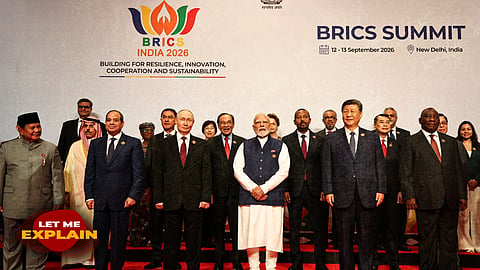
The flags of Brazil, Russia, India, China, South Africa and other countries were lined up in New Delhi this weekend as leaders gathered for the 18th BRICS Summit. Hosted by India on September 12 and 13, the summit came at a time of heightened geopolitical tensions, wars in West Asia and Ukraine, US tariffs and growing debates over who gets to shape the global economic and political order.
The group adopted a 140-paragraph New Delhi Declaration, covering issues ranging from global trade and sanctions to artificial intelligence, critical minerals, health, climate change and reform of international institutions. The declaration also called for restraint in West Asia, criticised unilateral tariffs and sanctions, and backed reforms to the global financial and trading systems without naming the countries involved.
But what exactly is BRICS? Why was it formed? And is it really a challenge to the US-led global order?
BRICS is a grouping of major emerging economies that cooperate on political, economic and development issues. The acronym BRIC was coined by Goldman Sachs in 2001 to describe Brazil, Russia, India and China as major emerging economies with the potential to become some of the world's largest economies. The four countries began formalising their cooperation in 2006, and held their first summit in Yekaterinburg, Russia, in 2009. South Africa joined in 2011, turning BRIC into BRICS.
The group expanded again in 2024, when Egypt, Ethiopia, Iran and the United Arab Emirates became full members. Indonesia joined as a full member in January 2025. BRICS currently has 11 members: Brazil, Russia, India, China, South Africa, Egypt, Ethiopia, Iran, Saudi Arabia, the UAE and Indonesia.
BRICS does not function like the European Union or NATO. It has no founding treaty, permanent secretariat or common budget. The presidency rotates among members, and the grouping operates primarily through consultations among leaders, ministers and officials, along with cooperation in areas such as trade, finance, health, technology, agriculture, energy and development.
The grouping presents itself as a platform for the Global South, broadly referring to developing and emerging countries seeking a greater voice in global affairs. The 2026 New Delhi Declaration said BRICS would continue to amplify the concerns and priorities of the Global South and called for a more representative and multipolar international system.
One of the main ideas behind BRICS is that global institutions created in the aftermath of World War II no longer adequately reflect the distribution of economic and political power in the world. The members have repeatedly called for reforms to institutions such as the United Nations Security Council, International Monetary Fund, World Bank and World Trade Organization.
The argument is straightforward: countries such as India, China and Brazil have enormous populations and economies, but emerging economies have less influence over many of the institutions that set global rules.
BRICS therefore advocates a more multipolar international system, in which power is distributed among several centres rather than concentrated around traditional Western powers. The New Delhi Declaration called for greater representation of emerging and developing economies in global decision-making institutions and specifically reiterated support for reform of the UN Security Council, IMF and World Bank.
At the 2026 summit, Prime Minister Narendra Modi described the Global South as needing to move from being “rule-takers” to “rule-shapers”. India has also repeatedly stressed that BRICS should not simply be viewed as an anti-Western grouping.
BRICS has increasingly become associated with opposition to unilateral economic measures imposed by Western countries. Russia and Iran face extensive Western sanctions, while China and India have faced US tariff measures.
The New Delhi Declaration criticised unilateral tariffs, non-tariff measures and unilateral economic and secondary sanctions. It also called for the restoration of the World Trade Organization's fully functioning two-tier dispute settlement mechanism.
The declaration also criticised protectionist measures imposed under the guise of environmental objectives and specifically opposed “carbon border adjustment mechanisms” that it said were punitive, discriminatory or protectionist. It did not name the European Union's Carbon Border Adjustment Mechanism, but the language can be read as criticism of such measures.
At the same time, India has been careful to say that BRICS is not an alliance against the West.
India held the BRICS presidency in 2026 under the theme “Building for Resilience, Innovation, Cooperation and Sustainability”. The summit's biggest formal outcome was the adoption of the New Delhi Declaration, a 140-paragraph document covering a wide range of global and economic issues.
Among its key themes were:
Trade and tariffs: BRICS criticised unilateral tariff and non-tariff measures and called for a stronger multilateral trading system centred on the WTO.
Sanctions: The declaration criticised unilateral coercive measures, including unilateral economic and secondary sanctions, that it said were contrary to international law.
Local currencies and payments: BRICS backed greater cooperation on cross-border payments and the use of national currencies in trade and financial transactions.
West Asia: The leaders called for maximum restraint amid escalating tensions in West Asia and urged the protection of civilians and civilian infrastructure. They also expressed concern over attacks on peaceful nuclear facilities under IAEA safeguards.
Palestine: The declaration reaffirmed support for Palestinian statehood and the two-state solution, backed full UN membership for Palestine and called for humanitarian access to Gaza. It also opposed forced displacement of Palestinians.
Technology and AI: Members backed greater cooperation in artificial intelligence, including efforts to make AI resources more accessible while promoting safety, security, inclusiveness and reliability.
Critical minerals: The declaration called for reliable, diversified and resilient supply chains for critical minerals, while recognising their importance to energy security and low-emission technologies.
Health: The summit backed cooperation on health systems, universal health coverage, infectious disease preparedness and digital health.
Climate and energy: The declaration called for just, orderly, equitable and inclusive energy transitions while recognising that fossil fuels would continue to play an important role, particularly for emerging markets and developing economies. It also criticised unilateral carbon border adjustment measures. The declaration also reaffirmed support for a more representative international system and called for greater participation of developing countries in global decision-making.
The biggest challenge is that BRICS has become much bigger and more diverse. Consider West Asia. Iran is a BRICS member, as are Saudi Arabia and the UAE, which have different relationships with Iran and the United States.
The group therefore faced a difficult task: how could 11 countries reach consensus on conflicts involving several of their members and strategic partners?
The New Delhi Declaration eventually used carefully negotiated language. It expressed concern about escalating tensions in West Asia, called for maximum restraint and urged dialogue and diplomacy without assigning responsibility for the conflict in the broad West Asia section. It did, however, specifically address Gaza, Lebanon and attacks on safeguarded nuclear facilities.
The same challenge was visible on Ukraine. Russia is a founding BRICS member, while India and China have maintained relations with Moscow while also seeking to preserve their relationships with Western countries.
The diversity within BRICS is one reason the grouping has generally preferred consensus-building and broad declarations over binding commitments.
The BRICS summit also sparked a political argument over the menu at the gala dinner hosted by Prime Minister Narendra Modi at Bharat Mandapam on September 12. The dinner featured an entirely vegetarian menu, including khandvi mille-feuille, khumb galouti, paneer lababdar, Himalayan morels, millet pulao and traditional Indian desserts.
Congress criticised the government over the all-vegetarian menu, arguing that India's diverse food culture also includes non-vegetarian cuisine. Congress leader Rahul Gandhi posted that “80% of Indians are non-vegetarian” and said Indian non-vegetarian food was delicious. His post did not directly mention the BRICS dinner, but it came amid the controversy over the menu.
However, the 80% figure should be treated as Gandhi's claim rather than an established national statistic. The previous NFHS-5 survey found that 83.4% of men and 70.6% of women aged 15-49 had consumed fish, chicken or meat at least occasionally, but those figures do not establish that 80% of India's entire population is non-vegetarian.
The BJP defended the dinner and accused the Congress of unnecessarily politicising the menu. The controversy was essentially about whether an official international dinner should reflect India's wider dietary diversity or whether an all-vegetarian menu could be viewed as a curated showcase of Indian regional cuisine.
The food debate was separate from the summit's formal outcomes, which focused on global governance, trade, conflicts, technology, climate, health and economic cooperation.
