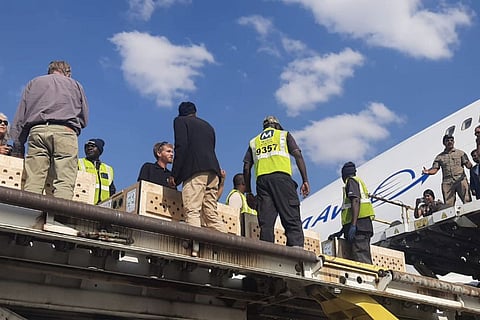

Eight cheetahs from Namibia landed in India on Saturday, September 17, as part of the programme to reintroduce the feline in India seven decades after it was declared extinct in the country. The plane landed at the Gwalior airbase shortly before 8 am, an official said. A modified Boeing aircraft, which took off from the African country Friday night, carried the cheetahs in special wooden crates during the around 10-hour journey. They are being flown to Kuno National Park in Madhya Pradesh, where Prime Minister Narendra Modi, who is celebrating his birthday, will release three of the cheetahs in quarantine enclosures of the park at 10.45 am.
The animals are being flown from Gwalior to Kuno in Sheopur district, 165 km away, in an Air Force helicopter, and the journey will take about 20-25 minutes, an official said. The cheetahs remained without food during the journey and will be given something to eat once they are released in the enclosures, an official said.
A dais has been set up in the Park under which special cages carrying cheetahs will be kept and Modi will release three of them into an enclosure by operating a lever. After that, other dignitaries will release the remaining cheetahs in other enclosures, he said.
The cheetahs were brought in a special flight of Terra Avia, an airline based at Chisinau, Moldova in Europe that operates chartered passenger and cargo flights. The Park is situated on the northern side of Vidhyachal mountains and is spread across 344 sq km.
The large carnivore got completely wiped out from India due to their use for coursing, sport hunting, over-hunting and habitat loss. The government declared the cheetah extinct in the country in 1952.
Starting in the 1970s, the efforts of the Indian government to re-establish the species in its historical ranges in the country led to the signing of a pact with Namibia, which is donating the first eight individuals to launch the Cheetah reintroduction programme, on July 20 this year. As part of the first-of-its-kind transcontinental mission, five female and three male cheetahs have reached India.
According to the Cheetah Conservation Fund (CCF), an international not-for-profit organisation headquartered in Namibia and dedicated to saving the cheetah in the wild, the five female cheetahs are aged between two years and five years and the male cheetahs are aged between 4.5 years and 5.5 years.
The male cheetahs include two brothers who have been living on the CCF's 58,000-hectare private reserve near Otjiwarongo, Namibia, since at least July 2021, when the CCF staff first noticed their tracks around the Centre. Male cubs from the same litter stay together for life and form coalitions to hunt.
Another male was born at the Erindi Private Game Reserve, a protected wildlife and ecological reserve in central Namibia, in March 2018. His mother was also born there.
The eight cheetahs include a female found with her brother at a waterhole near the city of Gobabis in southeastern Namibia. Both were very skinny and malnourished and the CCF believes their mother had died in a wildfire a few weeks prior. This cat has been living at the CCF centre since September 2020.
Another female cheetah was captured in a trap cage on the CCF's neighbouring farm in July 2022, owned by a prominent Namibian businessman.
One of the female cheetahs was born at Erindi Private Game Reserve in April 2020. Her mother was in the CCF's cheetah rehabilitation programme and had been successfully returned to the wild a little more than two years ago.
The fourth female cheetah was found on a farm near Gobabis, Namibia, in late 2017 by some farm workers. She was skinny and malnourished and the workers nursed her back to health.
In January 2018, the CCF staff learned about the animal and moved her to the CCF centre.
The CCF staff picked up another female from a farm located in the northwestern part of Namibia close to the village of Kamanjab in February 2019.
Since arriving, she has become best friends with the fourth female cheetah, and the two are typically always found together in their enclosure.
According to the CCF, the aircraft bringing the cheetahs to India has been modified to allow cages to be secured in the main cabin but will still allow vets to have full access to the cats during the flight.
The aircraft is an ultra-long range jet capable of flying for up to 16 hours and so can fly directly from Namibia to India without a stop to refuel, an important consideration for the well-being of the cheetahs, it said.
The mission has been designated as a Flagged Expedition by the Explorers Club, an American-based international multidisciplinary professional society with the goal of promoting scientific exploration.
Eight officials and experts will oversee the Namibian cheetahs during the mission, including Prashant Agrawal, High Commissioner of India to Namibia, Yadvendradev Vikramsinh Jhala, chief scientist for Project Cheetah and Dean of Wildlife Institute of India; Sanath Krishna Muliya, veterinarian, Union Environment Ministry; Laurie Marker, CCF Founder and Executive Director; Eli Walker, CCF conservation biologist and cheetah specialist; Barthelemy Batalli, CCF data manager and Ana Basto, CCF veterinarian.
At the KNP, the prime minister will release the cheetahs, aged four to six years, in smaller quarantine enclosures where they will be kept for 30 days. They will then be released in a six-sq km predator-proof holding facility with nine compartments.
Is it Hyderabad Liberation Day or Telangana National Integration Day? Watch this week's Let Me Explain on the politics over history: