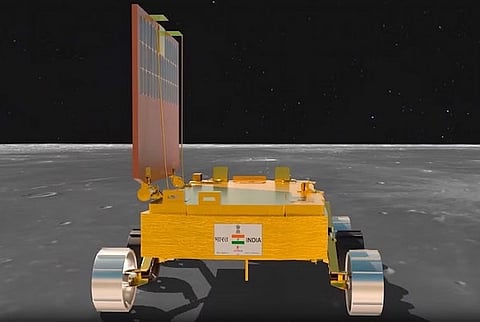

The Indian Space Research Organisation (ISRO) expects to wake up Chandrayaan-3, India’s moon mission that had entered sleep mode earlier this month. Chandrayaan-3’s Vikram lander and Pragyan rover had entered sleep mode and the payloads switched off after their solar power depleted and battery turned off. While the rover entered sleep mode on September 2, the lander’s sleep mode set in on September 4. The battery is expected to recharge on Friday, September 22 as dawn breaks on the moon and Chandrayaan-3 receives the sun’s rays. One lunar daylight period is about 14 earth days long.
The moon mission was launched from Sriharikota on July 14. On August 23, it soft landed on the moon’s south pole, becoming the first lunar mission to accomplish the feat. The Pragyan rover rolled down on to the moon’s surface, facilitated by a two-segment ramp. A solar panel enabled the rover to generate power.
On September 4, ISRO announced that the Vikram lander landed on the moon again, by successfully conducting a “hop experiment”. “On command, it fired the engines, elevated itself by about 40 cm as expected and landed safely at a distance of 30-40 cm,” ISRO said. The space agency said that the hop was of great significance as it “enthuses future sample return and human missions”.
With all payloads performing normally, Chandrayaan-3 soon began conducting in-situ scientific experiments. ISRO said that the rover came across a 4 m wide crater positioned 3 m ahead of it on August 27, and was commanded to retrace its path.
The first observations from the ChaSTE (Chandra's Surface Thermophysical Experiment) payload onboard the Vikram lander were released by ISRO on August 27. ChaSTE is meant to measure the temperature profile of the lunar topsoil around the pole, to understand the thermal behaviour of the moon’s surface. It recorded the temperature variations of the lunar surface/near-surface at various depths and was able to create the first such temperature profile of the lunar south pole.
Further in-situ experiments by the payloads Radio Anatomy of Moon Bound Hypersensitive Ionosphere and Atmosphere - Langmuir Probe (RAMBHA-LP), Instrument for the Lunar Seismic Activity (ILSA), and Alpha Particle X-ray Spectroscope (APXS) were able to make key observations and recordings.
RAMBHA-LP measured the near-surface lunar plasma environment over the south polar region. ISRO said that this was the first ever measurement of the plasma in the moon’s south pole. “The initial assessment indicates that the plasma near the lunar surface is relatively sparse. These quantitative measurements potentially assist in mitigating the noise that lunar plasma introduces into radio wave communication. Also, they could contribute to the enhanced designs for upcoming lunar visitors,” ISRO said.
ILSA, which is the first Micro Electro Mechanical Systems (MEMS) technology-based instrument on the moon, recorded the movements of the rover and other payloads.
ISRO also said that it recorded an event on August 26 that appears to be a natural one. “The source of this event is under investigation,” the space agency said.
APXS confirmed the presence of sulphur on the moon. It also detected other minor elements. ISRO said that the finding poses questions about the source of the sulphur, whether it is intrinsic, volcanic, or meteoric.