
Subscribe
This is the first part of an investigative series examining pharmaceutical companies linked to the deaths of children from contaminated medicines, and the regulatory failures that allowed them to keep operating. This series is supported by the Thakur Foundation. The foundation has not exercised any editorial control over the project.
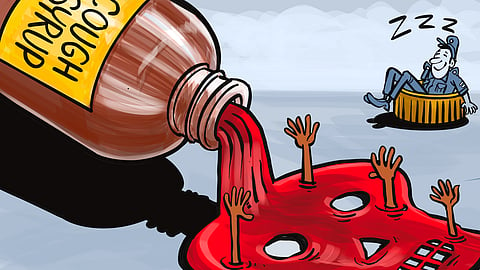
Sixteen children are dead. Five more are permanently disabled. The pharmaceutical company behind the cough syrups responsible has since racked up multiple quality failures. Its owners have even been accused of drug diversion and licence misuse.
But the company is still in operation.
That company is Digital Vision Pharma, owned by Ambala-based businessman Parshotam Lal Goyal, with his sons Konic and Manic Goyal as directors. It publicly touts an “unflinching dedication to uncompromising quality standards”. Though a closer look points to a very different record.
Despite being linked to the deaths of 14 children in Jammu and Kashmir between December 2019 and January 2020, Digital Vision allegedly continued manufacturing contaminated cough syrup, leading to two more children’s deaths the same year. In November 2025, the Narcotics Control Bureau (NCB) in Chandigarh busted a Rs 574 crore drug diversion racket, naming Digital Vision as a key player. The owners are currently absconding.
This Newslaundry-The News Minute (NL-TNM) story shows how Digital Vision Pharma stayed in business through repeated controversies. It is also the story of dozens of families forced to battle the state for meagre compensation, in a case where not a single person from the company has spent a day behind bars.
From veterinary medicines to a pharma empire
Parshotam Lal Goyal began his career as a medical retailer in Sangrur before entering pharmaceutical manufacturing in 1984 with Orison Pharmaceutical, a veterinary PCD (Propaganda-cum-Distribution) company in Ambala, Haryana. By the 1990s, Orison had expanded into general human pharmaceutical formulations. Around the same time, Goyal also set up Shiva Medical Hall, a wholesale outlet in Ambala dealing in pharma products including narcotic drugs, operating from the same address as Orison Pharma at 51, Industrial Area, Ambala Cantt.
Over the next three decades, Goyal steadily built a web of pharmaceutical entities: Digital Vision Pharma in 2009; Taxus Meditech – later renamed Vellinton Healthcare – in 2014; Skincare Fiber Pvt Ltd in 2020; and Parb Pharmaceuticals in 2022. His younger brother, Rakesh Goyal, who initially worked with him, branched out in 2008 to start Orison Pharma International.
Alongside this expansion ran a troubling reputation.
35 drug alerts in 13 years
An analysis of CDSCO and state drug control data shows that Digital Vision Pharma and its group companies – Orison Pharmaceuticals and Vellinton Healthcare – have been flagged at least 35 times over the last 13 years for manufacturing medicines that failed quality standards. These alerts were issued by multiple state Food and Drug Administrations and CDSCO laboratories.
Between 2014 and January 2026, drugs manufactured by Digital Vision were flagged as Not of Standard Quality (NSQ) at least 23 times by CDSCO laboratories in Chandigarh, Kolkata, Mumbai, Thiruvananthapuram, Guwahati and Ghaziabad, following samples drawn by drug control departments in states including Assam, Arunachal Pradesh, Meghalaya, Haryana, Jammu & Kashmir, Telangana, Kerala, Rajasthan, Andhra Pradesh and the Andaman & Nicobar Islands.
Its subsidiary Orison Pharmaceuticals was flagged in February 2020; Vellinton Healthcare was found producing NSQ drugs twice in June 2025 by the CDSCO’s Central Drugs Laboratory, Kolkata.
In January 2025, Vellinton Healthcare was also debarred by the Armed Forces Medical Services until January 2027 after the AFMS concluded that the company had submitted forged and fraudulent documents to secure business dealings with them.
At least 20 of these NSQ alerts were issued after the deaths linked to the cough syrups in 2019–20.
Prosecutions that went nowhere
Regulatory action has occasionally escalated into criminal prosecution, but with little result so far.
In 2015, the office of the Assistant Drug Controller, Dharwad Circle, Hubballi (Karnataka) filed a case against Parshotam Lal Goyal and his sons, Konic and Manic, for manufacturing substandard drugs. Goyal approached the Dharwad bench of the Karnataka High Court to quash the proceedings. The court rejected the petition, noting that “drugs of inferior quality directly affect the common man. Consumption of inferior drugs may prove fatal to one’s life. It is a serious offence.”
In 2022, another case was filed against Digital Vision in Karnataka, this time for manufacturing spurious antacid pantoprazole, initiated by then Assistant Drug Controller Shwetha Nagathan of the Vijayapura Circle.
An Assistant Drug Controller from Karnataka’s Drugs Control Department, speaking on condition of anonymity, said: “Digital Vision Pharma was producing spurious drugs containing incorrect ingredients, adulteration, and mislabelling. During the investigation, we uncovered these violations, following which the case was filed. The matter is still ongoing.”
In 2023, yet another case was filed against Digital Vision in Port Blair by Drug Inspector Deepak Shetty of CDSCO East Zone, Kolkata, for manufacturing drugs not of standard quality. A year later, the company approached the Calcutta High Court to quash those proceedings – and received an order in its favour. The court noted that the case lacked specifics that could prima facie establish offences against the firm.
The narcotics licence that was misused
In 2024, the Commissioner of State Taxes and Excise, Himachal Pradesh found that Digital Vision misused its MD-VI licence as a routing tool for exporting narcotic drugs to Sri Lanka.
An MD-VI licence is a strictly regulated permit – granted by state licensing authorities and overseen by the central drug regulator – that allows a company to manufacture and sell certain medicines. The licence is personal and non-transferable; misuse can enable diversion and illegal trafficking of drugs that can be used as abusive substances.
But over 2.1 lakh morphine tablets were exported to Sri Lanka-based Yaden International under the branding of Vellinton Healthcare, while packing was carried out at Digital Vision’s premises, according to an order by the commissionerate in December 2024.
At the time of the morphine export – June and July 2023 – Vellinton did not even hold an MD-VI licence; its licence was issued two months later. Authorities also pointed to concealment: Digital Vision failed to disclose these narcotic transactions in its statutory sale returns.
Vellinton’s new MD-VI licence was revoked in November 2024. It filed a review petition to the commissionerate, which was rejected.
Regulatory authorities also found that Digital Vision procured and possessed codeine phosphate on behalf of two unlicensed firms – Shiva Medical Hall and Skincare Creations – both also owned by Parshotam Lal Goyal.
“The act and conduct of the petitioner company and the manner in which the stocks have separately been kept by the petitioner company shows that under the garb of MD-VI license…the petitioner company has procured and possessed codeine phosphate on ‘account for’ M/s Shiva Medical Hall and M/s Skincare Creation, which in turn leads to the irresistible conclusion that the petitioner company was acting as proxy to these two firms on a single MD-VI license issued in its favour alone,” read the order.
In all the instances, the commissionerate pointed to a violation of the Himachal Pradesh NDPS rules.
The children
Janvi, Surbhi, Anirudh, Shreyansh, Kanishka, Lakshmi, Panku, Akshu, Amit, Irfan, Nigru, Jannu, Rutav, Ankita, Radhika and Anmol.
These are the 16 children who died between October 2019 and September 2020 after consuming toxic cough syrups manufactured by Digital Vision Pharma. Thirteen were from Ramnagar tehsil in Udhampur district, Jammu and Kashmir. One was from Bishnah tehsil in Jammu district; one from Baddi in Himachal Pradesh; one from Patiala in Punjab. Fourteen had consumed Coldbest-PC and two took Cofset-AT, both manufactured by Digital Vision. Laboratory tests found the syrups were contaminated with diethylene glycol – a toxic industrial solvent used in products such as brake fluid and antifreeze.
Five others – Pawan, Pranav, Ashish, Sapna and Sarbjeet – were left permanently disabled. Their disabilities have affected their brains, eyes, ears and bodies.
Pawan suffered intellectual impairment with 55 percent permanent brain disability. Pranav has 85 percent permanent disability, along with visual and hearing impairment. Ashish has sustained permanent hearing disability in both ears. Sapna has intellectual impairment with 40 percent permanent brain disability. Sarbjeet has 80 percent brain disability and lives in a vegetative state. We have seen copies of medical documents, status reports and disability certificates.
Sarbjeet is now 11. He cannot speak, sit, or eat on his own. He was five years old when he was given the syrup for mild cough and cold.
“Within a day, his condition worsened. He stopped urinating and began vomiting. He was referred to PGI Chandigarh and remained there for almost three months, including two months on a ventilator. The medical bills came to around Rs 18–20 lakh. I am just a car washer, but I somehow managed the money by borrowing from friends and relatives,” said Avtar Singh, Sarbjeet’s father. The family lives in Patiala, Punjab.
“He has been lying on that bed for the last six years. What he must be going through.”
At least six FIRs were filed against Digital Vision in multiple states. Court cases are ongoing in Himachal Pradesh, Punjab, Haryana, and Jammu and Kashmir in connection with the deaths. Not once has anyone associated with the company been arrested in connection with the deaths. The only person jailed was Mohinder Singh, a chemist who merely sold the cough syrup at Jamwal Medical Hall.
Jammu-based social activist Sukesh Khajuria has tracked the cases for years. He says the first FIR was registered on March 2, 2020, at Kala Amb in Himachal Pradesh, after the then Chief Minister Jairam Thakur was informed of the deaths. A day later, a second FIR was filed at Ramnagar police station in J&K. On March 4, a Special Investigation Team (SIT) was constituted under the Additional Superintendent of Police, Udhampur, mandated to file its report within one month.
Digital Vision’s owners approached the Jammu and Kashmir High Court and were granted anticipatory bail on April 20, 2020, on a bond of Rs 50,000. Khajuria says government lawyers did not even oppose the bail plea. “In contrast, chemist Mohinder Singh’s bail applications were rejected four times. He was granted bail only a month later, after the High Court had already extended protection to Parshotam Lal Goyal and his sons,” Khajuria noted.
We reached out to Gharu Ram and Bhishma Dubey, who were then DSPs leading the SIT.
Gharu Ram, who is now the additional SP of Samba district and was the first investigating officer of the SIT, said, “I believe a chargesheet was filed in the matter, but I was never called again to appear as an investigator or witness.” Dubey, now SDPO Katra, reiterated the same. “A chargesheet was filed, but nothing happened after that. I was never called to appear again.”
The SIT had filed the chargesheet nearly three years later – on February 28, 2023 – before the Additional Sessions Judge in Udhampur. Twenty-four hearings have since been held, the latest on January 14, 2026. In February 2024, the court had ordered further investigation based on certain findings. But Digital Vision approached the J&K High Court, which granted a stay on the order – that stay remains in effect.
Digital Vision’s drug manufacturing licence, suspended by Himachal Pradesh authorities in the wake of the children’s deaths on March 2, 2020, was restored within just three months. The company had challenged the suspension in the Himachal Pradesh High Court; in June 2020, the court set aside the blanket suspension, allowing Digital Vision to resume production of medicines that did not use diethylene glycol. There was a ban on the two cough syrups, but the company was back in business.
Meanwhile, for some families, even getting a paltry compensation was a struggle. Only 12 of the 16 families received any payment – and that was only after Khajuria approached the National Human Rights Commission (NHRC).
In January 2021, the NHRC directed the J&K administration to pay Rs 3 lakh each to affected families. The administration, then under President’s Rule, challenged the order in the High Court. When the petition was dismissed, it filed a Special Leave Petition in the Supreme Court. The Supreme Court dismissed it too, holding that officers of the Drug and Food Control Department had been negligent and that the state was therefore liable.
Priya Verma, whose son Pranav was permanently disabled, said: “My son became blind and deaf. He can only say ‘papa’ and ‘mumma’. We have to hold him to make him walk. We must guide him physically because he cannot hear. He has to live like this for the rest of his life. Who will take care of him after we die?”
Monu Kumar, a daily labourer from Baddi who lost his two-year-old daughter Radhika, said: “My child went through unbearable pain before her death. My wife still cries remembering her… The government should have cancelled their (the company’s) licence and shut them down permanently so that no other child suffers.”
When we reached Madanlal – a paramilitary officer and father of Shreyansh – he was surprised to learn the company was still operating. “I believed the government had banned the company. That’s what they said at the time. It is a complete failure of the system.”
Makhana Devi’s 11-year-old son Rutav was the first to die. She recalls that the entire village protested, forcing the sub-divisional magistrate of Ramnagar to form an inquiry committee comprising the Tehsildar and SHO of Ramnagar. “Till date, the inquiry report has not been made public.”
Jaswinder Singh, the then SHO of Ramnagar, said, “I don’t remember exactly, but I believe the inquiry report would have been submitted.”
However, a February 2022 letter from the SDM officer stated that the committee didn’t submit the report. The letter said even a medical expert was made part of the investigation on the committee’s request. “More than two years have passed and nothing has been responded from the constituted committee in this matter.”
An application filed on behalf of Khajuria before the Jammu district court in March alleged that the inquiry was never completed.
The drug diversion case and 17 arrests
Five years after the children died, the Narcotics Control Bureau (NCB), Amritsar, said it found that Digital Vision Pharma had been running a drug diversion racket worth Rs 574 crore.
A senior IPS officer, speaking on condition of anonymity, explained how such rackets work: “Drug diversion is an organised illegal network that reroutes legally manufactured medicines away from the authorised supply chain of manufacturers, distributors and pharmacies into the black market, narcotics criminal networks or fraudulent exports. These rackets typically operate through shell or fictitious firms. Licensed manufacturers supply huge quantities of controlled medicines to dubious buyers, supported by falsified invoices and transport records, with no verifiable proof of retail sale to patients. In most cases, these drugs ultimately end up in the hands of narcotics networks and are used for substance abuse.”
The officer described the mechanics: shell companies are often registered in the names of domestic workers, drivers or college students, in far-flung states like Manipur or Nagaland, to avoid scrutiny. The drugs are then diverted into black markets in states like Punjab, Haryana, Rajasthan and Uttar Pradesh.
An NCB officer who is part of the investigation team, also speaking anonymously, said that in February 2025 they received a tip-off about a tramadol consignment being transported in a vehicle. “Our investigation revealed that the consignment had been diverted into Punjab through Rajasthan. As we followed the trail, we identified two Uttarakhand-based firms… Further investigation led us to Digital Vision Pharma, which emerged as the main player in the racket.”
According to the officer, Digital Vision had created between eight and 10 shell companies across Rajasthan, West Bengal and Punjab, many registered in the names of domestic workers. The NCB recovered 34 lakh psychotropic tablets, 10.57 lakh bottles of codeine-based cough syrup, 1,613 kg of psychotropic raw material, 573 kg of tramadol bulk mixture, 50,000 tramadol ampoules and 5,000 vials of midazolam. “More than 60 per cent of the seized material is linked to Digital Vision Pharma,” the officer said.
The racket spans seven states and the investigation is ongoing. Seventeen people have been arrested so far. Parshotam Lal Goyal and other owners of Digital Vision have not yet been arrested. They have been absconding since August 2025.
In 2021, Rakesh Goyal – Parshotam Lal’s younger brother and owner of Orison Pharma International – was booked by Punjab Police in a similar drug diversion case involving tramadol, stemming from the seizure of 4,500 Celcidal tablets. Raids led to the recovery of around 30 lakh tramadol tablets and over 200 kg of tramadol powder. While then ASP Majitha Abhimanyu Rana named Rakesh Goyal as the prime suspect, he was later given a clean chit after the probe was transferred.
Asked for comment, Pathankot SP Manoj Thakur said, “Although the FIR was filed, during questioning, we came to know that Rakesh Goyal had all the permission to make those tablets. It was someone in Delhi with whom Goyal traded the drugs, who supplied these drugs back into Punjab and Himachal.”
Asked about the entity responsible and about the FIR mentioning fictitious firms with addresses in Mumbai and Ahmedabad, Thakur said, “I don’t know exactly and I think no drug diversion took place.”
A retired Haryana Food and Drug Administration officer, who monitored action against Digital Vision following the 2019–20 deaths, claimed Digital Vision Pharma is a “habitual offender”, “aided by support within sections of the drug regulatory and police machinery”.
The company has been applying for government subsidies.
We reached out to the owners of Digital Vision Pharma multiple times, but they were not available. Their reply will be added when they choose to respond.
Follow TNM's WhatsApp channel for news updates and story links.
