
Subscribe
The 73rd and 74th Constitutional Amendments marked a historic shift in India’s governance architecture by institutionalising local self‑government and mandating regular elections to panchayats and municipalities. These provisions were intended to deepen grassroots democracy, strengthen cooperative federalism and ensure that development planning responds to local needs.
Yet, across most states in India, the constitutional requirement of timely local government elections is routinely flouted. Delays, legal loopholes and administrative inertia allow state governments to sidestep their democratic duties. Tamil Nadu, despite its strong administrative capacity, has witnessed prolonged postponement of rural local government elections. Against this backdrop, Kerala stands out as a notable exception. For nearly three decades, the state has conducted local elections on time, with minimal political disruption.
This contrast raises an urgent question: What has Kerala done right, and what lessons can Tamil Nadu and other states draw from its experience?
Tamil Nadu’s Delays: Symptoms of deeper structural gaps
In Tamil Nadu, rural local government elections across all 28 districts have been pending for over a year. This delay is not merely procedural and it reflects deeper institutional and political shortcomings that undermine democratic decentralization.
The absence of a dedicated State Delimitation Commission, results in delays in updating ward boundaries after census exercises or administrative reorganisation. There is also excessive reliance on state government discretion, allowing political considerations to influence election timelines.
Weak statutory safeguards for the State Election Commission (SEC), limits its functional independence and enforcement capacity. Another issue is the lack of political urgency, with local governments increasingly treated as administrative extensions rather than constitutionally mandated elected institutions.
A 2024 CAG report highlights that, since the local elections are not conducted, district developmental plans are not prepared. These shortcomings have tangible consequences. Administrators continue in charge for extended periods, development works are stalled or fragmented, Gram Sabha processes weaken, and marginalised communities lose meaningful representation. Collectively, these trends erode the constitutional spirit of decentralisation and diminish the relevance of local self-governments.
Why Kerala holds elections on time: Structural and political factors
Kerala’s consistent adherence to election timelines is not accidental. It is the outcome of deliberate institutional reforms and a sustained political commitment to decentralisation
1. The People’s Plan Campaign (1996) – A foundational breakthrough
Soon after the constitutional amendments, the Left Democratic Front (LDF) launched the People’s Plan Campaign. It fostered a culture of participatory planning and normalised two ideas:
Local governments must be elected on schedule.
Citizens should actively shape development priorities.
This cultural shift became a political norm, persisting across successive governments.
2. A Strong, Autonomous State Election Commission
Kerala’s SEC enjoys clear statutory definition, functional insulation from partisan interference, and respect from successive state administrations. Consequently, election timetables are set and executed professionally rather than politically.
3. A separate State Delimitation Commission (since 2005)
Kerala created an independent commission tasked solely with delimiting wards. The commission ensures:
Timely restructuring of electoral boundaries,
Protection against political manipulation, and
Elimination of administrative excuses for postponement.
The IIPA report on Panchayat Elections in India cites this commission as a core driver of Kerala’s punctual elections
4. Consistent political will across governments
Both LDF and United Democratic Front (UDF) administrations have upheld the spirit of decentralisation. In Kerala, local elections are viewed as an integral part of governance, not an optional exercise.
Local democracy in practice: Constitutional values on the ground
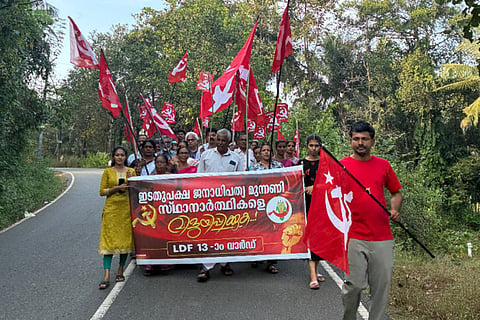
To understand how constitutional decentralisation operates in practice, the Institute of Grassroots Governance (IGG) conducted field visits to Idukki and Kasaragod during Kerala’s two-phase local government elections. These observations reveal democratic practices that are largely absent in many other states and demonstrate how Left-led political cultures operationalise constitutional values on the ground.
We found that party‑based elections encourage accountability, structured campaigning, and transparent tracking of development promises.
Decentralised election committees (ward, panchayat, municipal levels) help manage campaigns, gather citizen input, draft participatory manifestos, and reserve seats for youth and women.
Vision‑based, long‑term manifestos (some extending to 2050) help ground planning in local aspirations, keeping democracy vibrant and purposeful.
Politics is also rooted in development. The parties publish area‑wise progress reports, showcase infrastructure achievements, and discuss welfare delivery, fostering informed voters and competitive development politics.
These practices sustain not only timely elections but also meaningful democratic participation, reinforcing the legitimacy of local self-governments.
Recommendations for Tamil Nadu and other states
Drawing on constitutional expectations, field observations, and Kerala’s experience, the following reforms are essential:
Establish a permanent, Independent Delimitation Commission
The single most urgent structural reform. It will guarantee timely ward reconfiguration and prevent political gerrymandering.
Strengthen the autonomy of State Election Commissions
Statutory independence, clearly defined powers, and protection from executive interference are essential for enforcing election schedules.
Institutionalise participatory planning
A People’s‑Plan‑style initiative can boost public ownership, reduce resistance to elections, and improve accountability.
Adopt party‑based local elections
This clarifies responsibility, streamlines campaigning and encourages policy‑driven debate at the grassroots level. In Tamil Nadu contests using party symbols are limited to urban local governments and district‑/block‑level Panchayat elections, unlike in Kerala.
Legislate enforcement of constitutional timelines
Clear penalties for unjustified delays and transparent election-preparation schedules can curb discretionary postponements.
While these reforms may encounter political resistance, Kerala’s experience demonstrates that institutional clarity and democratic norms can overcome short-term political calculations.
Why timely elections matter
Delays in local government elections have far-reaching consequences. They disrupt development projects, leave funds underutilized, weaken accountability mechanisms, and break the link between citizens and decision-makers. For marginalized communities, prolonged postponements translate into lost opportunities for representation and voice. Over time, such delays hollow out democratic culture itself.
Kerala’s experience shows that when elections are held on time and embedded within participatory governance, local democracy becomes a driver of development rather than a procedural formality.
Kerala demonstrates that effective decentralization rests on a combination of determined political leadership, robust institutions, administrative clarity, and sustained citizen participation. Independent election and delimitation bodies, coupled with a culture that values local democracy, have made timely elections the norm rather than the exception.
Tamil Nadu and other states can replicate these practices if they prioritize democratic decentralization over short-term political convenience. Ensuring punctual local government elections is not merely a procedural requirement, it is a constitutional obligation and a cornerstone of India’s democratic fabric.
The author is Chairperson, Institute of Grassroots Governance (IGG), Tiruppur, Tamil Nadu.
